
Carrier Impersonation via SMS: Risks and How to Stop It

Carrier impersonation via SMS is defined as a smishing attack where fraudsters manipulate SMS sender information or mimic mobile carrier branding to deceive recipients into revealing credentials, installing malware, or authorizing account changes. The industry term for the broader technique is SMS spoofing, and carrier impersonation is one of its most damaging applications. According to the FDIC, bank impersonation is the most common text message scam, and carrier impersonation follows the same playbook. Attackers send messages that look like legitimate alerts about overdue bills, data usage limits, or account security breaches. The goal is always the same: exploit the trust users place in SMS as a channel for high-stakes notifications.
What is carrier impersonation via SMS and how does it work technically?
Carrier impersonation via SMS relies on SMS spoofing, a technique where an attacker alters the sender ID field in an outgoing message to display a carrier’s name or number instead of their own. This field is not authenticated by the SMS protocol itself, which means any software or service with access to an SMS gateway can overwrite it. Spoofing allows attackers to insert fabricated messages directly into an existing SMS thread between a victim and their real carrier, making the fake message appear visually indistinguishable from legitimate ones.
The technical methods attackers use fall into three main categories:
- SMS gateway abuse: Attackers use commercial or underground SMS gateway services that allow custom sender IDs. No carrier authentication is required at the gateway level.
- Compromised SIM cards: A stolen or cloned SIM can send messages that appear to originate from a legitimate number, bypassing basic sender checks.
- SIM swapping: In more advanced attacks, the attacker first harvests credentials via a spoofed carrier message, then contacts the carrier to transfer the victim’s phone number to a new SIM. This hijacks all future SMS traffic, including two-factor authentication codes.
- Embedded thread injection: Because most smartphones group SMS messages by sender name, a spoofed message with the carrier’s name appears inside the same thread as genuine carrier messages. Victims see no visual break between real and fake.
Pro Tip: If a message in your carrier’s SMS thread asks you to click a link or enter account credentials, open your carrier’s official app directly instead of tapping anything in the message.
The SIM swap technique deserves particular attention. Credential harvesting via spoofed carrier messages often precedes SIM swaps, making carrier impersonation the first stage in a multi-phase attack chain rather than a standalone scam.

What risks does carrier impersonation via SMS pose?
The damage from carrier impersonation extends well beyond a single stolen password. Attackers structure these campaigns to maximize yield from each victim, often executing several fraud stages in sequence.
- Credential harvesting: The spoofed message directs the victim to a fake carrier login page. Once credentials are entered, the attacker controls the account and can change recovery options before the victim notices.
- Malware delivery: Some campaigns skip the fake login page entirely and deliver a malicious APK or profile file disguised as a carrier update or security patch. Installing it gives the attacker persistent device access.
- SIM swap execution: After harvesting credentials, the attacker calls the carrier’s support line, passes identity verification using the stolen data, and ports the victim’s number to a new SIM. Every SMS-based two-factor authentication code now routes to the attacker.
- Lateral movement: With control of the phone number and carrier account, the attacker resets passwords for banking, email, and enterprise SSO accounts that rely on SMS verification.
- Financial fraud: Access to banking apps and payment platforms enables direct transfers, fraudulent purchases, or payroll redirection in corporate environments.
Attackers succeed because they exploit users’ conditioned trust in SMS for critical alerts. There is no need for sophisticated persuasion. Mimicking a routine billing notice or a security warning is enough. The victim acts because the message matches what they already expect from their carrier, not because they were tricked by an elaborate story.
Why is carrier impersonation via SMS difficult to detect?
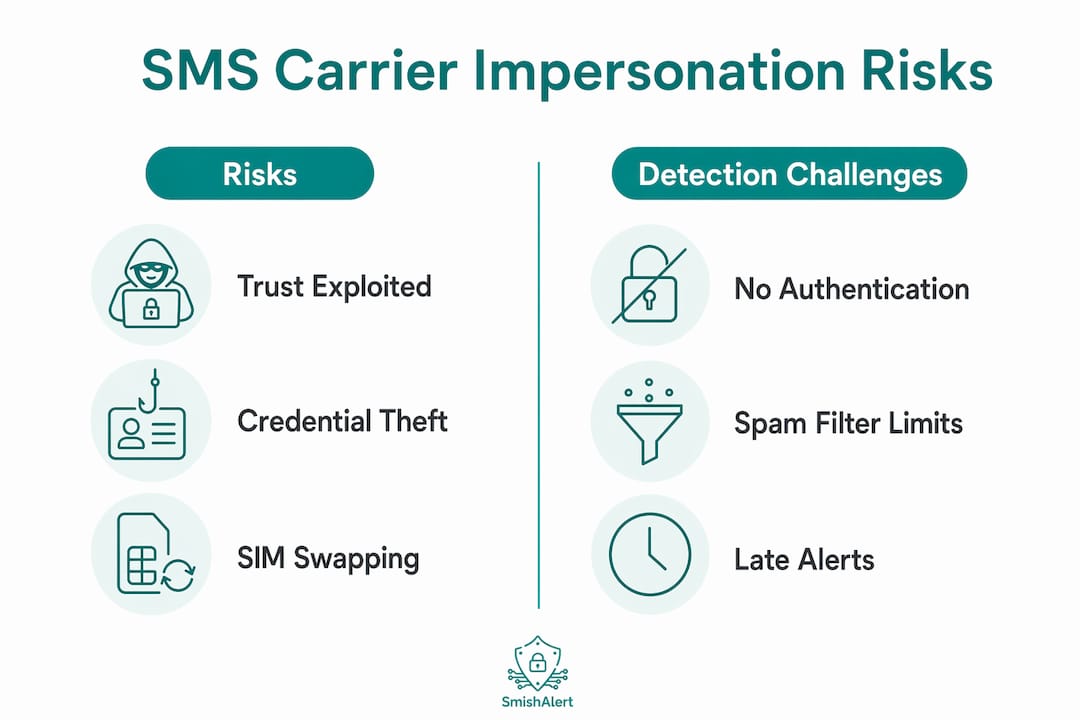
The core problem is architectural. SMS was designed for message delivery, not message authentication. Unlike email, which supports SPF, DKIM, and DMARC sender verification standards, SMS has no equivalent protocol that carriers are required to enforce universally.
| Detection layer | Limitation |
|---|---|
| Carrier spam filters | Rely on sender reputation, not message authenticity. Spoofed IDs appear legitimate and bypass filters. |
| Telco fraud teams | Telco visibility is limited to metadata. The social engineering conversation itself is unmonitored. |
| Device-level filters | Flag known bad numbers but cannot verify spoofed sender names or thread-injected messages. |
| User recognition | Victims see no visual difference between real and spoofed messages in the same thread. |
By the time unusual activity is detected, the scam has often already succeeded. Fraud teams typically identify the attack only after the victim reports unauthorized account changes or financial loss. That lag gives attackers enough time to complete a SIM swap and drain linked accounts.
Spam filters that rely on known bad sender patterns are structurally ineffective against spoofing because the spoofed sender ID looks identical to a trusted one. The filter has no mechanism to distinguish the real carrier from an attacker using the carrier’s name.
Pro Tip: Security teams should treat any SMS-reported account alert as unverified until confirmed through an independent channel, regardless of how legitimate the sender name appears.
How can individuals and organizations protect against SMS carrier impersonation?
Protection requires action at both the individual and organizational level. Neither alone is sufficient.
For individuals
- Apply a zero-trust approach to unsolicited SMS. Users should not trust messages urging urgent action without independent verification, even when the sender appears to be their carrier. Open the carrier’s official app or call the number on the back of your SIM card instead.
- Never click links in carrier alert messages. Type the carrier’s URL directly into a browser or use a saved bookmark.
- Enable account PINs with your carrier. Most major carriers offer a port-out PIN or passcode that must be provided before a number transfer is authorized. This blocks SIM swap attempts even after credential theft.
- Use authenticator apps instead of SMS for two-factor authentication. Apps like Google Authenticator or Microsoft Authenticator generate codes locally and are not vulnerable to SIM swapping.
- Report suspicious messages. Forward smishing messages to 7726 (SPAM) in the US. This feeds carrier fraud databases and helps protect other users.
For broader personal SMS safety practices, understanding the full range of smishing vectors is as important as knowing the carrier-specific ones.
For organizations
Businesses face a dual exposure: their employees receive carrier impersonation messages on personal and corporate devices, and their customers may receive messages impersonating the business itself.
Registering sender IDs with official carrier registries and using verified short codes tied to verified business identities blocks unauthorized spoofing of your brand. Verified short codes are among the most effective defenses because they tie a sender ID to a vetted business identity, making it technically harder for attackers to inject messages under that same ID.
Security teams should also integrate smishing protection for enterprises into their broader mobile threat defense programs. Employee education focused on recognizing urgent or unusual SMS requests reduces the human attack surface. Combining that education with real-time detection platforms gives security teams the telemetry they need to identify campaigns before they result in credential compromise. Organizations concerned about AI-assisted phishing defense should also evaluate how deepfake and voice-based social engineering intersects with SMS-based carrier impersonation in multi-channel attack chains.
Key Takeaways
Carrier impersonation via SMS succeeds because SMS lacks sender authentication, attackers exploit conditioned user trust, and telcos detect fraud only after it has occurred.
| Point | Details |
|---|---|
| Core definition | Carrier impersonation is SMS spoofing where attackers fake mobile carrier sender IDs to steal credentials or deliver malware. |
| Attack chain risk | Credential harvesting via spoofed carrier messages frequently precedes SIM swap fraud, enabling full account takeover. |
| Detection gap | Telcos see only metadata, not message content, so fraud is typically detected after the victim is already compromised. |
| Individual defense | A zero-trust approach to unsolicited SMS and independent verification through official apps is the most reliable personal protection. |
| Organizational defense | Registering verified short codes and deploying real-time smishing detection platforms blocks both inbound and outbound impersonation. |
The trust problem no one talks about enough
The most underappreciated element of carrier impersonation is not the technology. It is the psychology. Attackers do not need to write convincing fiction. They just need to replicate the format of a message the victim has already received dozens of times before. A billing alert that looks exactly like the last three billing alerts from the same carrier thread does not trigger skepticism. It triggers habit.
What I find most troubling is that the SMS channel was deliberately conditioned to carry high-trust communications. Carriers trained users to expect security codes, billing notices, and fraud alerts via SMS. Attackers did not create that trust. They inherited it. And that inheritance is the real vulnerability.
The good news is that the industry is moving. Real-time scam scoring technology, sender ID registries, and employee reporting programs are shifting the balance. But the shift is slow, and the gap between what attackers can do today and what most organizations can detect remains wide. The organizations that close that gap fastest are the ones treating SMS as a monitored attack surface, not a secondary communication channel.
Vigilance at the individual level matters. But it is not enough on its own. The structural fix requires carriers, businesses, and security teams to treat every unverified SMS sender as a potential threat until proven otherwise.
— Sophie
Smishalert’s approach to carrier impersonation detection
Carrier impersonation campaigns are difficult to catch precisely because they blend into normal SMS traffic. Smishalert gives security teams the visibility to change that.
Smishalert’s platform captures employee-reported SMS threats, correlates them into campaigns, and scores each message for social engineering risk in real time. The Smishalert solutions page covers the full range of attack types the platform surfaces, including carrier impersonation, executive impersonation, and credential harvesting. For SOC teams that need to understand the platform’s detection depth, the threat intelligence feed provides live campaign examples drawn from active smishing operations. Security leaders who want to stop these attacks before they reach employees can start there.
FAQ
What is carrier impersonation via SMS?
Carrier impersonation via SMS is a smishing attack where fraudsters alter SMS sender IDs or mimic carrier branding to deceive victims into clicking malicious links, entering credentials, or installing malware. The underlying technique is called SMS spoofing.
How does SMS carrier impersonation differ from standard smishing?
Standard smishing uses any deceptive sender identity. Carrier impersonation specifically mimics a victim’s mobile carrier, exploiting the high trust users place in carrier messages like billing alerts and security notifications.
Can spam filters block carrier impersonation messages?
Standard spam filters cannot reliably block these attacks. Spoofed sender IDs appear legitimate, and filters that rely on sender reputation have no way to distinguish a real carrier ID from a spoofed one.
What is the connection between carrier impersonation and SIM swapping?
Carrier impersonation frequently serves as the first stage of a SIM swap attack. Attackers harvest account credentials via a spoofed carrier message, then use those credentials to authorize a number port to a SIM they control.
What is the most effective defense against SMS carrier impersonation?
For individuals, applying a zero-trust approach to all unsolicited SMS and verifying requests through official carrier apps is the most reliable defense. For organizations, registering verified sender IDs and deploying real-time smishing detection platforms provides the strongest protection.