
Closing the Mobile Security Gap in Enterprises

Enterprise security teams have largely solved email security, hardened perimeters, and deployed endpoint detection on laptops. Yet the mobile security gap in enterprises keeps widening. 87% of monitored mobile apps are under active attack in 2026, a 58% increase since 2022, and the same AI accelerating your development pipelines is being weaponized against your applications at a pace most security programs cannot match. Mobile endpoints are not peripheral risk. They are the breach vector your adversaries prefer most.
Table of Contents
- Key takeaways
- The current mobile threat landscape in enterprises
- Why traditional approaches fail to close the gap
- Modern security frameworks that actually work
- Practical steps to reduce your mobile security exposure
- Emerging challenges enterprises should anticipate
- My perspective: the security gap is partly a culture problem
- How SmishAlert helps enterprises close the gap
- FAQ
Key takeaways
| Point | Details |
|---|---|
| iOS is no longer safer by default | The 21-point security gap between iOS and Android has closed; both platforms now face nearly identical attack rates. |
| Most breaches begin on mobile endpoints | 70% of successful enterprise breaches originate on endpoints, including mobile devices, making mobile defense non-optional. |
| MDM alone does not close the gap | Device management does not detect threats; privacy-first Mobile EDR and Zero Trust frameworks fill what MDM misses. |
| Smishing is an undermonitored entry point | Credential-harvesting through SMS and messaging apps bypasses email security controls and evades most enterprise monitoring. |
| Shift security left into the build process | Embedding application security into CI/CD pipelines prevents exploitable weaknesses from ever reaching production. |
The current mobile threat landscape in enterprises
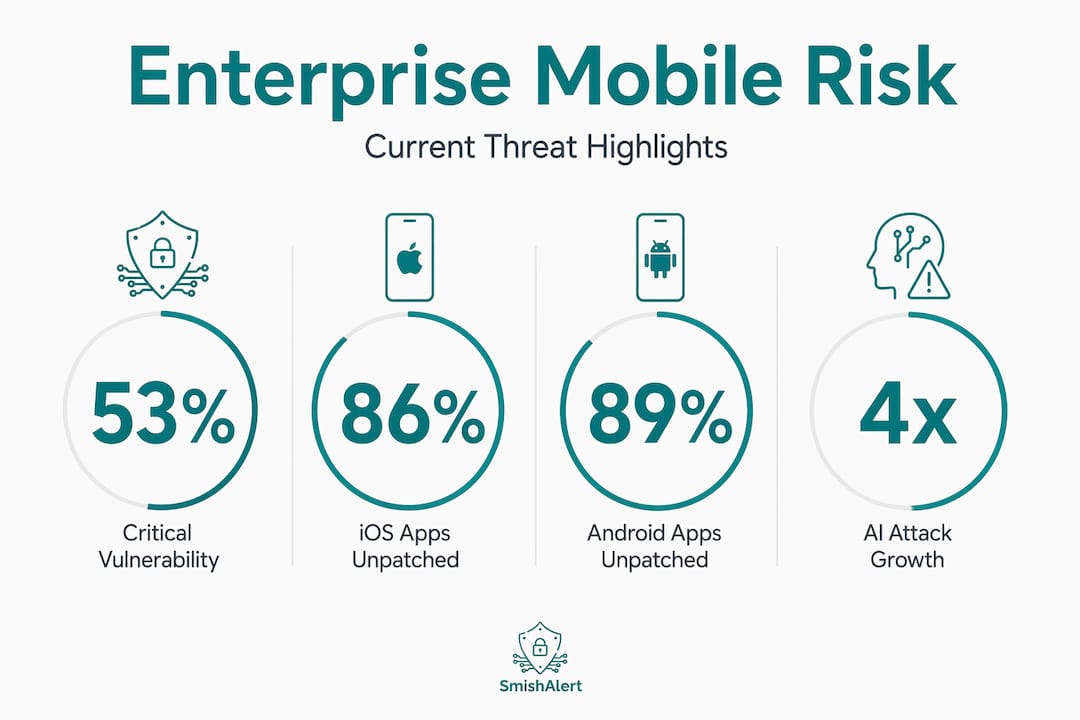
The industry term for what most organizations are dealing with is mobile attack surface expansion, and the data behind it is no longer easy to dismiss. iOS and Android apps face attacks at 86% and 89% respectively, a near parity that invalidates the longstanding assumption that iOS environments need less protection. Security budgets built on that assumption are now misaligned with operational reality.
The attack types targeting mobile endpoints span a wide and evolving range:
- Smishing and mobile phishing: Credential-harvesting messages delivered via SMS, iMessage, and third-party messaging apps that bypass email filtering entirely.
- Malware and trojans: Applications distributed through unofficial channels or injected into legitimate apps via supply chain compromise.
- Reverse engineering: Attackers decompile mobile applications to expose backend API keys, authentication tokens, and business logic.
- Man-in-the-middle attacks: Interception of mobile data over insecure or rogue Wi-Fi networks, particularly when employees connect to public hotspots.
The behavioral exposure compounds the technical risk. 53% of organizations have at least one device running a critically outdated OS, and 18% of managed devices connect to insecure public hotspots. Each of those data points represents an open door. Unpatched vulnerabilities in older OS versions are not theoretical risks. Exploit kits are actively built around them.
AI has fundamentally altered the pace of exploitation. The same AI accelerating mobile app development is used by threat actors to discover vulnerabilities faster, generate convincing phishing lures at scale, and automate lateral movement once an initial foothold is established. The time between vulnerability discovery and active exploitation has compressed significantly. Enterprises that still rely on post-deployment detection are already operating behind the threat curve.
Pro Tip: When conducting a mobile security threat assessment, do not limit scope to managed devices. Unmanaged BYOD endpoints accessing corporate email, Slack, or cloud storage carry equivalent risk and are frequently excluded from monitoring.
Why traditional approaches fail to close the gap
The most common enterprise response to mobile risk is deploying a Mobile Device Management (MDM) solution and assuming the gap is addressed. It is not. Mobile devices often receive weaker security controls than laptops despite accessing identical corporate data, and MDM does not change that fundamental asymmetry.
Here is where legacy approaches break down systematically:
- MDM detects configuration, not threats. MDM confirms whether a device is encrypted or screen-locked. It does not detect malicious applications, credential theft via SMS, or behavioral indicators of compromise.
- Employee resistance undermines adoption. When employees believe MDM allows IT to read personal messages or track location continuously, they find workarounds or refuse enrollment on personal devices. The surveillance perception is often inaccurate but operationally damaging regardless.
- Budget misallocation by platform. Enterprises misalign appsec budgets by prioritizing Android over iOS protection, despite attack rates being virtually identical across both platforms in 2026.
- Perimeter-based models ignore the channel. Legacy security architectures assume threats arrive via email or the corporate network. Smishing attacks, social engineering via iMessage, and credential theft through messaging apps operate entirely outside those detection zones.
- Fragmented visibility creates blind spots. When mobile security telemetry is separated from endpoint detection, SIEM correlation, and IAM systems, security teams lose the ability to connect the first signal in the human layer to downstream enterprise risk.
“Enterprise mobile security needs to shift from device-centric monitoring toward privacy-first, identity-aware security models to succeed.” — iVerify on BYOD Mobile Security
Pro Tip: Before evaluating new mobile security tools, audit whether your current MDM deployment is actually enrolled across all devices accessing corporate resources. Gaps in enrollment are far more common than most IT leaders expect.
Modern security frameworks that actually work
Addressing the underlying vulnerabilities in enterprise mobile programs requires a structural shift, not a point solution. Three converging frameworks are now defining what effective mobile security looks like.

Privacy-first Mobile EDR
Traditional Mobile Endpoint Detection and Response tools attempted to mirror laptop EDR capabilities on mobile devices, often through invasive monitoring that generated employee pushback. Privacy-first, identity-aware Mobile EDR solves this by focusing detection on behavioral anomalies and identity abuse rather than scanning personal device content. It identifies compromise signals, such as unusual app behavior, unauthorized credential use, and suspicious outbound connections, without requiring visibility into personal data. The result is better detection with significantly lower friction, which matters enormously in BYOD environments where enrollment is voluntary.
Zero Trust for mobile endpoints
Zero Trust is not a product. It is an architecture built on the principle of continuous, contextual verification of every device, user, and session before granting access to enterprise resources. Zero Trust endpoint security is foundational because mobile devices are now primary network access points, not secondary ones. Dynamic policies that evaluate device posture, user context, and behavioral signals in real time replace static network perimeters that mobile workforces have already made obsolete. Samsung’s Knox platform demonstrates this at the hardware layer, embedding security into the device architecture itself and integrating with major enterprise infrastructure.
Shift-left application security
Reverse engineering mobile apps exposes backend authentication, API endpoints, and business logic that attackers can weaponize within hours of a release. Embedding security testing into CI/CD pipelines, commonly called shift-left security, catches these vulnerabilities before deployment rather than after. Security gates in the build pipeline that test for insecure data storage, improper session handling, and exposed credentials have a fundamentally different outcome than reactive patching.
| Approach | What it addresses | What it does not cover |
|---|---|---|
| MDM | Device configuration, encryption, wipe capability | Threat detection, phishing, behavioral anomalies |
| Privacy-first Mobile EDR | Behavioral compromise signals, identity abuse | App-layer vulnerabilities in the build process |
| Zero Trust architecture | Access control, continuous device posture verification | Content-level threats in messaging channels |
| Shift-left AppSec | Pre-deployment code vulnerabilities, API exposure | Runtime attacks and social engineering post-release |
| Messaging security (SmishAlert) | SMS and messaging phishing, smishing campaigns | Device management, network-level controls |
Practical steps to reduce your mobile security exposure
Enterprise mobile security programs fail most often not from a lack of technology but from a lack of prioritization and process. The following approach addresses how to secure mobile devices in enterprises through concrete, sequenced actions.
-
Enforce Zero Trust access policies across your mobile fleet. Every mobile device accessing enterprise applications should be subject to continuous posture evaluation. Enforcing zero-trust policies dynamically restricts access when a device fails health checks, even mid-session.
-
Replace broad MDM monitoring with privacy-first Mobile EDR. Focus detection on behavioral signals and identity anomalies rather than device content surveillance. This approach improves threat detection rates while removing the employee distrust that degrades MDM enrollment numbers.
-
Mandate OS and application updates through policy. 70% of successful enterprise breaches begin on endpoints, and unpatched OS vulnerabilities are among the most consistently exploited entry points. Enforce minimum OS version requirements as a condition of network access.
-
Deploy targeted employee education on smishing and mobile phishing. Security awareness programs that focus on email and ignore SMS-based phishing attacks leave a major coverage gap. Include real smishing examples in training, not generic descriptions.
-
Restrict insecure hotspot connections through technical controls. An 18% connection rate to insecure hotspots is not a behavior problem alone. It is a policy enforcement failure. Require VPN activation before any corporate application can transmit data on unrecognized networks.
-
Build rapid isolation and restoration workflows. When a device is compromised, speed matters. Factory reset after isolation combined with encrypted daily backups minimizes downtime and data loss. Document and test this workflow before you need it.
-
Integrate mobile security telemetry into your security operations. Mobile threat signals that do not feed your SIEM or SOC are invisible to the analysts responsible for detecting and responding to breaches. Centralized mobile security monitoring ensures mobile endpoint data participates in enterprise-wide threat correlation.
Pro Tip: When rolling out Mobile EDR, communicate clearly to employees what the tool can and cannot see. Addressing MDM misconceptions directly, which modern MDM cannot read personal messages or photos, substantially improves enrollment rates and user cooperation.
Emerging challenges enterprises should anticipate
The threat environment surrounding enterprise mobile security will not stabilize. Several converging trends will increase pressure on security teams over the next 12 to 24 months.
- AI-generated, hyper-personalized attacks: Adversaries are using AI to generate smishing messages that reference real organizational context, recent events, or personal details harvested from social media. Generic security awareness will not prepare employees for these.
- IoT and mobile convergence: As mobile devices increasingly control physical infrastructure, building systems, and OT environments, a compromised phone becomes an entry point to systems far beyond corporate data.
- BYOD surface expansion: Enterprises continue expanding BYOD programs to attract talent and reduce hardware costs, but each unmanaged personal device is a potential gap in mobile data protection strategies that existing controls do not reach.
- Regulatory pressure increasing: Privacy regulations in multiple jurisdictions are beginning to address mobile data handling explicitly. Compliance requirements will shape what security tools are permissible, accelerating the move toward privacy-first architectures.
- Endpoint parity demands: Security operations teams are increasingly required to demonstrate that mobile endpoints receive the same detection coverage as servers and laptops. Parity is now an audit expectation, not just a best practice.
Executive awareness remains the critical enabling factor. Security teams that cannot translate mobile risk into financial and operational impact for leadership will continue to lose budget allocation arguments to more visible programs.
My perspective: the security gap is partly a culture problem
I’ve spent years watching organizations invest heavily in endpoint detection, threat intelligence, and perimeter controls, then leave mobile almost entirely unmonitored. The common explanation is resource constraints. My honest read is that it is a culture problem as much as a budget problem.
Mobile security has never felt urgent at the board level because breaches traced back to mobile endpoints often get attributed to other causes. A credential stolen via smishing gets classified as a phishing incident. A compromised device enabling lateral movement shows up in post-incident analysis as a network issue. The mobile origin gets lost in the attribution chain.
What I’ve found actually shifts this is pairing a mobile security threat assessment with specific, documented incidents, not hypothetical scenarios. When a security leader can show executives that a named competitor suffered a seven-figure breach that started with a smishing message to a senior employee, the conversation changes.
The privacy-first approach to Mobile EDR also deserves more credit than it typically receives. Organizations that communicate the boundary between what security tools monitor and what they do not see consistently report better employee cooperation. Trust is not a soft goal. It is an operational requirement for any program that depends on employee participation.
The hardest lesson I’ve learned is that technology without organizational alignment delivers partial results at best. The enterprises closing the mobile security gap are not necessarily using the most advanced tools. They are the ones where security teams, legal, HR, and executives have aligned on mobile risk as a shared responsibility.
— Sophie
How SmishAlert helps enterprises close the gap
One of the most persistently undermonitored enterprise mobile security risks is credential theft and fraud delivered through SMS and messaging channels. Email security tools do not see these attacks. MDM does not detect them. Traditional endpoint agents miss them entirely.
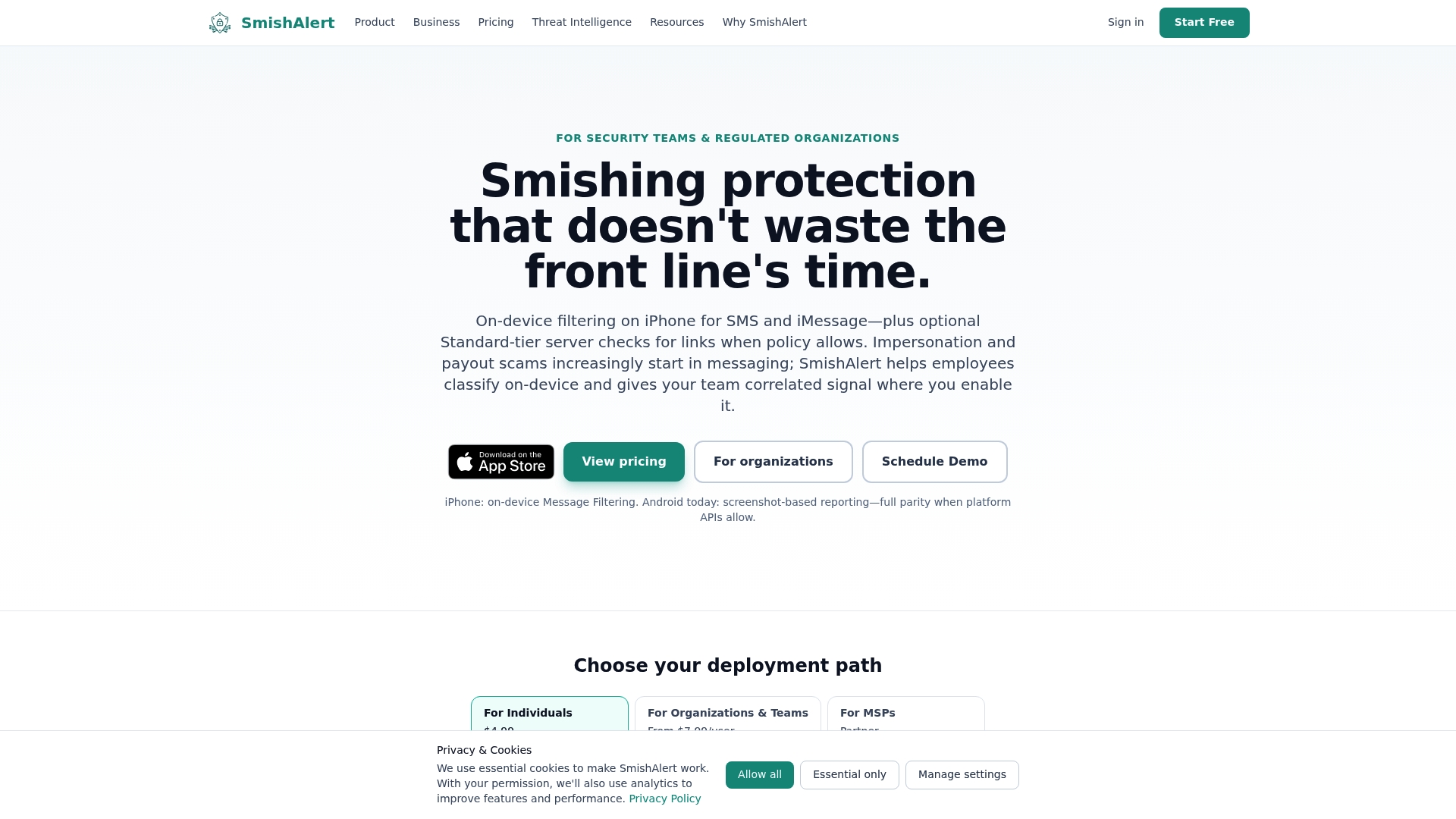
SmishAlert is built specifically for this gap. The platform combines on-device filtering, AI-powered threat analysis, and one-tap reporting to surface suspicious messages before they lead to credential theft or business compromise. Unlike device management tools, SmishAlert deploys without MDM dependencies, making it viable for BYOD programs and privacy-first security architectures. User-reported attacks are correlated in real time, giving security teams visibility into active smishing campaigns targeting their workforce. Explore the full messaging phishing detection capabilities and see how SmishAlert fits into your enterprise mobile security program.
FAQ
What is the mobile security gap in enterprises?
The mobile security gap refers to the significant disparity between the security controls applied to mobile endpoints and the actual threat exposure those devices carry. Most enterprises apply weaker defenses to mobile devices despite them accessing the same corporate data as heavily secured laptops.
Are iOS devices safer than Android in enterprise environments?
No. As of 2026, the historical security gap between iOS and Android has effectively closed, with 86% of iOS apps and 89% of Android apps under active attack. Enterprises should allocate security resources to both platforms equally.
Does MDM solve enterprise mobile security risks?
MDM addresses device configuration, encryption, and remote wipe capabilities, but it does not detect active threats, phishing delivered via SMS, or behavioral anomalies indicating compromise. It should be paired with Mobile EDR and messaging security tools.
What is smishing and why does it matter for enterprise security?
Smishing is credential-harvesting or fraud delivered through SMS and messaging applications. It bypasses email security controls entirely, making it a preferred attack channel against enterprise employees and executives, particularly those not covered by mobile-aware security programs.
How does Zero Trust apply to mobile device security?
Zero Trust applied to mobile endpoints means continuous, contextual verification of device posture, user identity, and behavioral signals before granting access to enterprise resources. Dynamic access policies can restrict or revoke access in real time when a device fails health checks or exhibits anomalous behavior.
Recommended
- How do you deploy mobile phishing protection without MDM? | SmishAlert
- Phishing and Smishing Answers for Enterprise Security | SmishAlert
- Cyber Risk: Not Just an IT Issue, It’s an SMS Security Concern Too | SmishAlert
- Bypassing MFA: The Rising Threat and How SmishAlert.ai Protects Your Business | SmishAlert