
Common CISO Mobile Security Oversights to Fix Now

Mobile security oversights are defined as the gaps in policy, tooling, and training that leave enterprise mobile endpoints exposed to exploitation, compliance failure, and data loss. Common CISO mobile security oversights now carry measurable consequences: mobile exploitation attacks jumped from 20% to 31% according to the Verizon DBIR 2026, and mobile endpoints account for 38% of compliance violations in regulated industries. The industry term for this discipline is mobile endpoint security, though security leaders increasingly use the broader frame of mobile threat defense (MTD) to capture both device and application risk. The oversights covered here span OS patch management, SDK supply chain exposure, human factor failures, MDM misconceptions, and AI-powered attack readiness. Each one represents a gap that attackers are actively exploiting right now.
1. Common CISO mobile security oversights in OS patch management
Outdated operating systems are the single most exploited entry point on enterprise mobile fleets. 50% of enterprise mobile devices run outdated OS versions, and 25% cannot be upgraded at all due to hardware limitations. That means one in four corporate devices will never receive a patch for a known vulnerability, regardless of policy.

The practical consequence is severe. Attackers target known OS vulnerabilities faster than most patch cycles can respond. Mobile OS exploits now outpace zero-day usage in enterprise breach chains, because the return on investment for attackers is higher when half the target fleet is already unpatched.
CISOs face three compounding challenges here:
- BYOD device diversity makes enforcing a minimum OS version across the fleet technically difficult without MDM enforcement.
- Carrier and OEM delays mean Android patches often arrive weeks after Google publishes them, creating a window that attackers exploit.
- User resistance to forced updates on personal devices slows compliance even when policy exists.
Pro Tip: Segment your device inventory by OS version and patch status monthly. Devices that cannot reach your minimum OS threshold should trigger conditional access restrictions, not just policy warnings.
2. Third-party SDK supply chain risks and compliance blind spots
The average enterprise mobile app contains 14 third-party SDKs, each capable of transmitting data to external endpoints that security teams have never reviewed. This creates audit blind spots that directly translate into FINRA, SEC, and HIPAA compliance failures.
Most compliance failures in mobile are documentation gaps. Security teams cannot explain what data each SDK collects, where it goes, or how it is retained. Regulators do not accept “we did not know” as a defense. The result is that a single undocumented analytics SDK can expose an organization to a material audit finding.
The following steps address SDK supply chain risk systematically:
- Inventory every SDK embedded in each production app, including transitive dependencies pulled in by primary SDKs.
- Map data flows for each SDK to identify what personal, behavioral, or device data is transmitted and to which third-party endpoints.
- Classify by regulatory sensitivity. SDKs that touch PII, financial data, or health information require documented data processing agreements.
- Automate SDK scanning in your CI/CD pipeline so new dependencies trigger a compliance review before they reach production.
- Review SDK vendor privacy policies annually, because vendors update data collection practices without notifying app developers.
Most compliance failures stem from the inability to explain third-party SDK data behaviors during an audit. Building a living SDK registry is the control that closes this gap.
3. Underestimating human factor risks in mobile security
The human factor remains the highest-risk vector in mobile security, and most organizations address it with desktop-focused training that does not translate to mobile behavior. Mobile-specific phishing policy failures and neglecting human factor training cause significant security and compliance risks that technical controls alone cannot mitigate.
Smishing (SMS phishing) and malicious QR codes are the two fastest-growing human-layer attack methods targeting mobile users. Both bypass email security gateways entirely. An employee who would recognize a suspicious email link will often tap a text message link without hesitation, because the cognitive context of SMS feels personal and trusted.
The most common mobile security policy blind spots in this area include:
- No smishing simulation program. Most organizations run email phishing simulations but have never tested employee response to a text-based credential-harvesting attempt.
- Weak lost device protocols. Policies often exist on paper but are never tested. Employees do not know the reporting procedure, and security teams have no practiced response playbook.
- QR code awareness gaps. Malicious QR codes in physical spaces (conference rooms, printed materials, parking meters) are not addressed in standard security awareness training.
Pro Tip: Run a quarterly smishing simulation using real-world lure templates. Measure click rates by department and use the data to target follow-up training. Smishalert provides enterprise smishing simulation capabilities built specifically for this use case.
4. MDM misconceptions that limit security adoption
MDM rejection is one of the most damaging mobile device management mistakes in enterprise security programs. Employees reject MDM due to privacy concerns, and those concerns are often based on inaccurate beliefs about what MDM actually does. Security leaders who fail to address this misconception directly end up with large portions of the BYOD fleet operating outside any management framework.
The core misconception is that MDM gives IT administrators access to personal photos, call logs, messages, and location data. Modern MDM tools cannot access personal photos, messages, or calls. This is enforced at the platform level by both Apple and Google. What MDM can do is enforce device encryption, require screen lock, and remotely wipe corporate data containers.
Security leaders have two practical paths when employees refuse MDM enrollment:
| Approach | What it controls | Privacy impact |
|---|---|---|
| Full MDM enrollment | Device configuration, app management, remote wipe | Low on modern platforms; perceived as high |
| Conditional access (no MDM) | Network and app access based on device health signals | Minimal; no device management required |
Conditional access models use identity and device health signals (OS version, screen lock status, jailbreak detection) to grant or deny access to corporate resources. This approach works for securing BYOD devices without requiring full device enrollment. The tradeoff is reduced visibility into device configuration, which must be compensated for with stronger application-layer controls.
5. Ignoring messaging-based social engineering outside the corporate perimeter
Traditional email security platforms do not monitor SMS, iMessage, or WhatsApp. This creates a structural blind spot: attackers who target employees through messaging channels operate entirely outside the visibility of most enterprise security stacks. Executive impersonation, payroll fraud, gift card scams, and credential harvesting via SMS are all attack types that bypass perimeter controls by design.
The attack chain typically starts with a text message that appears to come from a senior leader or trusted vendor. The employee responds, provides credentials or authorizes a transaction, and the security team has no telemetry on the interaction. By the time the breach is discovered, lateral movement has already occurred.
Security teams that want visibility into this threat surface need to address three gaps:
- User reporting mechanisms for suspicious texts and messages, with a clear, low-friction reporting path that employees will actually use.
- Campaign correlation to identify whether multiple employees are receiving similar lures, which signals an active, targeted campaign.
- Threat analysis that connects reported messages to known threat actor infrastructure, enabling proactive response rather than reactive investigation.
Smishalert is built to surface exactly this class of threat. Its platform captures reported messages, correlates campaigns across the organization, and provides security teams with the telemetry they need to detect messaging-based social engineering before it results in compromise.
6. Failing to counter AI-powered mobile attack automation
Attackers use automation and AI to outpace human analysts, making traditional manual mobile security defenses obsolete. This is not a future risk. It is the current operating environment. Security programs that rely on periodic reviews, manual log analysis, or quarterly penetration tests are structurally unable to keep pace with automated attack campaigns that iterate in hours.
AI-powered attacks against mobile endpoints include automated credential-harvesting campaigns that rotate domains faster than blocklists update, deepfake voice and text impersonation that defeats human judgment, and adaptive phishing lures that personalize content based on scraped social media data. Each of these techniques exploits the speed gap between attacker automation and defender response.
“Closing mobile security gaps requires runtime, on-device enforcement rather than relying solely on static or backend controls. Most mobile threats occur post-installation on real, often rooted or emulated devices, making backend defenses insufficient by the time an attack executes.” — OWASP Mobile Top 10 2026
Runtime on-device enforcement is the technical response to this problem. Controls that execute on the device itself, rather than at the network perimeter or application backend, can detect and block threats in real time without waiting for a human analyst to review an alert. CISOs who have not yet evaluated on-device threat detection as part of their mobile threat detection architecture have a critical gap in their defense posture.
Key takeaways
The most dangerous mobile security gap in 2026 is not a single technical flaw. It is the combination of unpatched devices, undocumented SDK data flows, untested human-layer defenses, and no visibility into messaging-based attacks.
| Point | Details |
|---|---|
| Patch management is the baseline | 50% of enterprise devices run outdated OS versions; enforce minimum OS thresholds via conditional access. |
| SDK documentation closes compliance gaps | Map every third-party SDK’s data flows before an audit finds them first. |
| Smishing simulations are non-negotiable | Email phishing training does not prepare employees for SMS-based credential harvesting. |
| MDM misconceptions reduce coverage | Correct the privacy myth directly; modern MDM does not access personal data on managed devices. |
| Runtime enforcement counters AI attacks | On-device controls respond in real time; backend and perimeter defenses cannot match attacker automation speed. |
What I’ve learned from watching mobile security programs fail
The pattern I see most often is not ignorance. It is misplaced confidence. Security leaders who have built strong email security programs assume that mobile is covered by extension. It is not. The attack surface, the user behavior, and the tooling requirements are fundamentally different.
The oversight that costs organizations the most is the absence of visibility into messaging channels. A CISO can have a mature SIEM, a full EDR deployment, and a well-staffed SOC, and still have zero telemetry on a smishing campaign that is actively harvesting employee credentials through WhatsApp. That gap is not a configuration problem. It is an architectural one.
The fix requires two things working together: technical controls that operate at the device and application layer, and human-centric policies that are actually tested. A policy that has never been exercised is not a control. It is a document. The organizations that close their mobile security gaps fastest are the ones that treat mobile as a distinct threat surface with its own program, not a footnote in the endpoint security policy.
— Sophie
How Smishalert addresses the gaps that other tools miss
Security leaders who have read this far recognize that messaging-based social engineering sits outside the coverage of most enterprise security stacks. Smishalert is built to fill that gap.
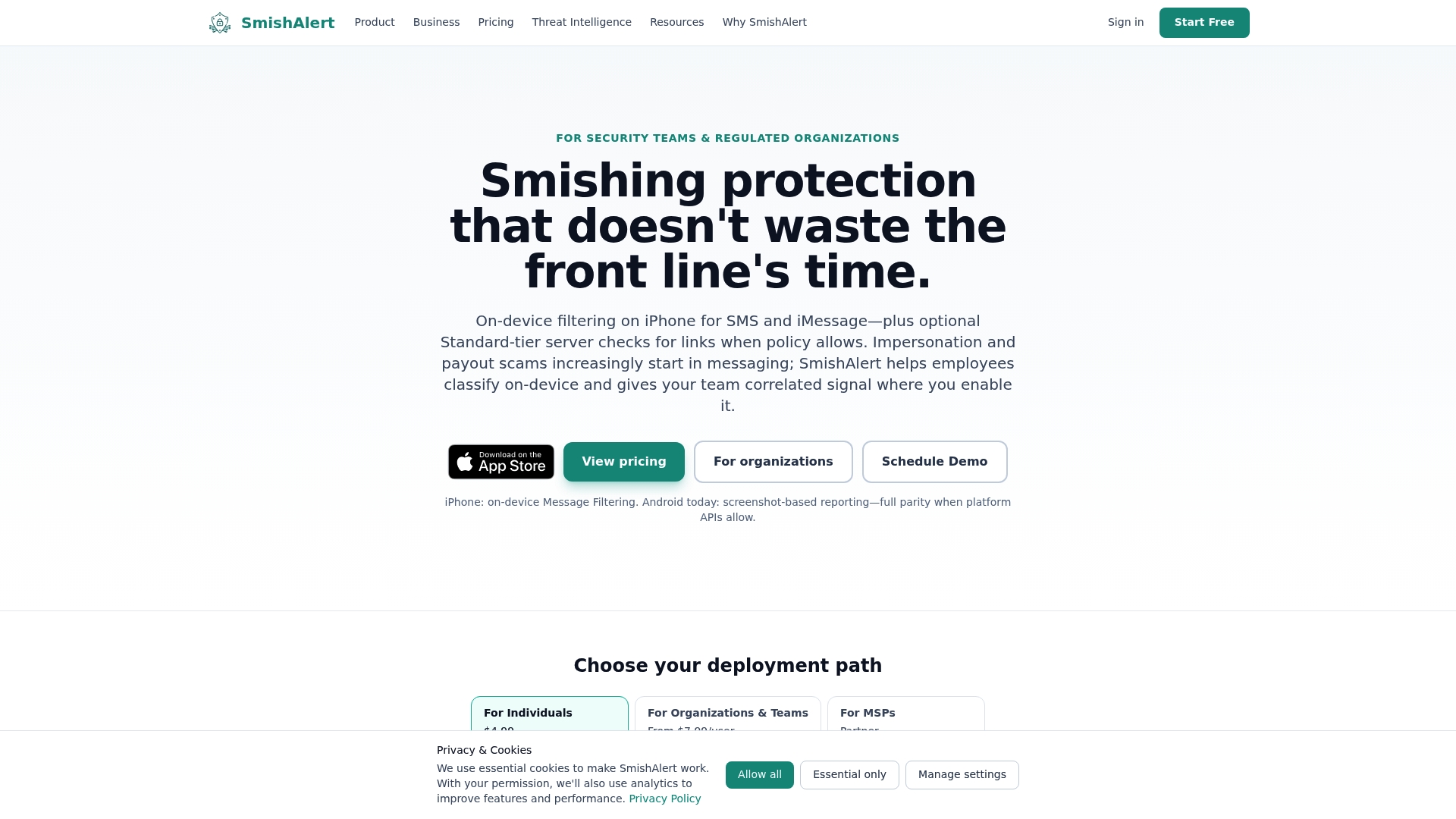
Smishalert gives security teams visibility into SMS, iMessage, and WhatsApp attacks targeting employees, including executive impersonation, credential harvesting, and payroll fraud. The platform captures reported messages, correlates campaigns across the organization, and delivers the threat intelligence security teams need to act before a breach occurs. For CISOs who need to demonstrate mobile security coverage to auditors and boards, Smishalert’s enterprise solutions provide the telemetry and reporting that close the human-layer visibility gap. Take the 2-minute readiness check to see where your program stands today.
FAQ
What are the most common mobile security oversights CISOs make?
The most common oversights are unpatched OS versions, undocumented third-party SDK data flows, no smishing simulation program, MDM adoption gaps driven by privacy misconceptions, and zero visibility into messaging-based social engineering attacks.
How do mobile compliance failures typically occur?
Mobile endpoints account for 38% of compliance violations, most often because organizations cannot document what data third-party SDKs collect or transmit during regulatory audits.
Why is MDM not enough for BYOD security?
MDM addresses device configuration but does not cover messaging-based attacks that occur outside the corporate perimeter. Conditional access models combined with application-layer controls and user reporting mechanisms provide broader coverage for BYOD environments.
How does AI change the mobile threat landscape for security teams?
AI-powered attacks rotate infrastructure, personalize lures, and execute at speeds that manual security reviews cannot match. Runtime, on-device enforcement is the only defense architecture that responds fast enough to counter automated mobile attack campaigns.
What is the fastest way to test mobile phishing readiness?
Run a smishing simulation targeting a cross-section of employees using realistic SMS lures. Measure click and response rates by department, then use the results to prioritize targeted awareness training for the highest-risk groups.