
Deploy SMS Security for Traveling Employees: 2026 Guide

Deploying SMS security for traveling employees is not a single-tool decision. It requires layered mobile protection, integration with travel risk management platforms, and compliance with standards like ISO 31030 before the first employee boards a flight. SMS remains a primary communication channel for real-time safety alerts, two-way check-ins, and incident response during travel. Yet it also carries well-documented vulnerabilities, from SS7 protocol weaknesses to smishing campaigns that specifically target executives abroad. For US organizations in 2026, the goal is not to eliminate SMS but to deploy it within a security framework that accounts for its limitations.
Key elements of a complete deployment:
- Platform selection: Choose a mass notification platform with itinerary tracking, two-way SMS, and audit trail capabilities.
- Device security: Enforce EMM or MTD policies with encryption, strong passcodes, and remote wipe before travel begins.
- MFA migration: Transition away from SMS-based two-factor authentication to authenticator apps or hardware keys prior to departure.
- Compliance documentation: Maintain auditable evidence of employee reachability to satisfy ISO 31030 duty of care requirements.
- Threat monitoring: Deploy mobile threat defense with behavioral analysis to detect smishing and credential-harvesting attempts in real time.
- Employee training: Run pre-travel awareness programs covering SMS phishing recognition and secure device usage.
What makes SMS security so difficult for traveling employees?
SMS carries structural vulnerabilities that become acute the moment an employee crosses a border. The SS7 signaling protocol, which underlies global carrier interconnection, has known weaknesses that allow interception of messages in transit. Text messages and many mobile apps used for voice and text communication often lack encryption, making them susceptible to adversary-in-the-middle attacks, particularly on foreign networks where carrier security standards vary widely.
Smishing is the more immediate threat for most travelers. Attackers craft SMS messages that impersonate HR systems, travel booking platforms, or IT helpdesks, targeting employees who are distracted, jet-lagged, or relying on unfamiliar networks. The risks of SMS on personal devices compound this: when employees use personal phones for work communications abroad, the organization loses visibility into whether a message was acted on, forwarded, or used to harvest credentials.
The authentication layer adds another failure point. SMS 2FA failures during travel commonly arise from roaming service loss, SIM swapping, and delayed or missing verification codes, which can lock employees out of critical systems at the worst possible moment. These are not edge cases. They are predictable failure modes that any pre-travel security checklist should address.
Key SMS security risks for traveling employees:
- SS7 interception: Carrier-level protocol weaknesses allow message interception without device compromise.
- Smishing campaigns: Targeted SMS phishing exploits distraction and unfamiliar environments during travel.
- SIM-swap fraud: Attackers redirect SMS messages by social-engineering the home carrier.
- Roaming failures: Loss of home carrier signal causes SMS 2FA codes to fail or arrive hours late.
- Personal device exposure: BYOD scenarios remove organizational visibility and control over SMS communications.
- Regulatory complexity: SMS data crossing international borders may trigger GDPR, HIPAA, or local data residency requirements depending on the destination.
SMS security alone cannot address this attack surface. It must be one layer within a broader mobile security strategy.
How to integrate SMS communications with travel risk management platforms
The most effective deployments treat SMS as one channel within a multi-modal communication architecture, not as the primary or sole alert mechanism. Cloud-based mass notification platforms combined with itinerary tracking allow organizations to confirm employee safety in real time and provide 24/7 assistance during travel, using SMS alongside push notifications and email to reach employees through whichever channel is available.

Everbridge Travel Protector is the most widely deployed platform for this use case among US enterprises. It automates location-aware SMS alerts based on traveler itineraries, triggers two-way safety check-ins during incidents, and generates audit trails that serve as compliance evidence under ISO 31030. When a security event occurs in a city where employees are traveling, the platform cross-references itinerary data and sends targeted alerts rather than broadcasting to the entire workforce.
Itinerary integration is what separates reactive from proactive travel security. Without it, security teams learn about incidents from news feeds and then manually identify which employees might be affected. With it, the platform already knows who is in the affected area and initiates contact automatically. The operational benefit is faster response time; the compliance benefit is a documented record of every alert sent and every response received.
Cost management matters here too. High-volume SMS across international carriers generates real expense, and uncontrolled notification volume can cause alert fatigue that degrades response rates. Governance frameworks should define which event categories trigger SMS versus push notification versus email, with SMS reserved for time-critical safety alerts where push delivery cannot be guaranteed.
Mobile device security best practices for protecting traveling employees
Enterprise Mobility Management and Mobile Threat Defense are the technical foundation for any travel security program. EMM platforms allow remote enforcement of security policies and network access controls, including encryption requirements, minimum passcode complexity, and the ability to remotely wipe a device that is lost or stolen abroad. MTD adds behavioral threat detection that operates on-device, identifying anomalous activity without requiring a connection back to a corporate network.

Pro Tip: Configure all corporate travel devices with EMM profiles, VPN enforcement, and MTD before the employee leaves the building. Attempting to push policy changes to a device already operating on a foreign carrier network is unreliable and sometimes impossible.
Phishing-resistant MFA deserves specific attention. SMS text codes are not a strong second authentication factor because they can be intercepted and compromised by malicious software on the device. Authenticator apps, passkeys, hardware tokens, and biometrics all provide stronger protection. The migration should happen before travel, not during an incident.
Practical steps for pre-travel device hardening:
- Enroll the device in EMM and verify policy compliance before departure.
- Enable full-disk encryption and enforce a minimum six-digit PIN or biometric unlock.
- Install and activate MTD with behavioral analysis enabled.
- Disable Bluetooth, NFC, and Wi-Fi auto-connect when not in active use.
- Configure a corporate VPN to activate automatically on untrusted networks.
- Remove or disable apps that are not required for the trip.
- Verify that backup authentication methods (authenticator app, hardware key) are configured and tested.
Training is the final layer. Technical controls fail when employees click on a smishing link before the MTD agent can block it. Employee training focused on SMS phishing awareness and cautious interaction with unknown messages reduces the attack surface that technical controls cannot fully cover. Pre-travel briefings should include specific examples of smishing lures targeting travelers, such as fake hotel Wi-Fi prompts, fraudulent airline rebooking messages, and executive impersonation texts requesting urgent wire transfers.
How to meet corporate duty of care and compliance obligations
ISO 31030 mandates that organizations maintain auditable evidence of active reachability and real-time assistance for traveling employees. This goes well beyond travel insurance. It requires documented proof that the organization can reach each employee during a crisis and that it took action when a threat arose. SMS communications, when properly logged, contribute directly to that evidence base.
Real-time connectivity monitoring is the operational mechanism. Solutions like corporate-managed eSIM deployments provide live connection status across multiple carrier networks, reducing the risk of an employee going unreachable in a low-coverage area. When connectivity drops, the system flags the gap, allowing the security team to initiate contact through an alternative channel before the situation escalates.
Steps to build a compliance-ready SMS security deployment:
- Define reachability SLAs: Establish maximum acceptable time-to-contact thresholds for employees in high-risk destinations.
- Implement audit logging: Ensure every SMS alert sent and every response received is logged with timestamps in the travel risk platform.
- Approve SMS templates in advance: Pre-approved message templates reduce the risk of inconsistent or legally problematic communications during an incident.
- Establish escalation protocols: Define what happens when an employee does not respond to an SMS check-in within the defined window.
- Address data privacy by destination: Map which countries impose data residency or consent requirements on SMS communications and configure routing accordingly.
- Conduct post-travel reviews: Debrief employees returning from high-risk destinations and log any security incidents or near-misses involving mobile communications.
GDPR applies when employees travel to or through EU countries and their SMS data is processed by a platform with EU data subjects. HIPAA applies when healthcare-sector employees communicate patient-adjacent information via SMS. Neither regulation prohibits SMS use, but both require documented controls, consent where applicable, and breach notification procedures. Building these requirements into the governance framework from the start avoids retrofitting compliance after an incident.
Advanced mobile messaging threat detection beyond SMS
The attack surface for traveling employees extends well beyond SMS. Smishing campaigns now run in parallel across iMessage, WhatsApp, and other messaging channels, targeting the same employees through whichever platform they are most likely to engage with. AI-driven, on-device behavioral analysis detects mobile phishing, smishing, and zero-day exploits in ways that traditional, rules-based mobile security technologies cannot match, because it identifies anomalous patterns rather than waiting for a known signature to appear.
Smishalert addresses exactly this gap. Where EMM and MTD platforms focus on device posture and network-level threats, Smishalert provides visibility into the human attack surface: the executive impersonation texts, credential-harvesting campaigns, payroll fraud attempts, and gift card scams that arrive through SMS, iMessage, and WhatsApp outside the corporate perimeter. Security teams can correlate reported messages across the workforce, identify active campaigns targeting travelers, and feed that intelligence back into incident response workflows.
The mobile threat detection practices that matter most for traveling employees combine on-device behavioral analysis with user reporting and campaign correlation. A single smishing report from one traveler may not trigger an alert. Ten reports of the same sender pattern across employees in the same city almost certainly indicate a targeted campaign. That correlation is what separates reactive incident response from proactive threat detection.
Multi-channel visibility also matters for compliance. When an employee reports a suspicious WhatsApp message impersonating the CFO, that report becomes part of the organization’s documented threat response record, supporting both ISO 31030 audit requirements and internal security governance.
What does a realistic SMS security deployment timeline look like?
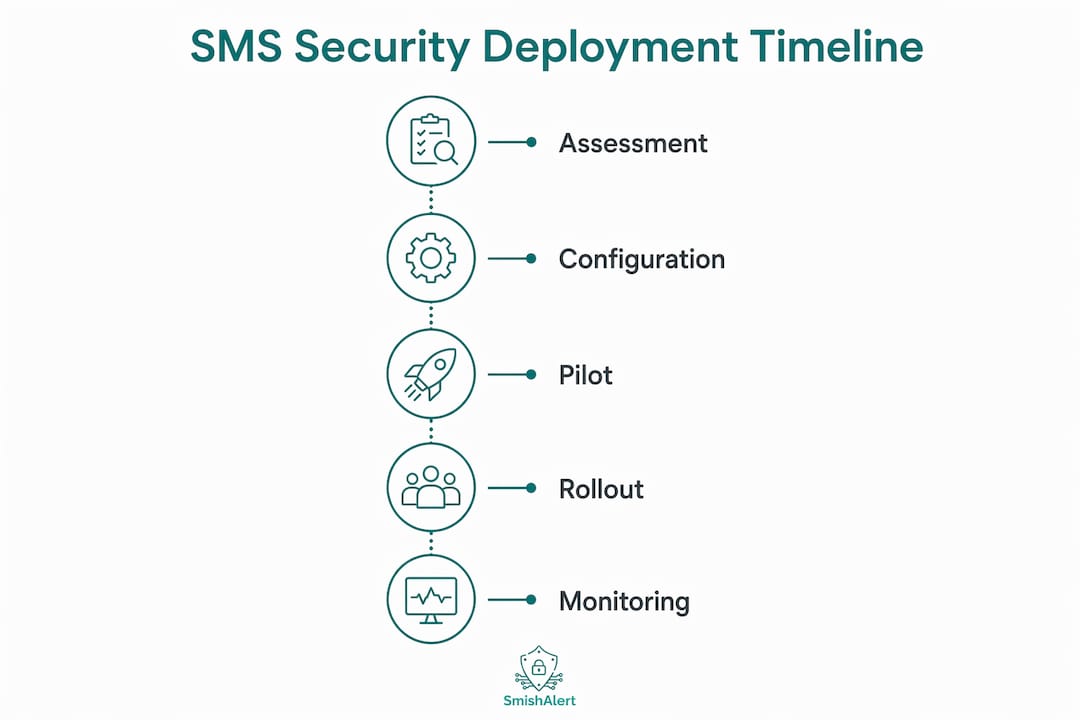
A phased deployment prevents the operational disruption that comes from pushing policy changes to a traveling workforce all at once. The timeline below reflects what US organizations typically execute across a 90-day initial deployment cycle.
Phase 1: Assessment and policy design (weeks 1–3)
Audit the current state of mobile device enrollment, SMS-based authentication dependencies, and travel risk platform capabilities. Identify which employees travel to high-risk destinations and which systems they access via SMS 2FA. Document data privacy obligations by destination. The output of this phase is a gap analysis and a prioritized remediation list.
Phase 2: Platform configuration and MFA migration (weeks 4–8)
Configure the travel risk management platform with itinerary data feeds, SMS alert templates, and audit logging. Begin migrating high-risk users off SMS 2FA to authenticator apps or hardware keys. Enroll corporate travel devices in EMM and deploy MTD. Test the full alert-to-response workflow in a tabletop exercise before any live travel occurs.
Phase 3: Pilot deployment and training (weeks 9–11)
Run the deployment with a pilot group of frequent travelers. Deliver pre-travel security briefings covering smishing recognition, secure messaging practices, and the escalation protocol for suspected incidents. Collect feedback on alert delivery rates, false positives, and employee experience with the new MFA methods.
Phase 4: Full rollout and continuous monitoring (week 12 onward)
Expand to the full traveling workforce. Establish a regular cadence for reviewing audit logs, updating SMS templates, and refreshing employee training. Integrate mobile threat intelligence from platforms like Smishalert into the SIEM to surface campaign patterns before they result in compromise. Schedule quarterly reviews of MFA enrollment status and connectivity monitoring coverage.
The deployment does not end at week 12. Threat actors update their smishing lures faster than most organizations update their training materials, which means continuous monitoring and periodic re-assessment are built-in requirements, not optional enhancements.
Key Takeaways
Deploying SMS security for traveling employees requires integrating travel risk platforms, phishing-resistant MFA, EMM enforcement, and multi-channel threat detection into a single governance framework before employees depart.
| Point | Details |
|---|---|
| SMS is a channel, not a strategy | Use SMS for real-time safety alerts within a multi-modal platform; never as the sole communication or authentication method. |
| MFA migration must happen pre-travel | SMS 2FA fails abroad due to roaming loss and SIM-swap; migrate to authenticator apps or hardware keys before departure. |
| ISO 31030 requires documented reachability | Audit trails of every SMS alert sent and response received are required evidence for duty of care compliance. |
| EMM and MTD are the device foundation | Enforce encryption, strong passcodes, and behavioral threat detection on all corporate travel devices before the trip begins. |
| Multi-channel visibility closes the gap | Smishing campaigns run across iMessage and WhatsApp, not just SMS; threat detection must cover all messaging channels. |