
How Managed Services Price SMS Protection in 2026

Managed services price SMS protection through two primary billing structures: per-message volume pricing and per-successful-verification (per-success) billing, layered with mandatory US-specific cost components that most headline rates omit. Premium tiers for specialized SMS fraud detection cost 40–60% more than baseline filtering solutions, reflecting the added cost of machine learning threat detection and behavioral analytics. Before evaluating any provider quote, security leaders should account for these non-negotiable cost layers:
- Per-message or per-success billing: Core pricing unit; per-success models charge only on validated verification events
- Carrier pass-through fees: US carriers impose approximately $0.0033 per OTP on 10DLC routes, added on top of provider rates
- 10DLC registration: The Campaign Registry charges a one-time $4 brand registration fee and roughly $10 per month per approved campaign
- Compliance and onboarding setup: Sender ID registration, brand vetting, and campaign approval carry additional one-time and recurring fees
- SLA and contract minimums: Managed service agreements typically include committed monthly volumes and tiered support costs
Understanding these layers before issuing an RFP prevents budget surprises and enables accurate total cost of ownership comparisons across providers.
Table of Contents
- How managed services price SMS protection: core models explained
- What US-specific fees add to your total SMS security cost
- How to evaluate SMS protection pricing and service value
- What Smishalert brings to managed SMS protection
- Key pricing takeaways for budgeting SMS protection
- What drives cost in US SMS managed services
- How costs scale with message volume and user count
- Comparing pricing approaches across US managed SMS protection providers
- What integration with existing security infrastructure actually costs
- Smishalert gives security teams visibility where pricing guides stop
- Key Takeaways
How managed services price SMS protection: core models explained
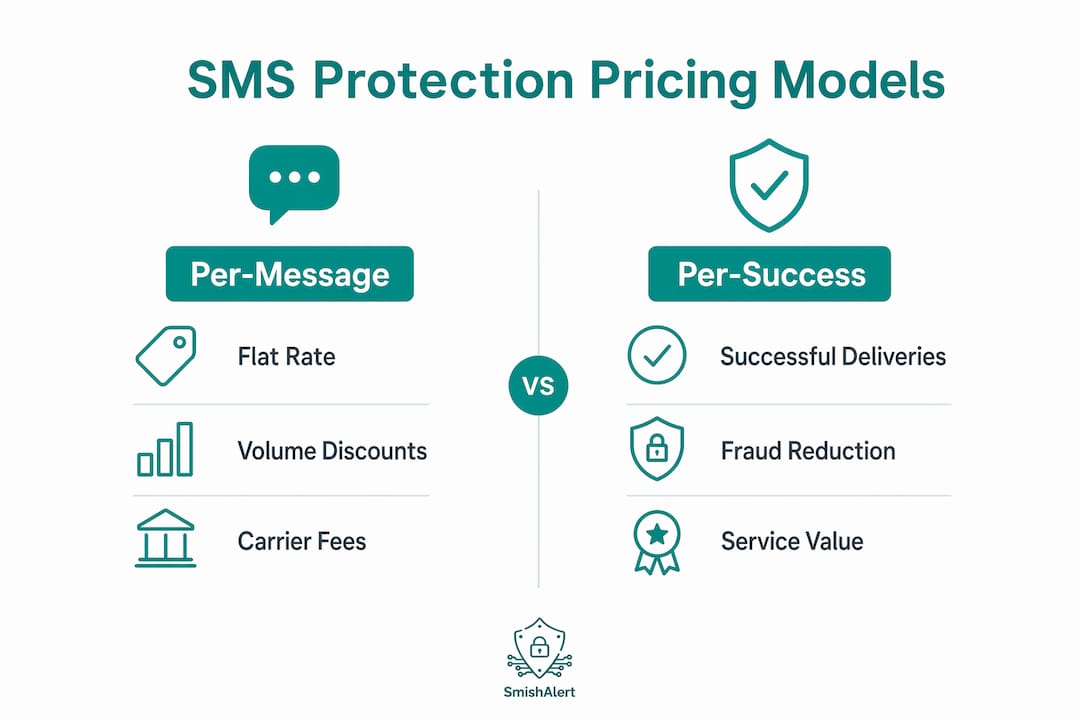
Cloud-based managed SMS protection services use consumption-based pricing, charging per million messages processed, with premium tiers reserved for advanced machine learning threat detection. On-premises licensing follows a different logic, typically structured as annual flat fees tied to throughput capacity rather than actual message volume.
The most common pricing structures in the US market include:
- Per-send pricing: Charged for every outbound message attempt, regardless of delivery outcome or fraud status
- Per-delivery pricing: Charged only for messages confirmed delivered to the end-user device
- Per-success (per-verification) billing: Charged exclusively on successful, validated authentication events, making fraudulent traffic economically non-billable
- Fixed subscription tiers: Monthly or annual flat rates covering a defined message volume ceiling, with overage charges above that threshold
- Volume-based tiered pricing: Effective cost per message decreases as monthly send volume increases, rewarding scale
The sophistication of fraud protection directly shapes where a service lands on this spectrum. Providers offering behavioral analytics, real-time telemetry, and ML-based anomaly detection command a 40–60% premium over baseline filtering. Organizations evaluating SMS management service pricing should map each provider’s detection capabilities against that premium to determine whether the uplift is justified.
What US-specific fees add to your total SMS security cost
The US SMS market carries mandatory cost layers that exist independently of any managed service provider’s pricing. These fees are non-negotiable and must be budgeted separately from provider rates.
Carrier pass-through surcharges from Verizon, AT&T, T-Mobile, and US Cellular apply to every message routed through 10DLC paths. At approximately $0.0033 per OTP, these fees accumulate quickly at enterprise send volumes. Carrier fees and 10DLC registration costs are fixed, unavoidable layers in US SMS pricing that no provider can waive.
10DLC registration fees include one-time brand registration and monthly campaign fees, varying by campaign type.
Compliance and setup costs add another layer. Sender ID registration, brand vetting, and campaign approval processes carry one-time fees that many providers bury in onboarding documentation. Hidden setup and compliance fees routinely surprise IT teams who evaluate only per-message rates. Procurement teams should request a full line-item quote covering every compliance-related charge before signing.
How to evaluate SMS protection pricing and service value
Pricing model selection has direct implications for fraud exposure. The per-success billing model charges only for successful verification events, making SMS pumping attacks economically unviable for attackers. When a fraudulent bot triggers thousands of OTP sends that never complete legitimate verification, per-success billing generates zero revenue for the attacker’s infrastructure and zero cost for the organization. Per-send pricing, by contrast, bills for every fraudulent attempt.
Pro Tip: Embed SMS protection costs into your broader communications infrastructure budget rather than treating them as a standalone security line item. Siloed spending obscures true total cost of ownership and makes it harder to justify protection tier upgrades during annual reviews.
Key evaluation criteria for security buyers:
- Bundling versus separate licensing: Providers that include fraud detection, compliance support, and reporting in a single tier reduce complexity and improve cost predictability compared to fragmented third-party add-ons
- SLA terms and minimum volume commitments: Understand whether the contract requires committed monthly minimums that may exceed actual send volumes during low-traffic periods
- Integration costs: API connectivity to existing SIEM, IAM, or SOC tooling may carry implementation fees not reflected in the base rate
- Fraud reduction efficacy: Full-stack SMS fraud defenses can reduce fraudulent OTP traffic from 5–15% down to under 0.5%, generating measurable cost savings in wasted messaging spend
- Scalability: Confirm that volume tier pricing applies automatically as send volumes grow, without requiring contract renegotiation
Organizations should also verify whether SMS protection is included in existing messaging API agreements or requires separate licensing. Discovering that protection is an add-on after deployment creates unplanned budget pressure.
What Smishalert brings to managed SMS protection
Smishalert addresses the threat category that most SMS pricing discussions overlook: social engineering attacks delivered through SMS, iMessage, and WhatsApp that target employees rather than authentication workflows. Smishalert’s platform integrates SMS threat detection, user reporting, and campaign correlation to surface attacks including executive impersonation, credential harvesting, payroll fraud, and gift card scams.
For enterprise security teams, the platform’s value proposition centers on visibility outside the corporate perimeter. Traditional email security tools have no telemetry on messaging-based threats. Smishalert fills that gap by enabling security teams to understand their organization’s human attack surface and detect emerging campaigns before they result in compromise.
Key capabilities relevant to security leaders and IT teams:
- User-reported threat ingestion: Employees submit suspected smishing messages directly, feeding campaign correlation analysis
- Executive impersonation detection: Surfaces high-risk impersonation attempts at the device level before lateral movement begins
- Credential-harvesting identification: Flags mobile phishing links designed to capture enterprise credentials
- Campaign correlation: Links individual reports into coordinated attack patterns, giving SOC teams actionable threat intelligence
- Bundled protection model: Core detection and reporting capabilities are integrated rather than sold as separate upcharges
Full-stack SMS fraud defenses can reduce fraudulent OTP traffic from 5–15% to under 0.5%, and Smishalert’s approach extends that protection philosophy to the human layer, where social engineering attacks begin.
Key pricing takeaways for budgeting SMS protection
Security leaders evaluating SMS protection costs should carry these points into every vendor conversation:
- Per-success billing is the most fraud-resistant pricing model; per-send billing exposes organizations to cost inflation from pumping attacks
- Carrier pass-through fees (~$0.0033 per OTP) and 10DLC registration fees are mandatory US market costs, not provider-negotiable
- Premium fraud detection tiers cost 40–60% more than baseline filtering but deliver measurable fraud reduction
- Bundled services offer better cost predictability than assembling protection from multiple third-party vendors
- Contract minimums and SLA terms can significantly affect total spend; evaluate committed volumes against realistic send projections
- Hidden compliance fees (sender ID registration, brand vetting) must be explicitly requested in any line-item quote
What drives cost in US SMS managed services
Three forces shape the cost structure of US SMS managed services beyond the base per-message rate. First, the sophistication of the threat detection engine: ML-based behavioral analytics and real-time telemetry require more infrastructure than rule-based filtering, and providers price accordingly. Second, the regulatory environment: US A2P 10DLC requirements create a compliance overhead that does not exist in many other markets. Third, traffic quality. Providers that route through direct carrier connections offer higher deliverability but charge more than those using aggregated routes. Each of these factors compounds, meaning the lowest headline rate often carries the highest operational risk.

How costs scale with message volume and user count
Volume-based pricing rewards scale, but the relationship is not linear. Most managed SMS protection providers structure tiers so that the effective cost per message drops as monthly send volume increases. An organization sending 500,000 OTPs per month will pay a meaningfully higher per-message rate than one sending 10 million. User count adds another dimension: platforms that price per protected user rather than per message can become expensive for organizations with large employee populations but low individual message frequency. Security leaders should model both variables, projecting costs under best-case, expected, and high-fraud-event scenarios before committing to a contract structure.
Comparing pricing approaches across US managed SMS protection providers
The US market for managed SMS protection does not have a single dominant pricing standard. Entry-level platforms typically offer pay-as-you-go per-message pricing with fraud filtering as an optional add-on, billed separately. Mid-market managed services bundle filtering and compliance support into tiered subscriptions, with pricing that scales by monthly message volume. Enterprise platforms add dedicated account management, SLA-backed infrastructure, SIEM integration support, and advanced analytics, all of which are reflected in higher base rates. The 40–60% premium for advanced ML-based detection applies across tiers. When comparing providers, request the complete landed cost: base rate, carrier pass-through, 10DLC fees, setup costs, and any add-on charges for reporting or integration. The cheapest per-message rate rarely represents the lowest total cost.
What integration with existing security infrastructure actually costs
Connecting a managed SMS protection service to existing IT and security infrastructure carries costs that rarely appear in a provider’s pricing page. SIEM integration, whether into Splunk, Microsoft Sentinel, or another platform, may require custom connector development or professional services engagement. IAM system connectivity for user identity correlation adds similar complexity. Organizations running bundled SMS security alongside endpoint protection tools need to account for data normalization, API rate limits, and ongoing maintenance. These integration costs can represent a significant portion of first-year total cost of ownership, particularly for organizations without dedicated security engineering resources. Providers that offer pre-built integrations with common SIEM and SOC tooling reduce this burden, which is a legitimate factor in pricing comparisons even when the base rate is higher.
Smishalert gives security teams visibility where pricing guides stop
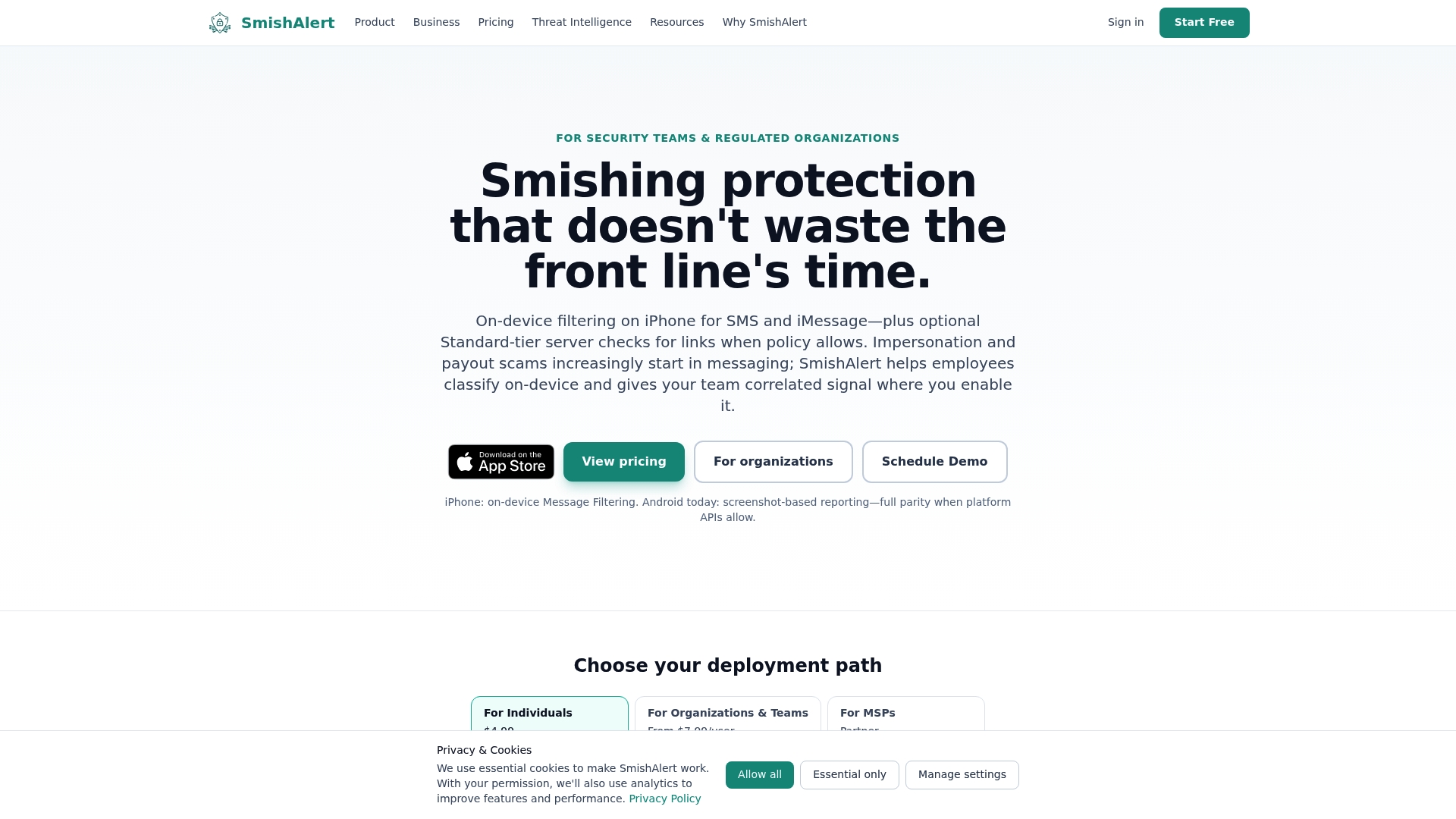
Most SMS protection pricing guides focus on OTP authentication workflows. Smishalert addresses the threat surface those guides ignore: the social engineering attacks that reach employees through SMS, iMessage, and WhatsApp, outside any corporate-controlled channel. For security leaders who have already budgeted for carrier fees and 10DLC registration, Smishalert adds the human-layer visibility that turns raw messaging data into a coherent threat picture. The platform captures user-reported smishing attempts, correlates them into campaigns, and surfaces executive impersonation and credential-harvesting attacks before they reach the SOC as incidents. There are no separate upcharges for core detection and reporting. Request your 30-day exposure assessment to see what social engineering activity is currently targeting your organization.
Key Takeaways
Managed services price SMS protection through layered models combining per-message or per-success billing with mandatory US carrier fees and 10DLC registration costs that must be budgeted separately from provider rates.
| Point | Details |
|---|---|
| Premium tier pricing | Advanced ML-based SMS fraud detection costs 40–60% more than baseline filtering solutions. |
| Mandatory US fees | Carrier pass-through fees (~$0.0033 per OTP) and 10DLC registration are fixed costs no provider can waive. |
| Per-success billing advantage | Charging only on validated verification events makes SMS pumping attacks economically non-viable for attackers. |
| Bundled versus fragmented services | Integrated protection tiers deliver better cost predictability than assembling fraud detection from multiple third-party vendors. |
| Smishalert’s role | Smishalert extends SMS protection to the human layer, surfacing social engineering attacks like executive impersonation and credential harvesting outside the corporate perimeter. |