
How Mobile Threats Reach SOC Teams: 2026 Defense Guide

Mobile threats reach SOC teams through three primary channels: SMS-based social engineering (smishing), malicious mobile applications, and network-layer exploits that operate entirely outside the corporate perimeter. Unlike email phishing, these vectors generate little to no telemetry in traditional SIEM environments, which means SOC analysts often receive no alert at all until a credential has already been harvested or a device compromised. The 2026 Verizon DBIR confirms that smishing and voice phishing succeed at a rate 40% higher than email phishing, and that 41% of social engineering breaches now use non-email vectors. AI-driven attack automation has accelerated both the volume and personalization of these campaigns, pushing SOC teams to adapt workflows built for network-centric threats to a mobile-first reality.
Key delivery mechanisms SOC teams must account for:
- SMS smishing and voice phishing (vishing): Delivered directly to employee devices, bypassing email gateways entirely
- Malicious and sideloaded apps: Third-party or repackaged applications that exfiltrate data or enable device surveillance
- Network-based exploits: Man-in-the-middle (MitM) attacks over cellular, Wi-Fi, and Bluetooth connections
- Unmanaged personal devices: BYOD endpoints invisible to MDM and MTD tooling, creating blind spots in SOC telemetry
- AI-automated campaigns: Attacker use of machine learning to scale, personalize, and accelerate mobile attack chains
Common mobile threat vectors affecting SOC operations
Mobile devices face a threat surface that differs structurally from traditional endpoints, and SOC teams need to understand each vector to build effective detection coverage.
Smishing campaigns are the highest-yield vector for attackers today. Because SMS and messaging apps carry no equivalent of an email gateway, a well-crafted smishing message reaches an employee’s personal or corporate device with no filtering layer in between. The 2026 Verizon DBIR reports nearly one mobile phishing campaign per week on managed devices alone. Unmanaged and personal devices are invisible to most security teams, so the actual volume is almost certainly higher.
Malicious and sideloaded applications represent a persistent blind spot. Many organizations lack visibility into what third-party apps are doing on employee devices, what corporate data they touch, or where they send it. Sideloaded apps, those installed outside Apple’s App Store or Google Play, may contain embedded malware or spyware that activates after installation without triggering any MDM alert.
Network-based attacks exploit the inherent mobility of devices. The Canadian Centre for Cyber Security identifies cellular, Wi-Fi, and Bluetooth connections as active attack surfaces, with threat actors using them to intercept communications, track device location via GPS, and activate microphones or cameras remotely.
Insider risk and user behavior exploitation compound the problem. Employees who misuse device permissions, connect to unauthorized platforms, or fail to follow security policy create vulnerabilities that threat actors actively probe. Social media apps installed on corporate devices conduct data mining that can expose contact lists and network topology.
Unmanaged personal devices remain the most difficult challenge for SOC visibility. BYOD endpoints that lack MDM enrollment generate no telemetry, making it impossible for SOC analysts to detect compromise, lateral movement, or credential harvesting on those devices without a dedicated mobile threat reporting mechanism.
How SOC teams detect and respond to mobile threats
Detection starts with telemetry, and mobile telemetry requires purpose-built tooling. Mobile Threat Defense (MTD) systems run an agent on the device and provide real-time, continuous monitoring for malicious apps, network attacks, phishing attempts, and configuration anomalies. Critically, MTD operates independently of network connectivity, so it can detect threats even when a device’s connection is blocked or compromised.
For SOC ingestion, MTD alert data must feed into SIEM and SOAR platforms to be operationally useful. The integration challenge is significant: mobile alerts arrive in formats that traditional SIEM data models were not designed to parse. SOC teams that have solved this use a defined data model, such as Splunk’s Common Information Model, to normalize mobile telemetry alongside network and endpoint data.
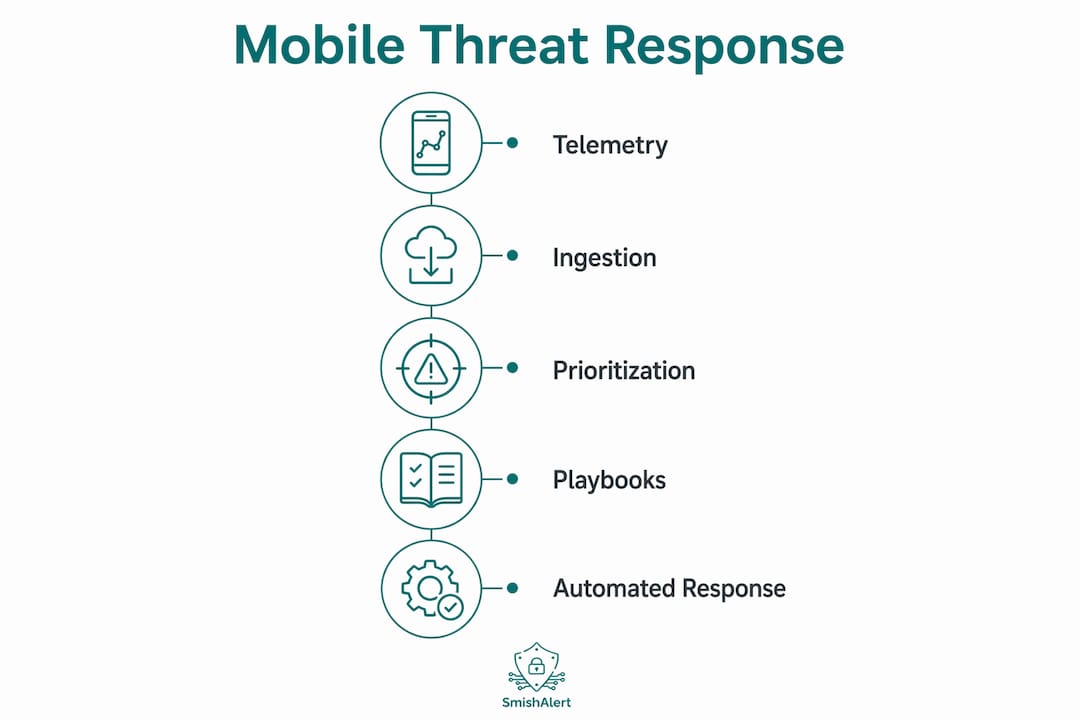
Alert prioritization is where most mobile SOC workflows break down. Raw MTD output can generate substantial noise, and without correlation logic, analysts spend time triaging false positives instead of responding to real incidents. AI-driven correlation tools address this by grouping related signals across device, app, network, and web layers into a single incident with a confidence score, then generating a plain-language attack narrative. This approach can reduce investigation time from days to hours, or in some cases to minutes.
Incident response playbooks for mobile threats must differ from those written for network or endpoint incidents. They need to identify mobile-specific stakeholders, including mobile device managers and app owners, and map remediation steps to the specific threat type. A smishing-driven credential-harvesting incident, for example, requires immediate IAM action alongside device quarantine, not just a firewall rule update.
Pro Tip: Build a dedicated mobile threat playbook that maps each MTD alert category to a named stakeholder and a specific remediation action. Leaving mobile alerts in a generic queue is where response timelines slip from hours to days.
How a defense-in-depth strategy improves mobile threat visibility
NIST SP 800-124r2 recommends integrating Mobile Device Management (MDM), Mobile Threat Defense (MTD), and Mobile Application Management (MAM) as a layered defense posture. No single control is sufficient. MDM enforces configuration and policy compliance; MTD detects active threats at runtime; MAM controls which applications can access corporate data and under what conditions.
Allow-listing mobile applications is a foundational control within this framework. Rather than attempting to block every malicious app reactively, allow-listing restricts device access to a vetted catalog, reducing the attack surface before a threat actor can exploit it. Regular Threat and Risk Assessments (TRAs) complement this by identifying risks specific to an organization’s mobile environment and tailoring mitigation strategies accordingly.
Continuous monitoring across the full device lifecycle, from onboarding through decommissioning, closes the gaps that point-in-time assessments miss. Devices that were clean at enrollment can be compromised weeks later through a malicious app update or a network-based attack. SOC teams need telemetry that reflects the current state of every managed device, not just its state at enrollment.
Mobile is now the most targeted and least defended enterprise attack surface. Attackers have adopted a mobile-first strategy, using AI to scale campaigns and targeting the channel where enterprise defenses are thinnest.
Feeding mobile security telemetry into SOAR platforms enables automated response workflows that match the speed of AI-driven attacks. Manual analysis cannot keep pace with the volume of mobile alerts generated in a large enterprise. Automation handles triage and initial containment; human analysts focus on confirmed incidents requiring judgment. For a practical framework on layered mobile defense, the architecture decisions made at the MDM and MTD integration layer determine how much visibility SOC teams actually have.
Understanding the human attack surface and its impact on SOC capabilities
The human attack surface is where mobile threats cause the most damage and generate the least SOC visibility. Employees receive smishing messages, executive impersonation texts, and credential-harvesting links on personal devices that no corporate tool monitors. By the time a compromise surfaces in network logs or IAM anomalies, the initial attack has often been complete for days.
SmishAlert addresses this gap directly. Its platform monitors SMS, iMessage, WhatsApp, and other messaging channels for social engineering attacks targeting employees outside the corporate perimeter. User reporting feeds into campaign correlation, giving SOC teams visibility into attack patterns, including payroll fraud attempts, gift card scams, and executive impersonation, that would otherwise be invisible.
User behavior analytics (UBA) supports detection of abnormal activity that may indicate mobile compromise. Unusual login times, access from unfamiliar locations, or sudden changes in data access patterns can all signal that a credential harvested via smishing is being used for lateral movement. UBA works best when it receives mobile context, knowing that an employee just reported a suspicious SMS message makes an anomalous login minutes later far more significant.
The mobile security risks for teams that operate without this visibility are substantial. Attackers deliberately target the human layer because it is the path of least resistance. Closing that gap requires both technical controls and a user reporting mechanism that turns employees into active participants in threat detection rather than passive targets.
Why identifying mobile threats takes longer than expected
Detection timelines for mobile threats are longer than for network or endpoint incidents, and the gap is structural. Mobile devices operate outside the corporate perimeter, so the telemetry that SOC analysts rely on, firewall logs, proxy data, endpoint detection alerts, simply does not exist for most mobile activity. A smishing attack that harvests credentials generates no network log entry. A malicious app that exfiltrates contacts over a cellular connection bypasses every perimeter control.
The result is that mobile incidents are often discovered reactively, after a user reports a suspicious message, after an account shows anomalous access, or after a fraud event triggers a financial alert. Mean time to detect for mobile-originated incidents tends to be significantly longer than for traditional endpoint compromises, because the first signal frequently arrives outside the SOC’s primary monitoring environment.
Organizational readiness compounds the timeline problem. SOC teams trained on network and endpoint workflows often lack the mobile-specific expertise to recognize attack patterns unique to iOS and Android environments. Jailbroken or rooted devices, for instance, present a fundamentally different risk profile than a managed corporate laptop, and the remediation steps differ accordingly.
Emerging mobile malware delivery methods targeting enterprises
Attackers targeting enterprises in 2026 have moved well beyond simple malicious APK files. The current generation of mobile malware delivery is more layered, more automated, and harder to attribute.

Repackaged legitimate apps are among the most effective delivery mechanisms. Threat actors take a widely used enterprise app, embed malicious code, and distribute it through third-party app stores or direct download links sent via smishing. The app functions normally, so users have no reason to suspect compromise, while the embedded payload silently exfiltrates data or establishes a command-and-control channel.
Zero-click exploits targeting mobile operating system vulnerabilities require no user interaction at all. A malformed iMessage or MMS payload can execute code on an unpatched device without the recipient ever opening it. These exploits are expensive and typically reserved for high-value targets, but their existence underscores why patch cadence on mobile devices matters as much as on servers.
AI-generated smishing lures have raised the quality bar for social engineering at scale. Attackers use large language models to generate personalized, grammatically correct messages that reference real organizational context, making them far harder for employees to identify as fraudulent. The mobile-first attack strategy documented in the 2026 Verizon DBIR reflects this shift: attackers are faster, more automated, and increasingly targeting the channel where enterprise defenses are weakest.
Supply chain compromise through third-party SDKs embedded in legitimate enterprise apps represents a growing risk. When 60% of the underlying code in customer-facing mobile apps is closed source, organizations cannot inspect it for malicious runtime behavior. A compromised SDK can affect every app that includes it, across every device where those apps are installed.
Case studies of mobile threat incidents reaching SOC teams
Smishing-to-payroll-fraud pipeline: A mid-size financial services firm experienced a payroll diversion incident that originated with a smishing message impersonating the company’s HR platform. An employee clicked the link, entered credentials on a spoofed login page, and the attacker used those credentials to change direct deposit routing within hours. The SOC had no visibility into the initial smishing message because it arrived on a personal device. The first alert came from the payroll system, not from any mobile security tool. Post-incident analysis confirmed the attack chain was complete before any SOC alert fired.
Executive impersonation via WhatsApp: A technology company’s CFO received a WhatsApp message appearing to come from the CEO, requesting an urgent wire transfer. The message used the CEO’s name, profile photo, and writing style. No corporate monitoring tool had visibility into the WhatsApp channel. The request was flagged only because the CFO followed an out-of-band verification procedure. Organizations without a platform for messaging threat visibility have no systematic way to detect or correlate these impersonation attempts across the employee population.
Sideloaded app enabling lateral movement: A healthcare organization’s SOC detected anomalous access to a clinical data system from a managed mobile device. Investigation revealed the device had a sideloaded app installed outside the MDM-approved catalog. The app had been exfiltrating authentication tokens for three weeks before the lateral movement triggered a SIEM alert. MTD tooling configured to detect sideloaded apps would have flagged the installation at the point of entry, not three weeks later.
Key Takeaways
Mobile threats reach SOC teams through SMS social engineering, malicious apps, and network exploits that generate no traditional perimeter telemetry, requiring dedicated mobile detection and human-layer visibility to close the gap.
| Point | Details |
|---|---|
| Smishing outperforms email phishing | Smishing and vishing succeed at a rate 40% higher than email phishing, per the 2026 Verizon DBIR. |
| MTD feeds SOC telemetry | Mobile Threat Defense systems provide real-time monitoring and must integrate with SIEM and SOAR platforms for SOC ingestion. |
| NIST SP 800-124r2 sets the standard | Defense-in-depth requires MDM, MTD, and MAM working together, supported by allow-listing and regular Threat and Risk Assessments. |
| Human layer is the primary blind spot | Smishing and executive impersonation attacks on personal devices generate no corporate telemetry without dedicated user reporting tools. |
| Detection timelines lag without mobile context | Mobile incidents are often discovered reactively because the first signal arrives outside the SOC’s primary monitoring environment. |