
Mobile Phishing Is a Compliance Risk: 2026 Guide

Mobile phishing is defined as credential theft and data interception delivered through SMS, iMessage, WhatsApp, and voice channels that operate entirely outside traditional email security controls. Compliance and risk management professionals face a direct threat from these attacks because regulatory frameworks including GDPR, HIPAA, and FINRA require documented access governance and communication archiving that mobile channels routinely lack. Mobile phishing campaigns achieve a 40% higher click rate than email phishing. That gap alone explains why mobile phishing is a compliance risk that demands dedicated governance, not just device management.
Why mobile phishing is a compliance risk in regulated enterprises
Mobile phishing, also called smishing when delivered by SMS, exploits a structural gap in most enterprise security architectures. Corporate email passes through gateways with logging, filtering, and archiving. SMS, WhatsApp, iMessage, and QR code interactions do not. That absence of telemetry is not just a security problem. It is a documentation failure that regulators treat as a compliance violation.
Regulatory bodies are specific about what they require. FINRA Rule 4511 mandates that broker-dealers archive all business communications, including those on mobile messaging platforms. GDPR Article 32 requires organizations to demonstrate technical controls over personal data transmission. HIPAA Security Rule 164.312 demands audit controls on all systems accessing protected health information. When a phishing attack occurs on a channel with no logging, the organization cannot produce the audit trail regulators expect.
The attack surface is broader than most compliance teams realize. Mobile phishing uses SMS text messages, encrypted messaging apps, QR codes embedded in physical mail or digital content, and voice calls impersonating executives or IT staff. Each vector reaches employees on devices they trust instinctively, which is precisely why user interaction drives 62% of breaches exploiting mobile channels. Familiarity with a channel reduces suspicion, and reduced suspicion produces clicks.

How mobile phishing exploits gaps in compliance frameworks
The governance gaps that mobile phishing exploits fall into four distinct categories, each with a direct regulatory consequence.
- Unarchived communication channels. Most enterprise mobile deployments lack integrated archiving for SMS and third-party messaging apps. FINRA Rule 4511 and SEC Rule 17a-4 require retention of business communications. A phishing attack that occurs on an unarchived channel leaves no record, which means the organization cannot demonstrate control during an exam.
- MFA bypass through credential harvesting. Mobile devices serve as the primary authentication factor for most enterprise identity providers. Compromised credentials via smishing bypass endpoint detection and audit logs entirely, granting persistent access to identity providers without triggering standard alerts.
- MDM blind spots. Mobile Device Management enforces encryption and remote wipe at the device level. MDM does not cover SMS or messaging app traffic where phishing is actually delivered. Compliance reports generated from MDM policies reflect device posture, not communication risk.
- Third-party SDK data flows. The average enterprise mobile app includes 14 third-party SDKs that can transmit device and user data outside policy. These undocumented flows create shadow compliance gaps affecting data residency obligations under GDPR and state privacy laws.
Pro Tip: Map every third-party SDK in your enterprise mobile apps against your data residency and privacy disclosures before your next audit. Undocumented transmissions are a leading cause of compliance findings unrelated to any breach.
Compliance teams that rely on MDM dashboards to certify mobile security posture are certifying device health, not communication integrity. Those are two different things, and regulators increasingly know the difference.
What the data shows about mobile phishing and regulatory impact
The scale of mobile phishing attacks is no longer a theoretical concern for compliance teams. It is a documented audit reality.
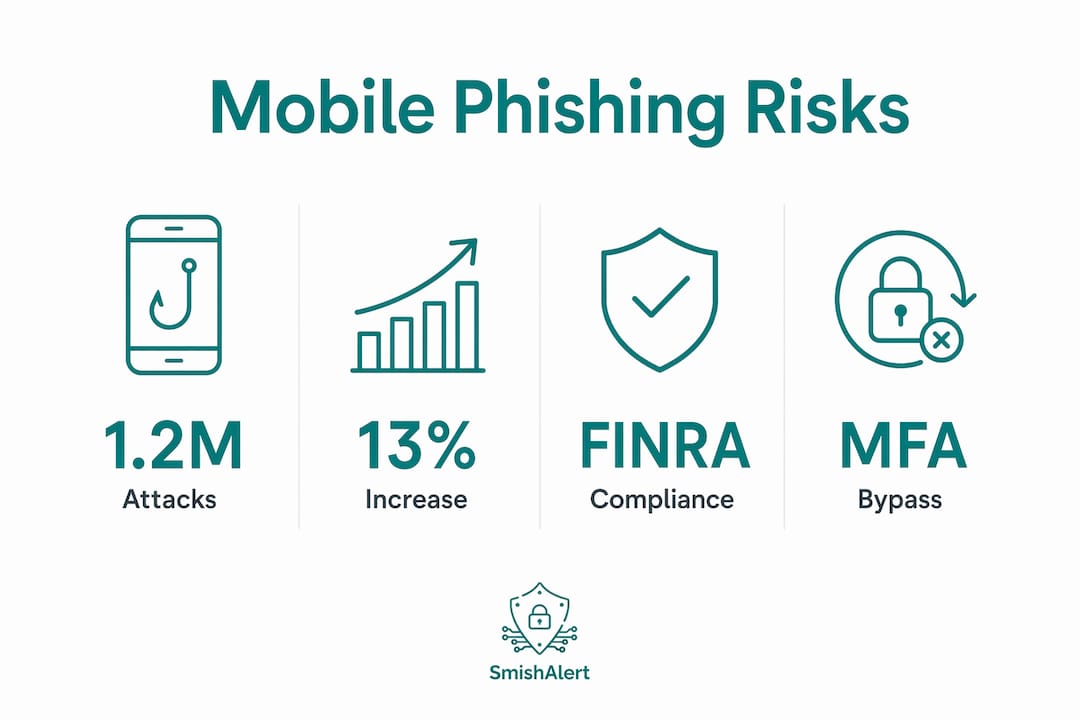
Over 1.2 million enterprise-focused mobile phishing attacks occurred across managed and unmanaged devices, with a 13% encounter rate. That means roughly one in eight enterprise devices encountered a mobile phishing attempt in a single reporting period.
The regulatory consequences are measurable. Mobile endpoints now account for 38% of violations in FINRA exams, up from 12% in 2020. That is a threefold increase in under six years. The driver is not a sudden surge in attacker sophistication alone. It reflects regulators catching up to the reality that mobile channels carry regulated communications.
| Year | Mobile violations in FINRA exams | Primary cause |
|---|---|---|
| 2020 | 12% of findings | Unarchived messaging |
| 2023 | ~25% of findings | MFA bypass, unarchived channels |
| 2026 | 38% of findings | SDK data flows, messaging gaps, credential theft |
“Compliance failures often stem from documentation and governance lapses rather than direct technical breaches, particularly around policies, app data flows, and communication archiving. Organizations fail audits not because they were breached, but because they cannot prove they were not.”
The distinction in that insight matters. A phishing attack that harvests credentials and is later remediated may never appear in a breach report. But the absence of logs, the missing archiving, and the undocumented SDK transmissions will appear in an audit finding. The compliance risk from mobile phishing is not only the attack itself. It is the governance void the attack exposes.
Why traditional compliance controls fall short against mobile phishing
Most compliance programs were built around perimeter security and device management. Mobile phishing operates in neither of those domains.
- MDM enforces device posture, not communication integrity. Encryption, screen lock, and remote wipe are device-level controls. They do not inspect or log the SMS message that delivered a credential-harvesting link. A fully MDM-compliant device can be the entry point for a successful phishing attack with no compliance record of the event.
- Compliance reports miss real-time attack vectors. Standard compliance dashboards aggregate device policy status. They do not surface phishing attempts in WhatsApp, iMessage, or QR code interactions. The report looks clean while the attack chain is active.
- SMS and push MFA are routinely bypassed. Phishing-resistant authentication using FIDO2 passkeys eliminates the credential-harvesting risk that SMS one-time passwords create. Organizations still relying on SMS MFA are operating with a known vulnerability that regulators and auditors increasingly flag.
- Compliance does not equal security on mobile. Device compliance and defense against phishing are distinct capabilities. An organization can pass a device compliance audit and remain fully exposed to credential theft through mobile messaging channels.
- Retrofit controls create audit blind spots. Adding compliance controls to existing mobile apps after deployment often misses regulated communication archiving and privileged access logging because the architecture was never designed to support them.
Pro Tip: Require phishing-resistant FIDO2 authentication for all identity provider access before your next compliance review. SMS-based MFA is a documented bypass vector that auditors now specifically examine.
Understanding why mobile endpoints are harder to protect requires accepting that the compliance gap is architectural, not operational. Patching MDM policies will not close it.
Governance and audit strategies to reduce mobile phishing exposure
Closing the compliance gap requires governance controls that address mobile communication channels directly, not just device posture.
- Document all mobile app data flows. Catalog every third-party SDK, its data transmission destinations, and whether those destinations comply with applicable data residency requirements. This documentation is the first line of defense in a GDPR or CCPA audit.
- Enforce mobile messaging policies aligned with privacy disclosures. If your client agreements or privacy notices state that communications are monitored and archived, your mobile messaging channels must reflect that. Inconsistency between policy and practice is a direct audit finding.
- Implement integrated archiving for all regulated channels. SMS, WhatsApp, iMessage, and any other messaging platform used for business communications requires the same archiving treatment as email. The NIST Cybersecurity Framework’s Protect function and CIS Mobile Security Benchmark both address communication integrity as a control requirement.
- Adopt phishing-resistant authentication and continuous access governance. FIDO2 passkeys, device trust signals, and identity analytics reduce the credential theft risk that mobile phishing creates. Continuous access governance means authentication is not a one-time gate but an ongoing verification of identity and device context.
- Build mobile phishing detection into incident response workflows. Incident response plans that address email phishing but not SMS or messaging app phishing leave a documented gap. Regulators examining incident response procedures will find it.
| Control category | Traditional approach | Mobile-aware approach |
|---|---|---|
| Communication archiving | Email gateway logging | Integrated archiving across SMS, WhatsApp, iMessage |
| Authentication | SMS OTP or push MFA | FIDO2 passkeys with device trust |
| Threat visibility | Endpoint detection and response | Mobile messaging telemetry and user reporting |
| Audit documentation | MDM compliance reports | App data flow maps, SDK inventories, communication logs |
Smishing protection best practices for enterprises go beyond device policy. They require treating mobile messaging as a regulated communication channel with the same governance obligations as email. Reviewing common employee cybersecurity vulnerabilities also helps compliance teams understand where human behavior intersects with mobile phishing risk.
How compliance and risk teams must evolve to address mobile phishing
The role of compliance teams is shifting from policy enforcement to active threat governance. Mobile phishing is the primary driver of that shift.
- Regulators now scrutinize mobile endpoint data transmission, messaging archiving, and privacy adherence as core audit areas, not edge cases.
- Security, legal, and compliance teams must coordinate on mobile compliance architecture from the design phase of any mobile application, not as a retrofit.
- Employee education on mobile phishing tactics, including executive impersonation via SMS and credential-harvesting QR codes, reduces the human factor that drives 62% of breaches.
- AI-driven detection at the identity layer is emerging as a compliance enabler. Systems that analyze behavioral signals across authentication events can surface credential compromise before it appears in access logs.
- Compliance teams that engage pre-development on mobile app architecture avoid the costly audit blind spots that retrofit controls create.
The mobile messaging policy decisions made today determine audit outcomes in the next regulatory cycle. Waiting for a finding to drive change is the most expensive approach available.
Key Takeaways
Mobile phishing is a compliance risk because it exploits unmonitored communication channels, bypasses MFA, and creates audit blind spots that regulators now actively examine.
| Point | Details |
|---|---|
| Mobile channels lack archiving | SMS and messaging apps used for business require the same retention controls as email under FINRA and SEC rules. |
| MDM does not cover phishing | Device compliance reports miss real-time phishing in messaging apps, creating a false sense of security. |
| Credential theft bypasses audit logs | Smishing attacks that harvest credentials grant persistent identity provider access with no endpoint log entry. |
| SDK data flows trigger audit findings | Undocumented third-party SDK transmissions violate GDPR and state privacy laws independent of any breach. |
| Governance must precede deployment | Mobile app compliance controls built in at design are far more effective than retrofit solutions applied after launch. |
The compliance gap nobody wants to admit
The hardest conversation I have with compliance professionals is about MDM. Every organization I encounter has MDM deployed. Every compliance officer points to it as evidence of mobile security governance. And almost none of them have visibility into what is actually happening in the SMS inbox or the WhatsApp thread on that MDM-enrolled device.
The uncomfortable truth is that device compliance and communication security are not the same thing. They never were. MDM was designed to manage hardware and enforce configuration policy. It was not designed to detect a credential-harvesting text message impersonating your CFO. Treating MDM coverage as mobile compliance coverage is the single most common mistake I see in regulated industries.
What I have found actually works is treating mobile phishing as an identity and governance problem, not a device problem. That means building archiving into messaging channels before regulators ask for it, mapping SDK data flows before an audit surfaces them, and deploying phishing-resistant authentication before a breach demonstrates why SMS MFA was insufficient. The organizations that get ahead of mobile phishing compliance risk are the ones that stopped waiting for a finding to tell them they had a gap.
— Sophie
Smishalert provides visibility where compliance gaps exist
Compliance teams need more than device posture reports to address mobile phishing risk. They need visibility into the messaging channels where attacks actually occur.
Smishalert captures and correlates social engineering attack data across SMS, iMessage, WhatsApp, and voice channels that MDM and email security tools cannot see. The platform integrates with existing governance workflows to close the archiving and monitoring gaps that produce audit findings. Security and compliance teams use Smishalert to generate reports aligned with regulatory requirements, track campaign patterns across the organization’s human attack surface, and detect credential-harvesting attempts before they result in identity provider compromise. Explore Smishalert’s detection and reporting platform or request a 30-day exposure assessment to understand your organization’s current mobile phishing compliance risk.
FAQ
What makes mobile phishing a regulatory compliance issue?
Mobile phishing compromises regulated communication channels that lack archiving and monitoring controls, creating audit failures under FINRA Rule 4511, GDPR, and HIPAA. The compliance risk is both the attack and the governance void it exposes.
Does MDM protect against mobile phishing?
MDM enforces device-level policies but does not monitor or log SMS, WhatsApp, or iMessage traffic where phishing is delivered. A fully MDM-compliant device can be successfully phished with no compliance record of the event.
How does mobile phishing bypass MFA?
Smishing attacks harvest credentials and session tokens in real time, allowing attackers to authenticate to enterprise identity providers before MFA challenges are completed. FIDO2 passkeys eliminate this vector; SMS-based MFA does not.
Which regulations specifically address mobile phishing risks?
FINRA Rule 4511, SEC Rule 17a-4, GDPR Article 32, and HIPAA Security Rule 164.312 each impose requirements on communication archiving, access governance, and audit controls that mobile phishing directly undermines.
How often do mobile phishing attacks result in compliance findings?
Mobile endpoints now account for 38% of violations in FINRA exams, up from 12% in 2020. Most findings stem from documentation and governance failures rather than confirmed breaches.