
Protect BYOD Devices from Smishing Attacks in 2026

Smishing, the industry term for SMS phishing, is the leading credential-harvesting vector targeting employees on personal devices enrolled in bring-your-own-device programs. The BYOD smishing vulnerability is structural: personal devices operate outside full corporate control, and attackers exploit that gap with precision. To protect BYOD devices from smishing attacks, IT teams need layered defenses that combine Mobile Threat Defense tools like IBM MaaS360, phishing-resistant authentication standards like FIDO2/WebAuthn, and structured user training. This article delivers the technical controls, policy frameworks, and architectural shifts that security teams need to close that gap in 2026.
What makes BYOD devices vulnerable to smishing attacks?
BYOD smishing risk is higher than on corporate-managed devices because the organization controls the application layer but not the device itself. Personal devices run unvetted apps, connect to unsecured Wi-Fi networks, and receive SMS messages that no corporate filter ever sees. That combination creates a wide attack surface with limited visibility for security teams.
Several specific factors amplify BYOD smishing vulnerability:
- No native SMS filtering. Corporate email gateways block malicious links in email, but SMS arrives unfiltered on personal devices. A credential-harvesting link sent via text bypasses every perimeter control the organization has deployed.
- User behavior gaps. Employees on personal devices are less likely to apply the same skepticism they use on corporate laptops. The informal nature of SMS lowers psychological defenses.
- SIM swap exposure. Attackers who successfully execute a smishing campaign can use harvested credentials to initiate SIM swap attacks, redirecting SMS-based one-time passwords to attacker-controlled SIMs. This turns a single smishing event into full account takeover.
- Inconsistent security posture. BYOD devices vary widely in OS version, patch level, and installed apps. That inconsistency makes uniform policy enforcement difficult and leaves gaps attackers actively probe.
CISA and NIST guidance updated in December 2024 expressly discourages SMS-based MFA precisely because of these interception and SIM swap risks. That guidance is not theoretical. It reflects observed attack patterns against organizations that assumed SMS OTP was sufficient protection.
Pro Tip: Run a device inventory audit before deploying any smishing defense. Knowing the OS versions and patch levels across your BYOD fleet tells you exactly where your weakest endpoints are.
What technical controls effectively protect mobile devices from smishing?
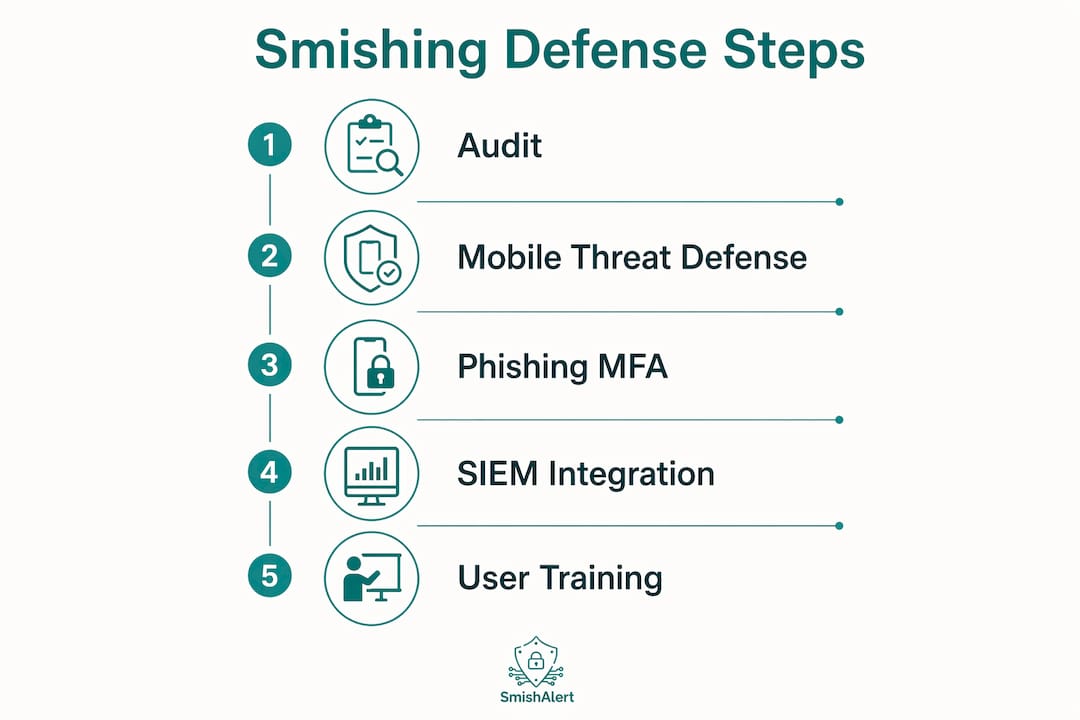
Effective smishing defense requires layered controls: phishing-resistant MFA, Mobile Threat Defense, Mobile Device Management enforcement, and SIEM integration. No single tool closes the full attack surface. The combination is what matters.

Mobile Threat Defense: detection at the messaging layer
Mobile Threat Defense (MTD) solutions operate at the layer where smishing actually occurs: the messaging inbox. IBM MaaS360 detects and flags phishing URLs in SMS and email on BYOD devices, alerting both users and administrators in real time using IBM X-Force Exchange threat intelligence. That real-time alert shortens the window between a user receiving a malicious link and a security team knowing about it. MTD deployed on BYOD devices detects smishing attempts at the messaging layer, complementing MDM and antivirus rather than replacing them.
Replacing SMS OTP with phishing-resistant MFA
SMS one-time passwords are not a secure second factor on BYOD devices. The GSA’s January 2026 mandate for phishing-resistant MFA now covers nonfederal systems handling controlled unclassified information, which means enterprises with government contracts face a compliance deadline, not just a best-practice recommendation. FIDO2/WebAuthn eliminates the SMS interception vector entirely because authentication is bound to the physical device and a cryptographic key, not a code delivered over an interceptable channel.
MDM, MAM, and SIEM integration
The table below compares the three primary technical control layers for BYOD smishing defense:
| Control layer | Primary function | Smishing-specific benefit |
|---|---|---|
| Mobile Threat Defense (MTD) | Real-time URL scanning in SMS and messaging apps | Blocks credential-harvesting links before the user clicks |
| Mobile Device Management (MDM) / Mobile Application Management (MAM) | Policy enforcement, app allowlisting, remote wipe | Limits which apps can receive corporate data; contains post-compromise blast radius |
| SIEM integration | Centralized log aggregation and alerting | Correlates smishing events with lateral movement or credential use anomalies |
SIEM integration is the control most often skipped in BYOD deployments, yet it is the one that catches post-compromise activity. When IBM MaaS360 flags a suspicious SMS and that alert feeds into a SIEM like Microsoft Sentinel or Splunk, the SOC can correlate it with a subsequent failed login attempt and respond before the attacker achieves lateral movement.
Pro Tip: Configure your MTD to forward flagged messages directly to your SOC ticketing system. Pairing messaging-layer detection with administrative workflows shortens incident triage from hours to minutes.
How to implement smishing awareness training for BYOD users
User education is not optional in a BYOD environment. Technical controls reduce risk, but a trained employee who recognizes a smishing attempt and reports it is faster than any automated detection system. The challenge is that most organizations deliver inconsistent training.
An NDSS study of 149 brands found that only 46% provide a clear definition of smishing, and only half offer instructions on how to report suspicious messages. That gap means employees improvise their response, which produces inconsistent outcomes and suppresses organizational reporting rates. Structured training eliminates that improvisation.
A practical BYOD smishing training program should follow this sequence:
- Define smishing precisely. Tell employees that smishing is an SMS-based phishing attack designed to harvest credentials, install malware, or redirect MFA codes. Vague definitions produce vague responses.
- Specify immediate actions. Instruct users to not click any link, not reply to the sender, and not call any number included in the message. Ambiguity here is where attackers win.
- Establish a clear reporting path. Provide a single reporting mechanism, whether that is a dedicated email address, a mobile app button, or a platform like SmishAlert, and make it frictionless. Structured training reduces user confusion and improves compliance in BYOD settings.
- Run smishing simulations. Extend your existing email phishing simulation program to include SMS. Platforms that support SMS simulation allow you to measure click rates on smishing lures and track improvement over time.
- Reinforce with scenario-specific examples. Show employees real smishing templates: fake IT helpdesk messages requesting credential resets, fake payroll alerts, and executive impersonation texts. Concrete examples build pattern recognition faster than abstract warnings.
Training should be refreshed at least quarterly. Attacker tactics evolve, and the smishing lures that employees learned to recognize six months ago may look nothing like current campaigns.
What advanced BYOD security models reduce smishing risk beyond device trust?
Traditional BYOD security assumes the device can be trusted if it passes an MDM compliance check. That assumption fails the moment a smishing attack compromises the device. The more resilient architectural model treats every BYOD endpoint as untrusted and confines corporate data to controlled environments.
Canonical advocates for remote app streaming and ephemeral sessions as the structural answer to BYOD data exposure. In this model, applications and data reside in a controlled cloud environment. The BYOD device renders a stream but never stores corporate data locally. If a smishing attack compromises the device, there is nothing to extract. Canonical’s ephemeral session model means that even a fully compromised BYOD device yields no corporate data to the attacker.
The table below shows how this architectural shift changes the risk profile:
| Security dimension | Traditional BYOD model | Ephemeral/remote streaming model |
|---|---|---|
| Local data storage | Corporate data cached on device | No local corporate data |
| Post-compromise exposure | High: files, tokens, and credentials accessible | Minimal: session terminates, no residual data |
| Audit trail | Partial, dependent on MDM logs | Centralized, complete session logs |
| Smishing impact after compromise | Credential theft enables lateral movement | Session revocation contains the incident |
This model also simplifies compliance. Audit trails are centralized rather than distributed across thousands of personal devices. Access revocation is immediate and does not depend on the device being reachable for a remote wipe command. For organizations managing a large mobile workforce, the operational reduction in incident response complexity is significant. You can learn more about protecting BYOD without MDM in environments where full device management is not feasible.
Key takeaways
Protecting BYOD devices from smishing attacks requires combining Mobile Threat Defense, phishing-resistant MFA, structured user training, and an architectural shift toward minimal local data exposure.
| Point | Details |
|---|---|
| Replace SMS OTP immediately | CISA and NIST both recommend FIDO2/WebAuthn over SMS MFA to eliminate SIM swap and interception risk. |
| Deploy MTD on every BYOD device | IBM MaaS360 and similar MTD solutions detect malicious URLs in SMS before users click them. |
| Standardize smishing training | Training must define smishing, specify immediate actions, and provide a single reporting path. |
| Architect for zero local data | Ephemeral session models ensure a compromised BYOD device yields no extractable corporate data. |
| Integrate alerts with SIEM | Feeding MTD alerts into Splunk or Microsoft Sentinel enables SOC correlation and faster response. |
Why the BYOD smishing threat demands a harder look at your assumptions
The organizations I see struggling most with BYOD smishing are not the ones that lack tools. They are the ones that deployed MDM, checked the compliance box, and assumed the problem was solved. MDM tells you whether a device has a screen lock and an up-to-date OS. It tells you nothing about the smishing message that arrived at 7 PM on a Friday and prompted an employee to enter their credentials into a convincing fake portal.
The uncomfortable reality is that SMS is a trust channel that attackers have learned to exploit precisely because organizations have not treated it with the same rigor as email. Email security has decades of investment behind it: SPF, DKIM, DMARC, gateway filtering, user training, simulation platforms. SMS has almost none of that infrastructure at the organizational level. That asymmetry is what makes smishing so effective against BYOD fleets in 2026.
Moving away from SMS OTP is the single highest-impact change most organizations can make today. It does not require a new architecture or a large budget. It requires replacing one authentication method with another. FIDO2/WebAuthn hardware keys or passkeys on managed apps eliminate the interception vector entirely. The GSA mandate makes this a compliance requirement for many organizations, but it should be a security priority regardless of regulatory obligation.
The ephemeral session model is where I think the field is heading over the next three years. Treating every BYOD device as a rendering terminal rather than a data store is the logical endpoint of zero-trust architecture applied to mobile. It is not yet mainstream, but the organizations piloting it are reporting meaningful reductions in post-compromise incident scope. That is a signal worth paying attention to.
For real-world context on how smishing campaigns have led to data breaches, the lessons from recent data leaks are instructive reading for any security team building a BYOD defense program.
— Sophie
How SmishAlert helps you secure BYOD against smishing
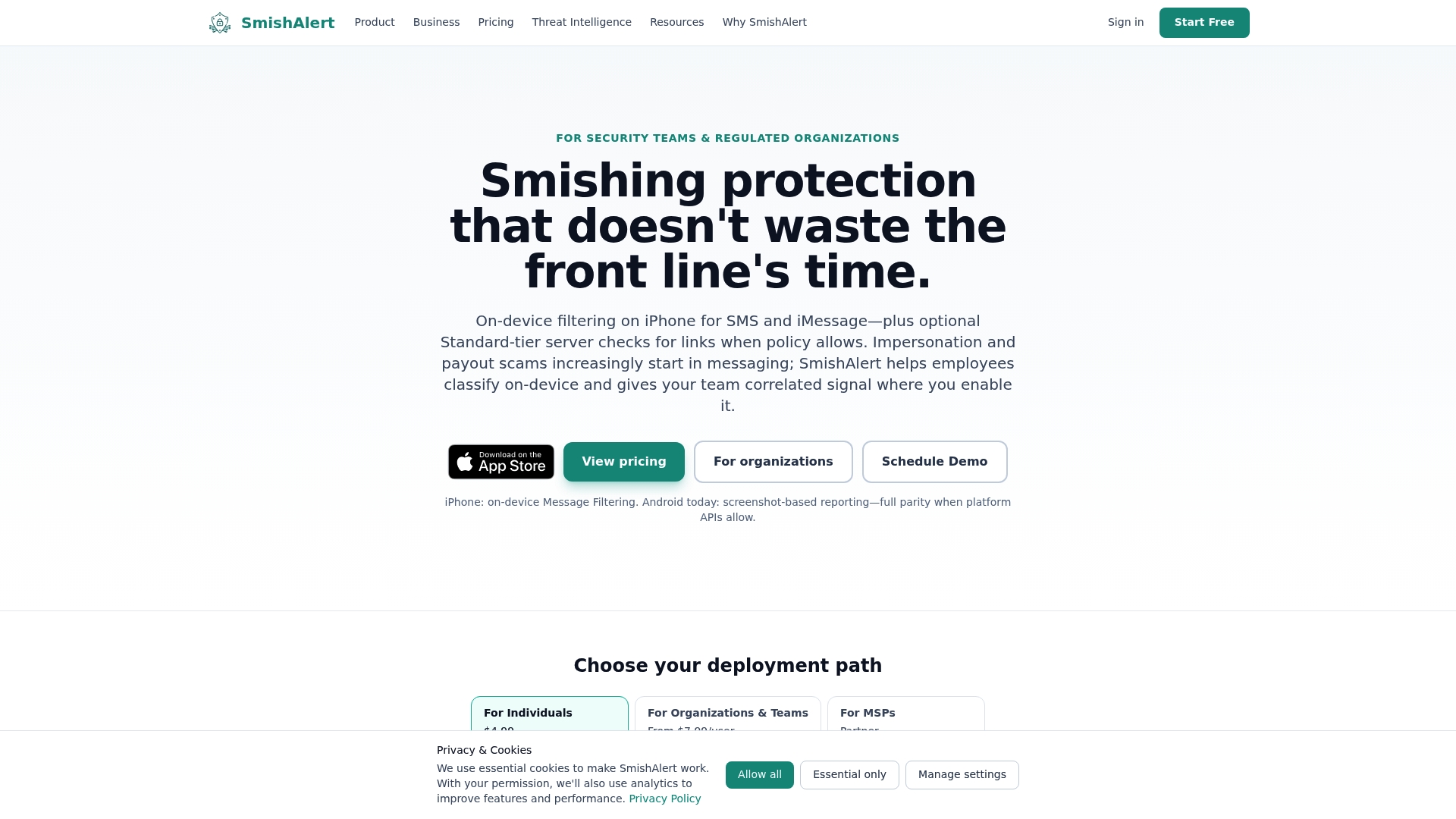
SmishAlert gives security teams the visibility into messaging-based threats that traditional endpoint tools miss entirely. Across SMS, iMessage, WhatsApp, and other messaging channels, SmishAlert detects executive impersonation, credential-harvesting campaigns, payroll fraud attempts, and mobile phishing attacks targeting your BYOD workforce. Unlike MDM platforms, SmishAlert operates outside the device management layer, which means deployment does not require full device enrollment and works in environments where employees resist intrusive controls. Threat analysis, campaign correlation, and user reporting feed directly into your existing security workflows. If your organization is evaluating smishing defense options for 2026, see SmishAlert at RSA Conference or explore the full SmishAlert product capabilities to understand how it fits your BYOD security architecture.
FAQ
What is smishing and why does it target BYOD devices?
Smishing is SMS-based phishing designed to harvest credentials, redirect MFA codes, or install malware. BYOD devices are targeted because they receive SMS outside corporate filtering infrastructure, giving attackers a direct channel to employees.
Why is SMS-based MFA unsafe on BYOD devices?
SMS OTP is vulnerable to SIM swap attacks and interception, both of which are enabled by successful smishing. CISA and NIST updated guidance in December 2024 expressly recommends replacing SMS MFA with FIDO2/WebAuthn.
What is Mobile Threat Defense and how does it help?
Mobile Threat Defense (MTD) scans SMS and messaging apps for malicious URLs in real time. Solutions like IBM MaaS360 alert users and administrators immediately when a smishing link is detected, enabling rapid triage before a user clicks.
How should employees report smishing on personal devices?
Training should provide a single, frictionless reporting path, such as a dedicated reporting button or platform. An NDSS study found only half of analyzed brands give users clear reporting instructions, which means most employees have no defined process to follow.
Can a BYOD device be secured without full MDM enrollment?
Yes. Mobile Threat Defense and smishing detection platforms like SmishAlert can operate without full device management enrollment. Ephemeral session architectures also reduce risk by eliminating local data storage, removing the primary target of a post-compromise attack.