
Security Budget Checklist for Mobile Threats in 2026

A mobile threat defense (MTD) strategy paired with enhanced logging is the most cost-effective foundation any enterprise can build for a security budget checklist for mobile threats. Mobile devices now represent the highest-probability attack surface for credential theft, smishing, and spyware deployment, yet most organizations still allocate the majority of their cybersecurity budget toward email and perimeter controls. Frameworks like OWASP MASVS and NIST SP 800-70 provide the structural scaffolding to convert vague mobile security goals into funded, testable controls. This checklist addresses each critical investment category in priority order, with procurement guidance and rationale grounded in current threat data.
1. Fund Mobile Threat Defense and enhanced logging first
The MTD plus logging combination addresses the highest-probability failure modes in enterprise mobile environments: malicious app installation, network-based phishing, jailbreak and root detection, and post-exploitation lateral movement. No other single investment covers that range of attack vectors with active containment capability. This is where your mobile security budget must start, not end.
MTD platforms detect threats at the device, network, and application layers. When integrated with an MDM or UEM platform such as Microsoft Intune or Jamf Pro, they can quarantine compromised devices, block risky certificates, and revoke access automatically. An MTD solution limited to alerting dashboards without policy action integration reduces your investment to a reporting tool. Require vendors to demonstrate active MDM/UEM containment during procurement evaluation.

Logging is the second pillar and the one most frequently underfunded. Device and identity logs become critical after mobile spyware outbreaks, providing evidence, shortening investigations, and proving attack scope. Enhanced logging often delivers better value per dollar than broad awareness training because it reduces uncertainty at exactly the moment when uncertainty is most expensive.
Pro Tip: When evaluating MTD vendors, ask specifically whether their platform triggers policy actions in your existing MDM or UEM. A vendor that only sends alerts without enforcement integration will not reduce incident dwell time.
Logging is not a passive investment. After a spyware incident, it is the difference between a two-hour investigation and a two-week one.
2. Map OWASP MASVS to your app security testing budget
OWASP MASVS defines two verification levels that directly inform budget allocation: L1 covers baseline security hygiene applicable to all mobile apps, while L2 addresses defense in depth for apps handling sensitive data or privileged access. Mapping your app portfolio to these levels tells you exactly how much testing capacity to fund per application.
The categories that produce the most severe findings in real-world pentests are authentication and storage. Authentication weaknesses allow credential theft and session hijacking. Storage vulnerabilities expose sensitive data written to unencrypted local files or accessible via backup channels. Budget analyst time toward these two categories before expanding to lower-severity control families.
A well-calibrated testing program requires approximately 350 analyst hours annually per application, distributed across static analysis, dynamic analysis, and quarterly penetration tests. Static analysis runs should complete in 8 to 10 minutes per build. Nightly dynamic analysis takes 2 to 4 hours. Quarterly pentests consume roughly 60 analyst hours per app. These figures give you a concrete basis for capacity planning.
| Testing method | Frequency | Estimated time per app |
|---|---|---|
| Static analysis | Per build | 8 to 10 minutes |
| Dynamic analysis | Nightly | 2 to 4 hours |
| Penetration testing | Quarterly | 60 analyst hours |
| Full annual total | Annual | ~350 analyst hours |
Pro Tip: Use OWASP MASVS L1 as your baseline for all apps and reserve L2 testing budgets for apps that handle regulated data, executive credentials, or privileged system access.
3. Replace SMS MFA and budget for phishing-resistant authentication
SMS-based multi-factor authentication is not phishing-resistant. NIST SP 800-63 and CISA explicitly discourage its use, and CISA’s December 2024 Mobile Communications Best Practice Guidance reinforces that position. Any enterprise still relying on SMS OTPs for privileged access is operating with a known, documented vulnerability in its authentication chain.
The migration path is well-defined. FIDO2 and WebAuthn hardware tokens, platform authenticators such as Apple Passkeys and Google Passkeys, and biometric MFA all provide phishing-resistant alternatives that eliminate the SMS interception risk. Budget for both the technology and the help desk capacity required to manage enrollment, recovery, and exception handling.
Help desk identity verification is a frequently overlooked budget line. Smishing campaigns often target help desk staff directly, using social engineering to reset MFA for high-value accounts. Hardening help desk verification procedures, including video confirmation or manager approval workflows for MFA resets, closes a gap that technical controls alone cannot address. For more on SMS phishing detection across messaging channels, enterprise teams need visibility beyond what traditional email security provides.
4. Build a smishing-specific defense layer into the budget
Smishing defense requires layered controls beyond training: phishing-resistant MFA, MTD-based URL blocking in SMS, simulation training, help desk hardening, and SIEM integration. Each layer addresses a different point in the attack chain. Funding only one or two of these controls leaves exploitable gaps.
The specific budget line items for a smishing-focused mobile threat assessment checklist include:
- MTD URL blocking: Configure your MTD platform to analyze and block malicious URLs delivered via SMS, iMessage, and third-party messaging apps. This is the technical control that stops credential-harvesting links before the user clicks.
- Simulated smishing training: Extend your existing email phishing simulation program to include SMS-based scenarios. Vendors such as KnowBe4 and Proofpoint offer smishing simulation modules that integrate with existing awareness platforms.
- SIEM integration: Feed MTD telemetry and mobile device logs into your SIEM, whether that is Microsoft Sentinel, Splunk, or IBM QRadar. Unified incident detection across email, endpoint, and mobile channels reduces the time from initial alert to containment.
- Behavioral analytics: Post-compromise behavioral analytics detect lateral movement regardless of the initial access vector. Budget for this capability as part of your SOC workflow, not as a standalone mobile tool.
Pro Tip: Smishing simulations are most effective when they mirror real campaigns targeting your industry. Work with your simulation vendor to customize scenarios based on current threat intelligence rather than using generic templates.
For context on how modern attacks escalate from a single smishing message to full credential theft, the progression is faster than most security teams anticipate.
5. Use NIST SP 800-70 checklists to govern configuration spending
NIST SP 800-70 Rev. 5 defines how to use security configuration checklists from the National Checklist Repository to minimize vulnerabilities and reduce attack surfaces across IT products. For enterprise mobile security, this means selecting pre-validated configuration baselines for iOS, Android, and mobile application platforms rather than building bespoke policies from scratch.
The governance benefit is significant. Reusable NIST checklists eliminate the cost of repeated internal policy development and provide audit-ready documentation that maps directly to compliance frameworks including FedRAMP, CMMC, and HIPAA. Security teams that treat these checklists as authoritative starting points rather than optional references reduce both their configuration variance and their audit preparation time.
Automation amplifies this efficiency. MDM platforms can enforce NIST-aligned configuration baselines at scale, generating evidence-ready compliance reports without manual analyst effort. Budget for the integration work required to connect your MDM configuration management to your GRC platform. That integration pays for itself in reduced audit labor within the first compliance cycle.
| Approach | Cost driver | Governance outcome |
|---|---|---|
| Bespoke internal policy | High analyst hours, high variance | Inconsistent, hard to audit |
| NIST checklist adoption | Low development cost, reusable | Standardized, audit-ready |
| Automated MDM enforcement | Integration cost, low ongoing effort | Scalable, evidence-ready |
Pro Tip: Start with the NIST National Checklist Repository entries for iOS and Android before evaluating third-party configuration tools. The NIST baselines are free, authoritative, and accepted by most compliance auditors.
6. Tailor budget priorities to your incident scenario and risk profile
A mobile security budget checklist is not a static document. The right allocation depends on where your organization sits in its incident lifecycle and what your regulatory exposure looks like. Three distinct scenarios require different budget emphasis.
Scenario 1: Policy gaps on lower-risk devices. If your MDM audit reveals configuration drift or missing policy enforcement on standard employee devices, prioritize MDM upgrades and configuration baseline remediation before adding new tool categories. Fixing what you have is more cost-effective than adding layers on top of a misconfigured foundation.
Scenario 2: Active compromise or unclear blast radius. When a mobile spyware incident is underway or recently contained, shift budget immediately to MTD deployment and logging infrastructure. The post-incident logging investment is what determines whether you can prove the scope of compromise to regulators, legal counsel, and leadership. Without it, you are estimating.
Scenario 3: Regulated data or privileged user populations. Organizations handling HIPAA-covered data, financial records, or government-classified information must fund compliance tooling alongside technical controls. This includes mobile-aware DLP, IAM integration for device-based conditional access, and audit logging that meets retention requirements. Budget for phased investments if full deployment is not feasible in a single cycle.
The common thread across all three scenarios is that operational capacity must match the controls you fund. Buying an MTD platform without the analyst hours to triage its alerts produces the same outcome as not buying it at all. Deploying mobile phishing protection without MDM integration is a real constraint many enterprises face, and it requires a different budget approach than a fully managed environment.
Key takeaways
A mobile threat defense platform integrated with enhanced logging is the single highest-return investment in any enterprise mobile security budget, because it provides both active containment and forensic visibility across the full attack chain.
| Point | Details |
|---|---|
| Fund MTD and logging first | These two controls address the widest range of mobile attack vectors with active containment and investigation support. |
| Use OWASP MASVS for app testing | Map L1 and L2 verification levels to app criticality to allocate analyst hours where findings are most severe. |
| Replace SMS MFA now | NIST and CISA both discourage SMS OTPs; migrate to FIDO2, WebAuthn, or biometric alternatives. |
| Layer smishing defenses | URL blocking, simulation training, SIEM integration, and help desk hardening each address different points in the attack chain. |
| Adopt NIST checklists for governance | Reusable NIST SP 800-70 baselines reduce policy development cost and produce audit-ready compliance documentation. |
Where most mobile security budgets actually go wrong
Having reviewed mobile security budget proposals across organizations of varying sizes and regulatory contexts, one pattern stands out consistently: the money goes to visibility tools while logging and containment get deferred. Security teams buy dashboards. They buy training platforms. They buy threat intelligence feeds. Then a spyware incident hits, and the first question from legal is “what did the attacker access?” The answer is often “we don’t know,” because logging was never funded.
The second mistake is treating smishing as a training problem. Awareness training has real value, but it cannot substitute for phishing-resistant MFA and MTD-based URL blocking. A well-crafted smishing message will fool a percentage of your workforce regardless of how many simulations you run. The technical controls exist to catch what training misses. Budgeting for training without budgeting for those controls is a documented gap that regulators and auditors will find.
OWASP MASVS and NIST SP 800-70 are genuinely useful frameworks, but only when treated as operational tools rather than compliance checkboxes. The organizations that get the most value from them are the ones that map controls to specific apps and risk profiles, automate enforcement through MDM, and use the resulting documentation in budget conversations with leadership. Frameworks justify spending when they connect technical controls to measurable risk reduction. That connection is what makes a budget conversation winnable.
The advice to avoid overbuying holds here too. MTD platforms often include features well beyond what most enterprises need in year one. Prioritize the attack chain: detection, containment, logging, and authentication hardening. Add behavioral analytics and advanced threat intelligence once the foundation is solid.
— Sophie
How SmishAlert fits into your mobile threat defense stack
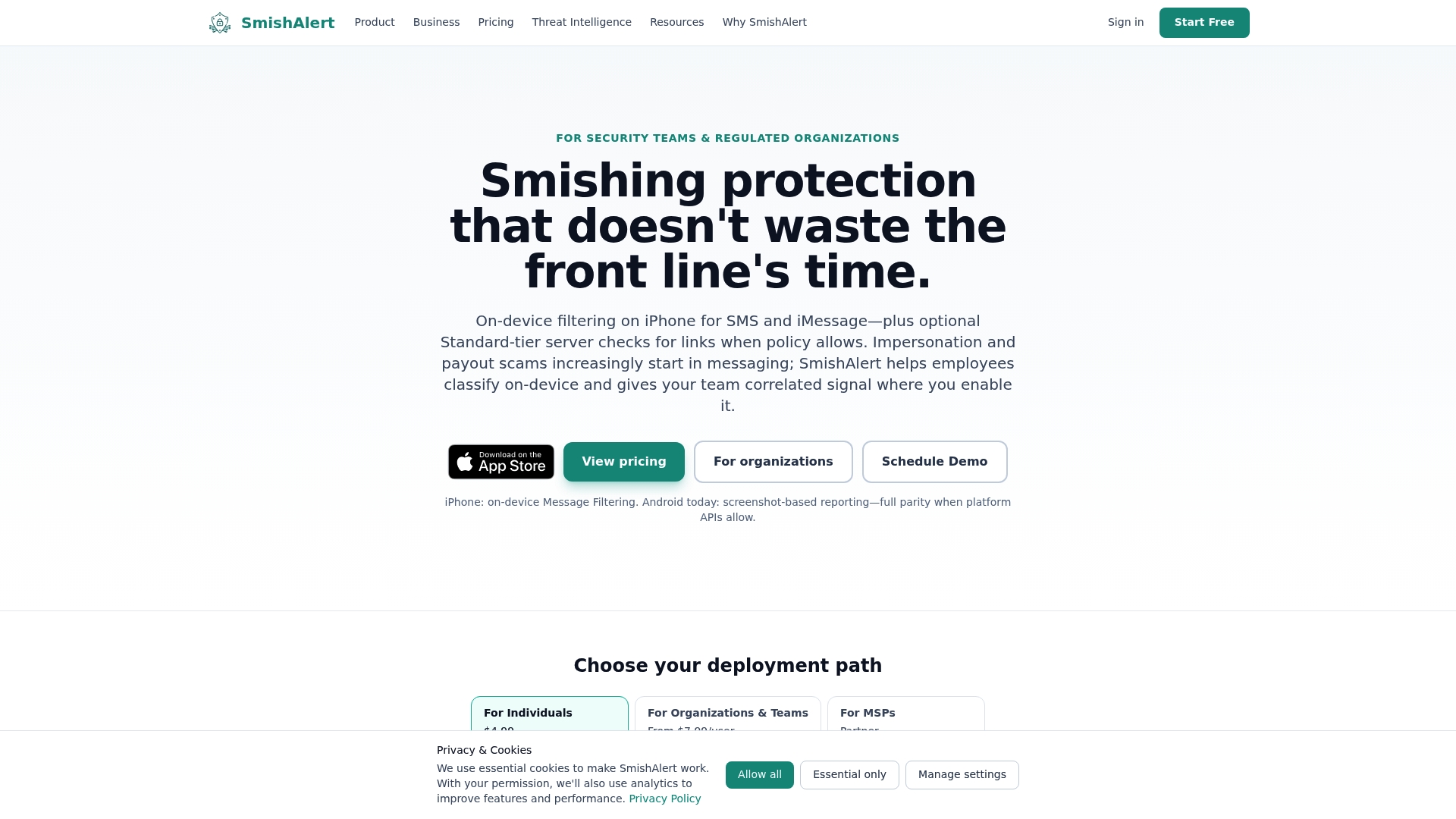
SmishAlert gives enterprise security teams the messaging-specific visibility that traditional MTD platforms and email security tools miss. The platform detects smishing, impersonation, and social engineering attacks delivered through SMS, iMessage, and other messaging channels in real time, feeding user-reported threats into a correlated analysis engine that identifies broader campaigns as they develop. For SOC teams integrating mobile phishing detection into unified workflows, SmishAlert provides the telemetry layer that connects messaging threats to your existing SIEM and incident response processes. It complements your MTD investment rather than replacing it, covering the messaging attack surface that endpoint-focused tools leave unmonitored. Enterprise teams evaluating their smishing defense options can explore how SmishAlert maps to the budget checklist priorities covered in this article.
FAQ
What should be the first line item in a mobile security budget?
Mobile Threat Defense paired with enhanced logging is the highest-priority investment. MTD addresses malicious apps, phishing, and jailbreak detection, while logging provides the forensic visibility needed to scope and contain incidents after they occur.
Is SMS-based MFA still acceptable for enterprise use?
No. NIST SP 800-63 and CISA’s December 2024 guidance both explicitly discourage SMS-based MFA because it is not phishing-resistant. Enterprises should migrate to FIDO2, WebAuthn, or biometric authentication for all privileged access.
How many analyst hours should we budget for mobile app security testing?
A well-calibrated program requires approximately 350 analyst hours annually per application, covering static analysis per build, nightly dynamic analysis, and quarterly penetration tests of roughly 60 hours each.
How do NIST checklists reduce mobile security budget waste?
NIST SP 800-70 checklists provide pre-validated configuration baselines that eliminate the cost of building bespoke policies internally. They also generate audit-ready documentation that reduces compliance labor across frameworks like FedRAMP and HIPAA.
Why is smishing treated separately from general mobile phishing in budget planning?
Smishing exploits SMS and messaging channels that traditional email security tools do not monitor. Defending against it requires specific controls including MTD URL blocking, phishing-resistant MFA, and SIEM integration, each of which represents a distinct budget line item beyond standard mobile device security measures.