
Smishing Protection Best Practices for Enterprises

Smishing protection is defined as a multi-layered defense strategy combining phishing-resistant authentication, mobile threat defense, dedicated reporting channels, and smishing-specific training to prevent SMS-based social engineering from resulting in credential theft, lateral movement, or data breach. Security teams that treat smishing as a distinct threat category, separate from email phishing, consistently outperform those that bolt SMS onto existing email security programs. A defense-in-depth approach integrating technical controls, user education, and operational incident response represents the current industry standard for smishing risk management frameworks. CISA, NIST, and Vectra AI all reinforce this layered model as the foundation for enterprise smishing defense programs in 2026.
1. Smishing protection offering best practices: the layered defense model
The core principle behind effective smishing protection is that no single control is sufficient. Phishing-resistant MFA, mobile threat defense, smishing simulation, and SOC-integrated alerting must operate together to address the full attack lifecycle. Each layer compensates for the blind spots of the others. An organization that deploys Mobile Threat Defense (MTD) but skips simulation training will still see employees click malicious links on unmanaged devices. One that trains employees but relies on SMS OTP for authentication remains vulnerable to SIM swap and adversary-in-the-middle (AiTM) attacks.
The layered model maps directly to the smishing kill chain: initial delivery via SMS, user interaction with a malicious link or payload, credential harvesting or malware installation, and finally lateral movement within the enterprise environment. Smishing risk management frameworks built around this kill chain allow security teams to measure exposure at each stage and prioritize controls accordingly.

2. Why phishing-resistant MFA is the non-negotiable foundation
SMS-based MFA one-time passwords are vulnerable to SIM swap attacks, SS7 interception, and AiTM proxy toolkits such as Evilginx2. This is not a theoretical risk. Enterprise guidance in 2026 positions phishing-resistant authentication as the mandatory replacement for SMS OTP on any high-risk or privileged account. The implication is direct: if your organization still uses SMS OTP as a second factor for VPN, email, or identity provider access, smishing is a viable path to full account takeover.
FIDO2 hardware keys and passkeys eliminate the credential relay problem entirely because the cryptographic response is bound to the legitimate origin domain. U.S. government standards under NIST SP 800-63 mandate phishing-resistant MFA for sensitive systems, and enterprises with high-risk accounts are following suit. The migration path is staged:
- Inventory all authentication methods across identity providers, VPN, SaaS, and privileged access management systems.
- Classify accounts by risk tier: privileged, high-value, and standard.
- Deploy FIDO2 hardware keys (YubiKey, Google Titan) or platform passkeys for the top two tiers first.
- Replace SMS OTP with authenticator app TOTP as an interim step for lower-risk accounts while hardware rollout continues.
- Enforce phishing-resistant methods via Conditional Access policies in Microsoft Entra ID or Okta.
Pro Tip: When migrating away from SMS OTP, disable SMS fallback options in your identity provider before declaring the migration complete. Attackers specifically target fallback paths that security teams forget to close.
3. How Mobile Threat Defense complements smishing protection
Mobile Threat Defense solutions detect and block malicious SMS links in real time, reducing the window between delivery and compromise. MTD is recommended for enterprise devices as a core layer of multi-stage smishing prevention, precisely because it operates independently of user judgment. When an employee receives a credential-harvesting link and taps it, MTD can intercept the connection before the page loads.
Key MTD capabilities relevant to smishing defense include URL reputation scanning against threat intelligence feeds, behavioral analytics that flag anomalous app activity post-click, and network traffic inspection for command-and-control callbacks. Integration with Mobile Device Management platforms such as Microsoft Intune, Jamf, or VMware Workspace ONE allows security teams to enforce MTD compliance as a condition of device enrollment. Non-compliant devices can be quarantined automatically, limiting blast radius if a smishing payload executes.
MTD coverage has real limits. It does not protect personal devices used for work under BYOD policies unless the agent is installed and maintained. It also does not address the social engineering component: an employee who calls back a spoofed number after receiving a smishing message bypasses every technical control. For mobile phishing protection without MDM, organizations need reporting-based approaches that capture threat signals from unmanaged endpoints.
4. Smishing-specific employee awareness and simulation training
Smishing click rates are 4 to 7 times higher than email phishing in reported comparisons. That gap exists because employees apply email skepticism habits to their inboxes but treat SMS as a trusted channel. Dedicated smishing simulation training corrects this by exposing employees to realistic attack scenarios on the channel where they are most vulnerable.
Effective smishing awareness programs follow a structured approach:
- Baseline simulation: Send a realistic smishing message to all staff, mimicking common attack themes such as payroll updates, IT helpdesk alerts, or package delivery notifications. Measure click rate and credential submission rate.
- Targeted training delivery: Route employees who clicked or submitted credentials to a short, scenario-specific training module immediately after the simulation.
- Behavioral signal training: Teach employees to recognize urgency, unexpected requests, and authority impersonation as red flags, not just grammar errors. Sophisticated smishing messages are grammatically clean.
- Policy reinforcement: Communicate a clear written rule that no legitimate representative will request MFA codes via SMS. This single policy, repeated consistently, eliminates a major class of social engineering success.
- Post-incident updates: After any real smishing incident, update training content to reflect the specific lures used. Real examples from your own organization are far more effective than generic scenarios.
Pro Tip: Run smishing simulations on a recurring schedule, not just annually. Threat actors rotate lures seasonally around tax season, open enrollment, and major corporate events. Your training cadence should match their campaign cadence.
5. Establishing low-friction reporting and incident response workflows
Publishing clear, simple reporting channels and documenting incident response chains before incidents occur dramatically improves containment speed. The reporting path must be so obvious that an employee under stress can execute it in under 30 seconds. Complexity kills reporting rates.
Recommended reporting infrastructure includes a dedicated internal SMS number or email alias for forwarding suspicious messages, a one-tap reporting button within your mobile security app if deployed, and a visible intranet page with step-by-step instructions. Externally, forwarding suspicious texts to 7726 (SPAM) and filing complaints with the FTC creates carrier-level blocking feedback loops that benefit the broader ecosystem.
The incident response workflow triggered by a smishing report should follow this sequence:
| Stage | Action |
|---|---|
| Triage | SOC analyst reviews forwarded message, classifies threat type, and identifies targeted accounts. |
| Containment | Credential reset and MFA revocation for any accounts that interacted with the lure. |
| Scope assessment | Correlate with SIEM telemetry to identify lateral movement or additional compromised endpoints. |
| Help desk hardening | Temporarily elevate identity verification requirements for password resets to prevent social engineering of the help desk. |
| Reporting | File with FTC, IC3, and relevant carrier spam channels; document for internal post-incident review. |
Help desk social engineering is a major exploitation vector post-smishing. Identity lifecycle management procedures must require multi-factor identity verification for any account recovery request that follows a reported smishing event in the same time window.
6. Comparing top smishing protection solutions for enterprises
Top smishing defense platforms offer simulation, device threat detection, reporting workflows, and SOC visibility integrations. Selecting the right combination depends on your existing security stack, device management posture, and whether you need to cover managed devices only or extend to BYOD and third-party contractors.
The primary categories of smishing protection tools are:
- Smishing simulation platforms: These deliver controlled SMS phishing campaigns to employees, measure behavioral outcomes, and feed results into learning management systems. They are the SMS equivalent of KnowBe4 or Proofpoint Security Awareness Training but purpose-built for mobile channels.
- Mobile Threat Defense vendors: Lookout, Zimperium, and Microsoft Defender for Endpoint (mobile) provide on-device URL scanning, malware detection, and network anomaly detection. Selection criteria include iOS and Android parity, MDM integration depth, and threat intelligence feed quality.
- Reporting and visibility platforms: Tools that aggregate employee-reported smishing attempts, correlate campaigns across the organization, and surface threat intelligence to the SOC. This category addresses the gap that MTD and simulation platforms leave: visibility into real-world attacks targeting your specific organization.
- SIEM and SOAR integrations: Any smishing defense tool that cannot push structured alerts into Splunk, Microsoft Sentinel, or IBM QRadar creates a visibility silo. Prioritize vendors with documented API integrations or native connectors.
Budget considerations are real. MTD licensing for a 5,000-seat enterprise can run $15 to $30 per device annually. Simulation platforms typically add $10 to $20 per user per year. Organizations with constrained budgets should prioritize phishing-resistant MFA migration first, as it delivers the highest risk reduction per dollar spent, followed by reporting infrastructure, which is largely a process investment rather than a software cost.
Key takeaways
Effective smishing defense requires phishing-resistant MFA, mobile threat defense, dedicated simulation training, and hardened incident response workflows operating as a unified program, not independent controls.
| Point | Details |
|---|---|
| Replace SMS OTP immediately | Migrate privileged and high-value accounts to FIDO2 hardware keys or passkeys to eliminate AiTM and SIM swap risk. |
| Deploy MTD with MDM integration | Mobile Threat Defense blocks malicious URLs in real time but requires MDM enforcement to cover managed device fleets. |
| Run recurring smishing simulations | Smishing click rates are 4 to 7 times higher than email phishing; training must match attacker campaign cadence. |
| Build low-friction reporting paths | Simple reporting channels reduce dwell time; integrate with SOC triage and automate credential reset workflows. |
| Harden help desk identity verification | Post-smishing help desk social engineering is a primary escalation path; elevate identity checks after any reported incident. |
Why most enterprise smishing programs fail before they start
I have reviewed smishing defense programs across financial services, healthcare, and technology organizations, and the failure pattern is almost always the same. Organizations treat smishing as an extension of their email phishing program and assign it to the same team with the same tools and the same annual training cycle. That approach misses the fundamental difference: SMS is a trusted channel with no equivalent of a spam folder, no sender reputation system, and no organizational perimeter to enforce policy at.
The second consistent failure is SMS OTP retention. Security teams know it is a weak factor. They have read the CISA advisories. But migrating MFA methods is operationally painful, and the risk feels abstract until an incident occurs. By then, the attacker has already used the compromised account to move laterally, and the smishing message is a footnote in the incident report rather than the root cause that gets fixed.
What actually works is treating every reported smishing attempt as the first signal in the human layer of a potential kill chain. That framing changes the organizational response from “warn the user” to “initiate triage, check for credential use, and assess lateral movement.” It also forces the help desk hardening conversation that most security teams avoid because it creates friction for legitimate users.
The emerging threat worth watching is AI-generated smishing at scale. Attackers are already using large language models to generate contextually accurate, grammatically clean messages personalized with data from prior breaches. The behavioral signals that training programs teach employees to recognize, urgency and unexpected requests, remain valid. But the grammar-based heuristics that older training relied on are now obsolete. Simulation content needs to reflect this shift, and it needs to happen now, not at the next annual review cycle.
— Sophie
How SmishAlert strengthens your smishing defense program
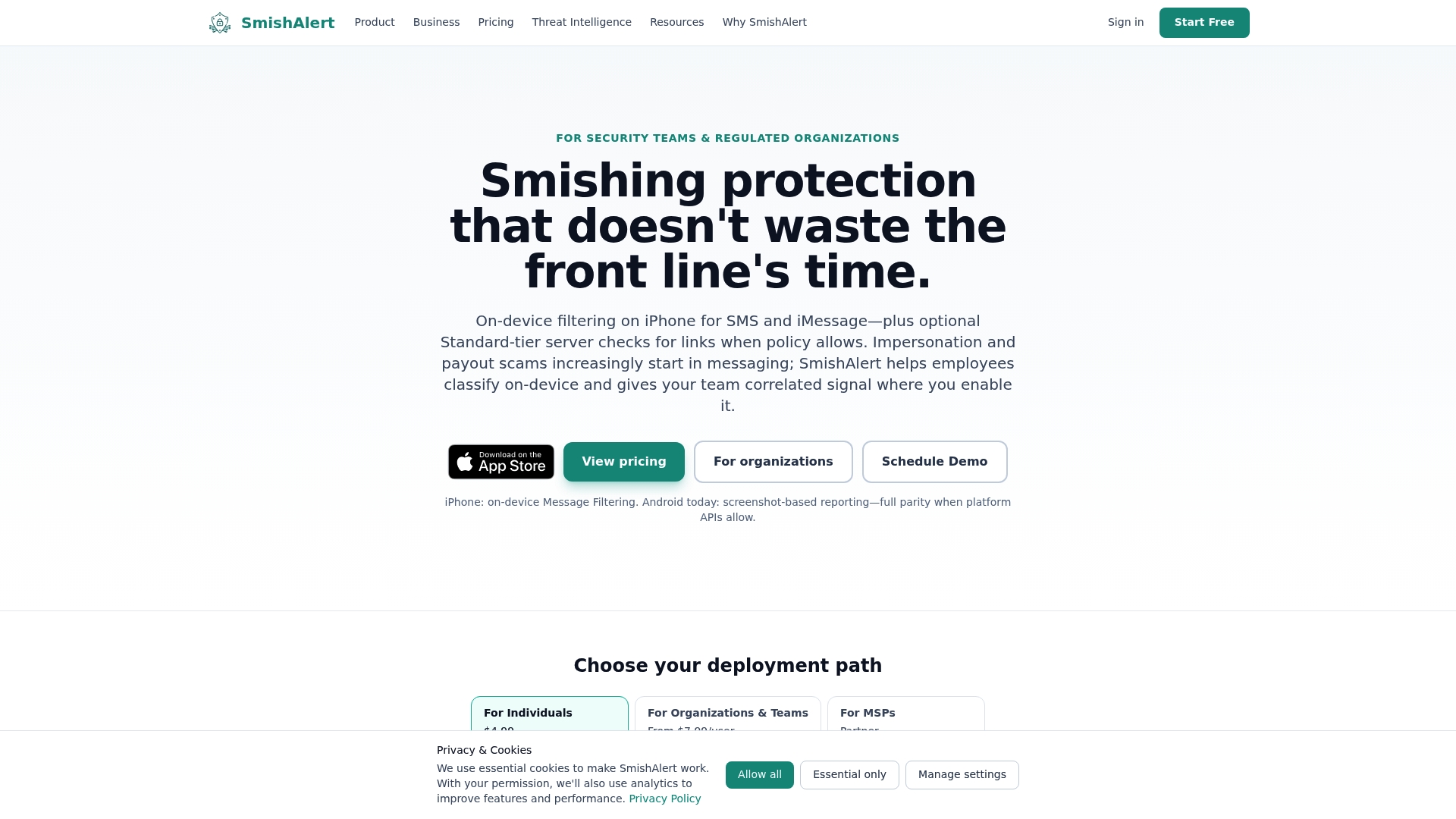
SmishAlert gives security teams the visibility layer that MTD and simulation platforms cannot provide on their own. The platform aggregates employee-reported smishing attempts across SMS, iMessage, and WhatsApp, correlates campaigns across the organization, and surfaces threat intelligence directly to SOC workflows. Security leaders get a clear picture of which lure types are targeting their employees, which departments are most exposed, and how attack patterns evolve over time. For organizations building an enterprise smishing defense program, SmishAlert provides the reporting infrastructure and campaign correlation that transforms isolated user reports into structured threat intelligence. Explore SmishAlert’s full capabilities or connect with the team at RSA Conference 2026.
FAQ
What is the most effective smishing protection for enterprises?
A layered defense combining phishing-resistant MFA, Mobile Threat Defense, smishing-specific simulation training, and SOC-integrated reporting is the current best practice for enterprise smishing protection. No single control addresses the full attack lifecycle.
Why is SMS OTP considered weak for multi-factor authentication?
SMS OTP is vulnerable to SIM swap attacks, SS7 interception, and AiTM proxy toolkits that relay credentials in real time. NIST SP 800-63 and CISA guidance both recommend replacing SMS OTP with FIDO2 hardware keys or passkeys for high-risk accounts.
How do smishing click rates compare to email phishing?
Smishing click rates are 4 to 7 times higher than email phishing because employees treat SMS as a trusted channel and apply less skepticism than they do to email. This gap makes dedicated SMS simulation training a separate program requirement, not an add-on to email phishing training.
What should employees do when they receive a suspicious text?
Employees should forward the message to the organization’s designated reporting channel and to 7726 (SPAM) for carrier-level blocking. They should not click any links, call back any numbers in the message, or share any credentials or MFA codes.
How does Mobile Threat Defense integrate with existing enterprise security tools?
MTD platforms such as Lookout, Zimperium, and Microsoft Defender for Endpoint integrate with MDM solutions including Microsoft Intune and Jamf for policy enforcement, and push structured alerts to SIEM platforms such as Splunk and Microsoft Sentinel for SOC visibility.