
SMS Threat Client Reporting Template Examples for Security Teams

SMS threat client reporting templates are standardized documents that capture the metadata, context, and communication needed to document, escalate, and resolve smishing attacks. Security teams that lack a consistent template miss critical forensic details, slow down incident response, and leave clients without clear guidance. The industry term for this practice is “smishing incident documentation,” and the best sms threat client reporting template examples share three traits: structured data fields, audience-appropriate language, and a clear call to action. Agencies like the FTC, IC3, and India’s Chakshu portal have each defined minimum data requirements that effective templates must satisfy.
What are the essential components of an SMS threat client reporting template?
A functional SMS threat analysis template captures six core data fields without which attribution and blocking are impossible.
- Sender ID: Record the full originating number, short code, or alphanumeric sender name. Short codes and long codes require different carrier escalation paths.
- Timestamp: Log the exact date and time the message was received, including time zone. Correlation across multiple reports depends on precise timestamps.
- Screenshot: Attach a full screenshot of the message thread. Screenshots are crucial but may miss technical header data, so capturing message headers separately strengthens forensic value.
- Message content and attacker request: Record the full text verbatim and note what action the attacker requested, whether credential entry, a callback number, or a payment.
- URL or domain: Extract any embedded link for domain analysis, including homograph detection. Internal templates should include sender origin details and URL properties for forensic correlation.
- Reporter context: Note the device type, carrier, and whether the recipient interacted with the link.
Template design also determines whether employees actually submit reports. Low-friction design with simple questions boosts participation. Security teams parse the technical details later. Avoid asking non-technical employees to classify sender code types or perform URL analysis themselves.
Pro Tip: Build two versions of every template: a simplified employee-facing form with five fields maximum, and a full technical version for your SOC analysts to complete during triage.

Citizen-facing templates differ from internal ones in a critical way. Public portals like India’s Chakshu require OTP verification and screenshot upload to confirm reporter identity and prevent false submissions. Internal templates skip identity verification but add fields for SIEM correlation tags and threat feed cross-references.
Examples of SMS threat reports across four use cases
Different reporting scenarios demand different template structures. The four most common use cases are citizen-facing portals, internal SOC intake forms, client notification messages, and formal regulatory filings.
1. Citizen-facing reporting form
This template targets non-technical users reporting suspicious messages to a public portal or carrier. Citizen-facing reports need OTP verification and must enable screenshot uploads and free-text description to empower non-technical reporters. India’s Chakshu portal reduced its takedown threshold to 5 complaints in 10 days, meaning a single well-structured report can contribute directly to blocking a campaign.
Fields: mobile number, OTP verification, screenshot upload, free-text description of the requested action, date received.
2. Internal security team intake form
This template is for SOC analysts and IT staff logging a reported threat into a ticketing system or SIEM. It captures sender origin (short code vs. long code), full URL with domain registration age, homograph flags, timestamp, and a campaign correlation tag. Technical metadata enable better threat correlation and blocking across multiple incidents.
Fields: incident ID, sender type, raw message content, extracted URL, domain WHOIS data, reporter device and carrier, initial severity classification, assigned analyst.
3. Client notification template
This template alerts end users or customers that a threat campaign is active and tells them what to do. Tone is the defining variable here.
“We have identified a fraudulent SMS campaign impersonating [Organization Name]. Do not click any links in messages claiming to be from us. Verify all requests by calling our official support line at [number]. Your account is secure. No action is required unless you have already clicked a link.”
Calm, authoritative tone in client notifications maintains trust and avoids panic or technical overload. Security professionals consistently recommend clear, reassuring language over technical detail in outbound alerts.
4. Regulatory or agency escalation report
This template supports formal filings with the FTC, IC3, or IRS. Formal threat reports should include a screenshot, sender ID, date and time, URL, and a description of the attacker’s request. The IRS specifically mandates these metadata fields for smishing reports submitted to phishing@irs.gov. Regulatory templates require precise, factual language with no editorial commentary.
Fields: reporter contact information, full message text, sender ID, timestamp, embedded URL, description of requested action, whether the reporter interacted with the message, and any financial loss incurred.
How to use reporting templates to accelerate incident response
Templates reduce response time only when they connect directly to a defined workflow. A template that feeds a shared inbox with no assigned owner delivers no speed advantage.
- Assign an incident ID at intake. Every submitted report should generate a unique ID immediately. Rapid alerts combining SMS and email with a unique incident ID and clear calls to action reduce fraud impact and improve user response rates.
- Set a one-hour response threshold for high-risk events. High-risk security events require response within one hour, including outbound SMS and email alerts with the incident ID and support links.
- Automate the first-level triage. Route reports with embedded URLs to automated domain analysis. Flag short-code senders for carrier escalation. Reserve analyst time for correlation and decision-making.
- Close the feedback loop with reporters. Send a brief confirmation message to every employee who submits a report. Acknowledgment increases future participation rates.
- Forward to 7726 and file with FTC and IC3. Standard smishing reporting includes forwarding to 7726 for carrier blocking and filing with the FTC and IC3 for fraud tracking. Templates should include these steps as a checklist item, not an afterthought.
Understanding common employee cybersecurity vulnerabilities also helps security teams design templates that address the specific behaviors attackers exploit, such as urgency responses and authority compliance.
Pro Tip: Add a “did you interact with this message?” binary field to every template. That single data point determines whether the incident stays at low severity or escalates to credential-harvesting investigation.
Attackers exploit urgency and fear, so templates should emphasize verification through official channels rather than any interaction with suspicious links. Consistent sender IDs in outbound alerts also reduce false reports from employees who cannot distinguish legitimate security communications from threats.
Comparative overview: key features across template types
The right template type depends on the audience receiving it and the system it feeds.
| Template type | Data fields collected | User complexity | Communication tone | Intended audience | Primary purpose |
|---|---|---|---|---|---|
| Citizen-facing | Sender number, screenshot, free-text description | Low | Plain language, guided | General public, non-technical employees | Volume reporting for carrier and regulator action |
| Internal SOC intake | Sender type, URL, domain data, SIEM tags, severity | High | Technical, structured | SOC analysts, IT security staff | Forensic triage and threat correlation |
| Client notification | Incident summary, recommended action, support contact | None (outbound) | Calm, authoritative | Customers, end users | Trust maintenance and behavioral guidance |
| Regulatory filing | Full metadata, financial loss, reporter contact | Medium | Formal, factual | FTC, IC3, IRS, carrier fraud teams | Legal record and enforcement support |
A cyber incident response plan should specify which template type applies to each threat severity level. Teams that use a single template for all four scenarios either collect too little data for internal use or overwhelm public reporters with technical fields they cannot complete accurately.
The Pyramid of Pain framework, referenced in cyber threat intelligence reporting, offers a useful prioritization model. Templates should tier their fields by adversary cost: domain names and IP addresses are easy for attackers to rotate, while TTPs (tactics, techniques, and procedures) are expensive to change. Prioritizing TTP documentation in internal templates produces more durable intelligence.
Key takeaways
Effective SMS threat reporting requires templates matched to the audience, the data system, and the response workflow they feed.
| Point | Details |
|---|---|
| Match template to audience | Use simplified forms for employees and full technical intake for SOC analysts. |
| Capture six core fields | Sender ID, timestamp, screenshot, message content, URL, and reporter context are non-negotiable. |
| Set a one-hour response threshold | High-risk smishing events require outbound alerts with incident IDs within 60 minutes. |
| Use calm, authoritative tone in client alerts | Reassuring language maintains trust; technical detail in outbound notifications increases panic and reduces compliance. |
| Connect templates to defined workflows | A template without an assigned owner and escalation path delivers no speed advantage. |
What most security teams get wrong about reporting templates
The most common mistake I see is treating the reporting template as a data collection exercise rather than a communication tool. Teams spend weeks perfecting the fields on their internal intake form and then send client notifications that read like legal disclaimers. Those notifications erode trust faster than the attack itself.
The second mistake is building one template and calling it done. A single form cannot serve a non-technical employee reporting a suspicious text, a SOC analyst performing forensic triage, and a compliance officer filing with the FTC. Each audience has a different tolerance for complexity and a different downstream system to feed. Trying to satisfy all three with one document produces a form that nobody completes correctly.
What actually works is a tiered template architecture: a five-field employee form that feeds automatically into a full SOC intake record, which in turn generates a pre-populated regulatory filing. The employee never sees the technical fields. The analyst never has to re-enter data the employee already provided. The compliance officer gets a filing-ready document with one click.
The third underappreciated factor is template maintenance. Threat actors change their tactics faster than most organizations update their documentation. A template built around SMS sender ID spoofing in 2024 may miss the RCS-based impersonation campaigns active in 2026. Build a quarterly review into your incident response calendar and treat the template as a living document, not a one-time deliverable.
— Sophie
Smishalert’s platform for capturing and reporting SMS threats
Security teams that want to move beyond manual templates need a system that captures, correlates, and reports on threats automatically.
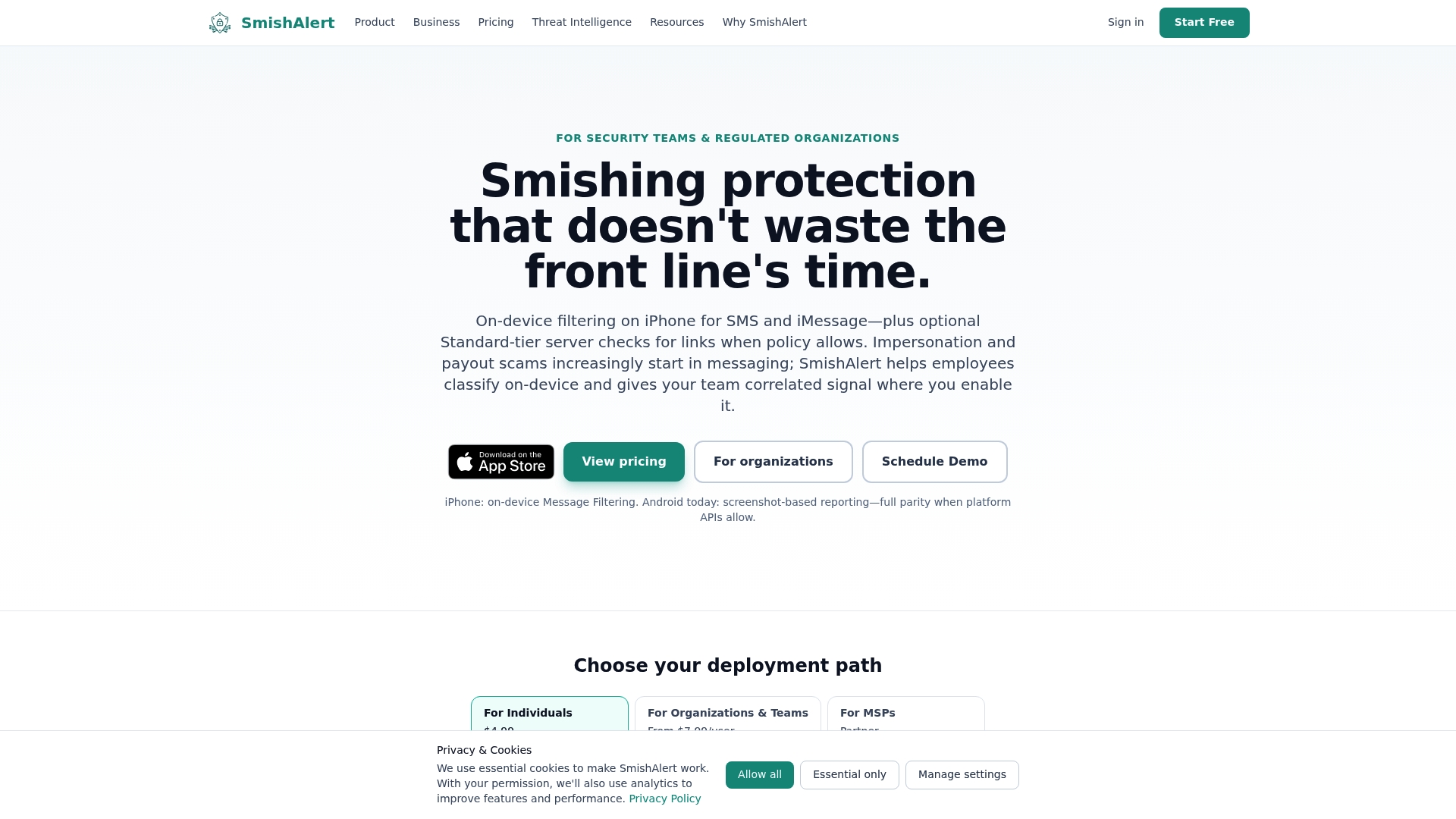
Smishalert is built specifically for this workflow. The platform captures employee-reported SMS, iMessage, and WhatsApp threats, correlates them across campaigns, and surfaces the patterns that manual templates miss. SOC teams get structured threat data without chasing down incomplete submissions. Security leaders get the reporting visibility needed to quantify workforce exposure and communicate risk to the board. The Smishalert platform connects user reporting directly to threat analysis and incident response, replacing the manual template stack with a purpose-built detection and reporting workflow. Teams can also review social engineering solutions to understand the full range of attack types the platform surfaces.
FAQ
What fields must every SMS threat report include?
Every SMS threat report must include the sender ID, timestamp, a screenshot, the full message text, any embedded URL, and a description of the action the attacker requested. The IRS and FTC both mandate these fields for formal smishing submissions.
How do client reporting templates for SMS threats differ from internal ones?
Client-facing templates use plain, reassuring language and focus on recommended actions, while internal templates capture technical metadata like sender code type, domain registration data, and SIEM correlation tags for analyst use.
How do you report a smishing attack to a carrier or regulator?
Forward the message to 7726 for carrier-level blocking and file a report with the FTC at ReportFraud.ftc.gov or the IC3 at ic3.gov. IRS-impersonation smishing goes to phishing@irs.gov with a screenshot and sender details attached.
What tone should a client notification template use after a smishing campaign?
Client notifications should use a calm, authoritative tone that confirms the threat is known, tells recipients what not to do, and provides a verified contact channel. Avoid technical language and avoid language that implies the recipient’s account has been compromised unless it has.
How often should SMS threat reporting templates be updated?
Templates should be reviewed quarterly and updated whenever a new attack vector, sender type, or regulatory requirement emerges. Threat actors rotate tactics frequently, and outdated templates produce incomplete reports that slow down response.