
White-Label Smishing Protection: What Security Teams Need to Know

White-label smishing protection is defined as a B2B licensing model where security providers acquire a carrier-grade SMS defense platform and rebrand it to deliver SMS phishing defense under their own name. The industry term for the underlying capability is “SMS phishing prevention,” and the white-label model is the delivery mechanism MSSPs use to bring it to market without building the infrastructure themselves. Attackers have accelerated their shift from email to SMS, iMessage, and WhatsApp, making this model operationally urgent. Smishalert is built precisely for this environment, giving security providers visibility into messaging-based social engineering across every major channel.
What is white-label smishing protection, and how does it work?
White-label smishing protection works by separating the technology layer from the brand layer. A vendor builds and maintains the core SMS threat detection engine, including spam filtering, grey route blocking, and number validation. An MSSP or security provider licenses that engine, applies their own branding, and delivers it to clients as a named service. The client never sees the underlying vendor.
The model solves a real infrastructure problem. Building a carrier-grade SMS firewall requires telecom relationships, SS7 integration, and ongoing threat intelligence feeds. Most MSSPs cannot justify that investment. White-labeling resolves the build-vs-buy dilemma by letting providers compete on service quality and speed rather than internal R&D capacity.

Smishing prevention, as a discipline, covers the detection, blocking, and reporting of SMS-based social engineering attacks. Executive impersonation, credential harvesting via fake login pages, payroll fraud, and gift card scams all arrive through SMS channels that traditional email security tools never see. White-label platforms extend that prevention capability to any provider willing to license it.
What features do white-label smishing platforms provide?
The core technical capabilities in a white-label smishing platform go well beyond a reskinned dashboard. Full white-labeling requires custom domain hosting, branded API endpoints, multi-tenant data architecture, and co-branded reporting templates. Each of these components serves a specific operational purpose.
Core feature categories
- Custom domain hosting: The platform runs under the MSSP’s domain. Clients interact with a URL that carries the provider’s brand, not the vendor’s.
- Branded dashboards and reporting: White-labeled reporting templates let security teams present threat data, campaign summaries, and risk scores under their own visual identity.
- Multi-tenant architecture: Each client’s data is isolated in a separate logical partition. This is not optional. Multi-tenancy isolation is the technical foundation for both compliance and client trust.
- SMS firewall functions: Grey route blocking, policy enforcement, and carrier reputation monitoring form the active defense layer. These controls stop malicious SMS traffic before it reaches end users.
- HLR lookup APIs: Home Location Register lookups validate phone numbers before any SMS interaction, reducing fraud exposure and improving detection accuracy. This makes the firewall proactive rather than reactive.
- API access under client branding: Integration endpoints carry the MSSP’s domain, so automated workflows and SIEM connections appear native to the provider’s stack.
Pro Tip: Before signing a white-label contract, request a full API reference document. If the vendor cannot provide one with your domain substituted in the endpoint paths, the integration is not truly white-label.
The table below maps feature categories to their operational impact for security teams.
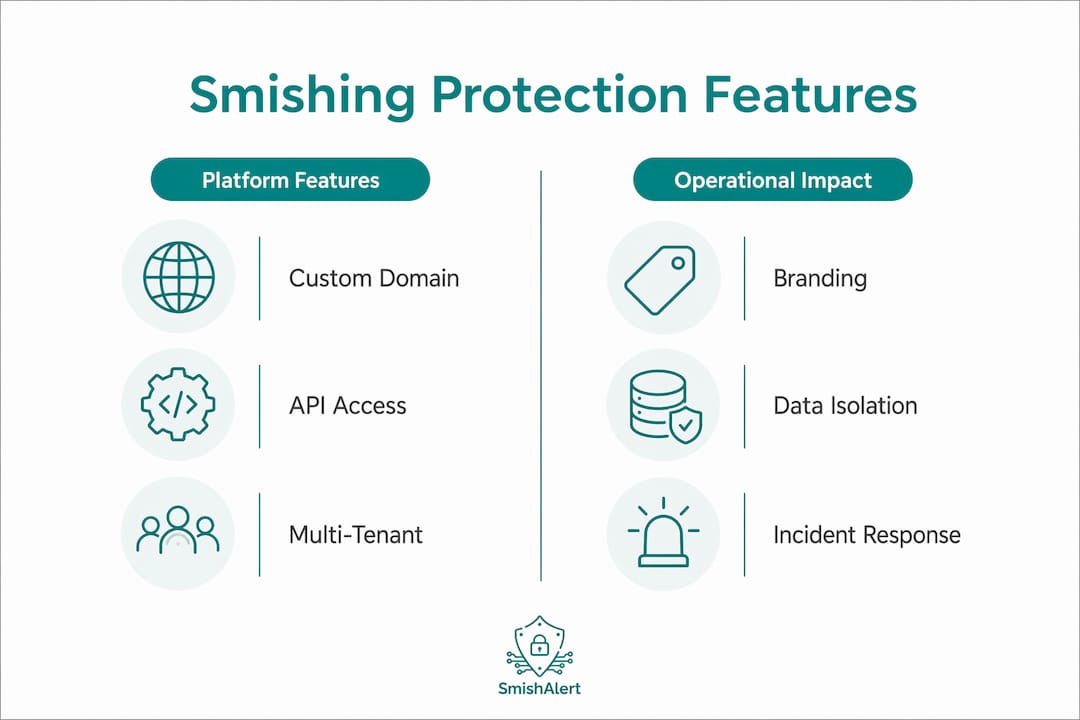
| Feature | Operational impact |
|---|---|
| Custom domain hosting | Clients see only the MSSP’s brand; vendor is invisible |
| Multi-tenant isolation | Regulatory compliance and client data segregation |
| SMS firewall and grey route blocking | Active threat interception before delivery |
| HLR number validation | Proactive fraud reduction and delivery accuracy |
| Branded API endpoints | Native SIEM and workflow integration under provider identity |
Why do MSSPs choose white-label smishing solutions?
The business case for white-label smishing solutions is straightforward. Attackers have migrated to SMS channels faster than most enterprise security stacks have followed. MSSPs that cannot offer SMS phishing defense lose clients to providers that can. White-labeling closes that gap without a multi-year infrastructure build.
The strategic drivers break down into five areas:
- Speed to market. A white-label platform can be deployed under a provider’s brand in weeks. Building equivalent capability internally takes years and requires telecom partnerships that most MSSPs cannot negotiate independently.
- Cost efficiency. R&D and telecom infrastructure costs stay with the vendor. The MSSP pays a licensing fee and redirects internal resources toward client-facing services.
- Competitive differentiation. Branded dashboards and threat reports let MSSPs present a complete security portfolio. Clients perceive a single, integrated provider rather than a patchwork of third-party tools.
- Client retention. MSSPs using white-label threat intelligence report stronger retention because clients interact daily with the provider’s branded interface. Switching costs rise when the brand experience is consistent and embedded in client workflows.
- Meeting demand for SMS threat intelligence. Clients increasingly request simulation campaigns, threat feeds, and mobile phishing awareness programs. White-label platforms deliver all three under the MSSP’s name.
Pro Tip: When evaluating white-label contracts, ask specifically whether smishing simulation campaigns can be launched under your brand. Some vendors restrict simulation features to higher licensing tiers, which affects your ability to run smishing awareness programs for clients.
What are the key deployment considerations for security teams?
Deploying white-label smishing protection requires more than flipping a branding switch. Tiered access models define what each licensing level actually controls. Misreading those tiers creates hidden costs and gaps in brand visibility that surface only after client onboarding begins.
The critical deployment considerations are:
- Data sovereignty. Client data must reside in jurisdictions that satisfy each client’s regulatory requirements. GDPR, HIPAA, and sector-specific frameworks all impose constraints. Confirm data residency options before signing.
- Strict multi-tenancy. Logical isolation is not sufficient for high-compliance clients. Confirm whether the platform supports physical or cryptographic separation for sensitive accounts.
- Co-branded technical documentation. Incident response workflows, user guides, and API references must carry the MSSP’s branding. Clients should never encounter vendor-branded documentation during an active incident.
- Custom API endpoint configuration. API integration under custom domains requires DNS configuration, SSL certificate management, and endpoint mapping. This is a technical task, not a marketing one.
- Tailored incident response flows. The platform’s alerting and escalation paths must align with the MSSP’s existing SOC procedures. Generic vendor workflows create confusion during live incidents.
- SS7 integration and number validation. Reliable SMS traffic analysis depends on access to SS7 signaling data and HLR lookup services. Confirm these are included in the licensing tier, not sold as add-ons.
Pro Tip: Run a full tabletop exercise using the white-label platform before going live with any client. Simulate a credential-harvesting smishing campaign and trace every alert, escalation, and report through your branded interface. Gaps in the workflow are far cheaper to fix in testing than during a real incident.
For teams managing BYOD environments, protecting unmanaged devices from smishing adds another layer of complexity that the platform’s mobile integration must address directly.
How do security teams integrate smishing protection into their broader architecture?
White-label smishing protection does not operate in isolation. It feeds into the same detection and response workflows that govern endpoint, network, and identity security. The integration points determine how much operational value the platform actually delivers.
Effective integration follows a consistent pattern across mature security operations:
- SIEM correlation: SMS phishing alerts feed into SIEM platforms such as Splunk or Microsoft Sentinel via the branded API. This gives SOC analysts a unified view of the attack chain, from the initial SMS lure to any subsequent lateral movement or credential use.
- Endpoint and network pairing: SMS-based attacks often precede endpoint compromise. Correlating smishing telemetry with endpoint detection data surfaces attack sequences that neither system would catch alone. Bundling SMS security with endpoint protection creates a stronger combined offering for MSSP clients.
- BYOD and mobile security programs: White-label platforms support mobile phishing awareness training that runs without requiring MDM enrollment. This matters because most smishing attacks target personal devices that fall outside traditional MDM scope.
- Automated simulation campaigns: APIs allow SOC teams to schedule and launch smishing simulation campaigns programmatically. Simulation data feeds directly into risk scoring and awareness program metrics.
- Client-facing risk reporting: Branded dashboards translate raw threat telemetry into executive-readable risk posture reports. CISOs can present these directly to boards without reformatting vendor output.
- Compliance alignment: Platforms that support audit-grade logging satisfy requirements under frameworks including NIST CSF, ISO 27001, and sector-specific regulations. Confirm logging granularity before deployment.
For organizations assessing business phone security risks, the integration of SMS threat data into existing security architecture is the step that converts a point solution into a systemic defense.
Key Takeaways
White-label smishing protection is the most direct path for MSSPs to deliver carrier-grade SMS phishing defense under their own brand, without the cost or time of building the underlying infrastructure.
| Point | Details |
|---|---|
| Definition is precise | White-label smishing protection licenses a carrier-grade SMS defense engine for rebranding, not just UI reskinning. |
| Multi-tenancy is non-negotiable | Strict client data isolation is required for regulatory compliance and client trust in any white-label deployment. |
| Tiered contracts carry hidden risks | Misreading access tiers can limit brand control, API access, or simulation features after onboarding. |
| Integration depth determines value | SMS threat telemetry must connect to SIEM, endpoint, and identity systems to deliver full SOC visibility. |
| Speed to market is the primary driver | White-labeling lets MSSPs launch SMS phishing defense in weeks rather than years of internal development. |
What I’ve learned about white-label smishing protection that most articles miss
The conversation around white-label smishing protection tends to focus on branding and cost savings. Those matter, but they are not where deployments succeed or fail.
The real differentiator is incident response fidelity. When a smishing campaign hits a client’s workforce, the SOC team needs to move fast. If the white-label platform’s alerting paths, escalation logic, and reporting templates are not pre-configured to match the MSSP’s existing workflows, the response slows down at exactly the wrong moment. I have seen providers spend months on branding and skip the tabletop exercise entirely. That is the wrong order of operations.
The second thing most articles understate is the importance of simulation capability. Smishing awareness programs only work if employees encounter realistic simulated attacks before real ones arrive. A white-label platform that restricts simulation to higher tiers, or that requires vendor involvement to launch campaigns, undermines the entire training model. SOC teams should treat simulation access as a baseline requirement, not a premium feature.
The future of this space points toward multi-channel coverage. SMS is the current primary vector, but iMessage, WhatsApp, and RCS are growing attack surfaces. White-label platforms that cover only traditional SMS will require replacement or augmentation within two to three years. Smishalert’s architecture already addresses multi-channel messaging threats, which is why it is worth evaluating now rather than after the next platform migration.
— Sophie
Smishalert’s white-label smishing protection platform
Smishalert delivers a fully white-label platform built for MSSPs and security providers that need carrier-grade SMS phishing defense without the infrastructure overhead.
The Smishalert platform supports multi-tenant architecture, branded API endpoints, and custom domain hosting out of the box. Security teams get visibility into SMS, iMessage, WhatsApp, and other messaging channels, covering the full scope of modern social engineering threats. Simulation campaigns, threat correlation, and audit-grade reporting all run under the provider’s brand. Explore the full smishing protection solutions or use the SOC team feature overview to assess fit for your current security operations.
FAQ
What is white-label smishing protection?
White-label smishing protection is a B2B model where security providers license a carrier-grade SMS phishing defense platform and rebrand it as their own service. The underlying vendor remains invisible to end clients.
How does white-label smishing protection differ from standard smishing prevention?
Standard smishing prevention refers to the technical capability of detecting and blocking SMS-based phishing attacks. White-label smishing protection is the delivery model that lets MSSPs offer that capability under their own brand.
What technical features should a white-label smishing platform include?
A complete platform includes custom domain hosting, multi-tenant data isolation, branded API endpoints, SMS firewall functions such as grey route blocking, and HLR number validation for proactive fraud prevention.
Why is multi-tenancy critical in white-label smishing deployments?
Multi-tenancy ensures each client’s data is logically or physically isolated from other clients. This separation is required for regulatory compliance under frameworks including GDPR and HIPAA, and it protects client confidentiality in shared infrastructure environments.
How do MSSPs integrate white-label smishing protection with their existing security stack?
MSSPs connect SMS threat telemetry to SIEM platforms via branded API endpoints, correlate smishing alerts with endpoint and identity data, and use the platform’s reporting tools to deliver client-facing risk posture summaries.