
Why Healthcare Mobile Devices Are Vulnerable in 2026

Healthcare mobile devices are defined as one of the most exploited entry points in modern clinical infrastructure, combining high-value data access with inconsistent security controls across thousands of endpoints. The core reason why healthcare mobile devices are vulnerable is structural: clinical workflows demand constant connectivity, but the governance frameworks protecting those connections have not kept pace. Mobile endpoints carry protected health information (PHI) through apps, APIs, and cloud integrations that span multiple trust boundaries, each one a potential failure point. Understanding these layered risks is the first step toward building defenses that match the actual threat model.
Why healthcare mobile devices are vulnerable to attack
Mobile devices in healthcare are described as “low hanging fruit” by 2026 researchers, precisely because insufficient patch controls and inconsistent update cycles leave known vulnerabilities open far longer than in traditional IT environments. That characterization reflects a systemic problem, not an isolated one. Every smartphone, tablet, or connected clinical device added to a hospital network creates a new entry point, and in large health systems those entry points number in the thousands.
The mobile health security risks compound when you factor in bring-your-own-device (BYOD) policies. BYOD environments introduce a heterogeneous pool of devices with no uniform security baseline, forcing risk management teams to assume variance rather than enterprise-grade hygiene. A clinician’s personal Android phone running a two-year-old OS patch is functionally a different risk profile than a hospital-issued, MDM-enrolled device, yet both may access the same EHR system.

Traditional security monitoring tools, built around perimeter defenses and endpoint detection on managed workstations, often lack visibility into mobile device activity. This means threats propagating through SMS, iMessage, or mobile apps may never surface in a SIEM alert. The attack surface expands, but the monitoring coverage does not.
Key mobile health security risks that expand the attack surface include:
- Unpatched operating systems on personal and shared clinical devices
- BYOD devices connecting to hospital Wi-Fi without NAC enforcement
- Shared clinical tablets with no per-session authentication
- Mobile apps with excessive permissions accessing device sensors and storage
- SMS and messaging channels operating outside email security gateways
Pro Tip: Build a centralized device inventory that distinguishes between MDM-enrolled devices and BYOD endpoints. Without that baseline, you cannot enforce policy or measure patch compliance across your mobile fleet.
How governance gaps and user behavior increase device risk
Nearly half of healthcare organizations lack formal mobile device management policies, a gap that directly translates into uncontrolled credential sharing, persistent login sessions, and devices left accessible in clinical areas. That statistic means that for a significant portion of health systems, the rules governing how staff use mobile devices simply do not exist in written, enforceable form.
The behavioral risks are specific and well-documented. Staff sharing login credentials across shifts, leaving devices signed into EHR portals between patient interactions, and using personal messaging apps to transmit clinical information are all common practices that undermine technical controls. Governance fragmentation across departments and facilities worsens this posture, as uneven policy implementation means a security control applied in one ward may be entirely absent in another.
The 2026 data on Android-targeted attacks in healthcare is particularly striking. Android-targeted attacks rose 244% in healthcare environments, a figure that reflects both the prevalence of Android devices in clinical settings and the relative ease of targeting them through social engineering and malicious apps. That growth rate signals that threat actors have identified healthcare mobile users as a productive attack vector.
Risky behaviors that security teams should monitor and address include:
- Credential sharing between colleagues on shared devices
- Persistent authenticated sessions left open on unattended devices
- Use of personal cloud storage to transfer clinical files
- Installing unapproved third-party apps on devices with EHR access
- Responding to SMS-based phishing without verification protocols
Pro Tip: Policy enforcement without training produces compliance theater. Pair formal mobile device policies with quarterly scenario-based training that uses real examples of smishing and credential-harvesting attacks targeting healthcare staff.
What technical flaws in mobile apps and APIs expose patient data
Mobile threat exposure in healthcare is multi-layer and transitive. A vulnerability in a mobile app does not stay contained to the device. It propagates through API calls, third-party SDKs, and cloud storage integrations, each of which may handle PHI with different security controls and logging practices. The device is the entry point; the data exposure happens downstream.
Authentication token handling is a recurring failure point. Mobile apps that store OAuth tokens in insecure local storage, or that fail to enforce token expiration, allow an attacker who gains physical or remote access to a device to authenticate as the legitimate user against backend systems. Misconfigured API boundaries compound this: when a mobile app’s backend does not enforce object-level authorization, a compromised session can access records beyond the authenticated user’s scope.
Third-party SDKs embedded in healthcare apps introduce additional risk that app developers often cannot fully audit. Analytics SDKs, push notification libraries, and advertising frameworks may transmit device metadata and usage patterns to external servers. A 2026 peer-reviewed study found that end users cannot reliably assess how mobile health apps handle their data, calling for systematic privacy risk assessment tools. That finding places the burden squarely on development and security teams rather than end users.
The table below maps the primary vulnerability types across the mobile app stack:
| Layer | Vulnerability type | Example exposure pathway |
|---|---|---|
| Device | Unpatched OS, insecure storage | Token theft via local file access |
| Application | Broken access control, weak auth | Unauthorized EHR record retrieval |
| API / Backend | Missing object-level authorization | Cross-patient data leakage |
| Third-party SDK | Opaque data transmission | PHI metadata sent to analytics servers |
| Cloud storage | Misconfigured bucket permissions | Bulk PHI exposure via public URL |
Healthcare IT teams building or procuring mobile apps should apply OWASP Mobile Application Security Verification Standard (MASVS) controls at each layer, not just at the device or application tier. The healthcare UX design context also matters: security controls that create friction in clinical workflows are routinely bypassed, so the architecture must account for usability alongside protection.
How MDM platform vulnerabilities put thousands of devices at risk
The greatest single amplifier of mobile device risk in healthcare is not the endpoint itself. It is the mobile device management infrastructure controlling those endpoints. Compromise of an MDM or EPMM server gives an attacker the ability to push malicious configurations, disable security policies, or extract device inventories across every enrolled device simultaneously. One compromised server can undermine protections for thousands of devices at scale.
In early 2026, attackers actively exploited two critical zero-day vulnerabilities in Ivanti Endpoint Manager Mobile, tracked as CVE-2025-4427 and CVE-2025-4428. These unauthenticated remote code execution flaws required no valid credentials to exploit, meaning any attacker with network access to the EPMM server could execute arbitrary code on the management platform. Healthcare organizations running Ivanti EPMM faced the prospect of their entire mobile security control plane being seized before a patch was applied.
The steps healthcare IT teams should take to reduce MDM platform exposure are concrete and sequenced:
- Maintain a current inventory of all MDM and EPMM platform versions and apply vendor patches within 24 to 48 hours of a critical advisory.
- Restrict management console access to specific IP ranges and require multi-factor authentication for all administrative accounts.
- Monitor MDM server logs for anomalous API calls, configuration changes, and bulk device queries that fall outside normal administrative patterns.
- Segment the MDM management network from general clinical traffic so that a compromised management server cannot directly reach patient-facing systems.
- Subscribe to CISA Known Exploited Vulnerabilities (KEV) catalog alerts and treat any MDM-related entry as a P1 incident requiring immediate response.
Pro Tip: Treat your MDM platform with the same patch urgency as your firewall or identity provider. A delayed patch on a management server is not a low-priority item. It is a potential single point of failure for your entire mobile security posture.
What makes home-based telehealth environments especially difficult to secure
Hospital-at-home (HaH) architectures move clinical endpoints into environments that no IT team controls. NIST CSWP 34 frames patient homes as untrusted networks and recommends treating hospital-grade medical devices as isolated from personal devices and consumer IoT on the same network. That framing reflects a real operational challenge: a remote patient monitoring device sharing a home Wi-Fi network with an unpatched smart TV or a compromised personal laptop is exposed to lateral movement risks that would not exist in a segmented hospital network.
The specific risks in home telehealth environments include:
- Medical devices connecting to unsecured consumer routers with default credentials
- Personal smartphones used for telehealth video calls running outdated OS versions
- Consumer IoT devices on the same network segment as clinical monitoring equipment
- No organizational visibility into the security state of the home network
- Patients or family members inadvertently installing malware on shared devices
NIST CSWP 34 recommends access control, continuous monitoring, and network isolation as minimum controls for HaH deployments. Practically, this means healthcare organizations should provision dedicated clinical devices for home use rather than relying on patient-owned hardware, configure those devices to use VPN tunnels back to organizational infrastructure, and establish remote monitoring capabilities that flag anomalous device behavior regardless of physical location.
The risks of using mobile devices in healthcare extend beyond the hospital walls. Any security model that treats the clinical perimeter as the boundary of responsibility will fail to account for the growing share of care delivered outside it.
Key takeaways
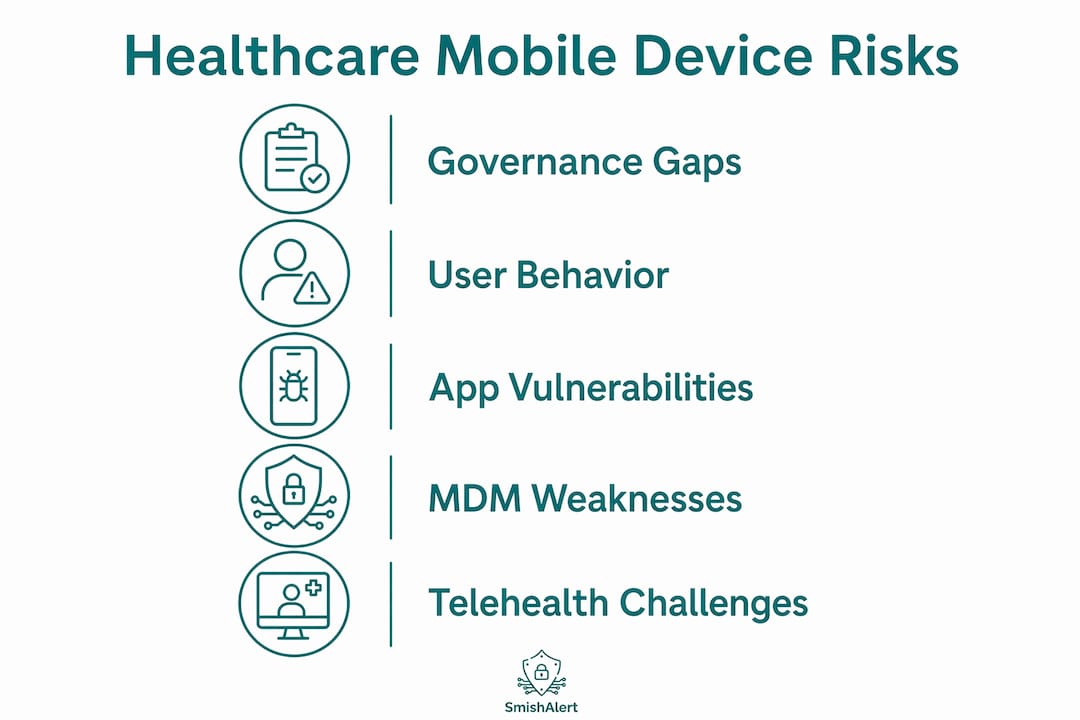
Healthcare mobile devices are vulnerable because governance gaps, user behavior, app-layer flaws, MDM infrastructure weaknesses, and uncontrolled telehealth environments each create independent and compounding exposure pathways that no single control can address.
| Point | Details |
|---|---|
| Attack surface expansion | Every BYOD and unmanaged device added to a clinical network creates an entry point with inconsistent security controls. |
| Governance and behavior gaps | Nearly half of healthcare organizations lack formal device policies, enabling credential sharing and persistent session risks. |
| App and API layer flaws | Authentication token mishandling and misconfigured API boundaries allow PHI exposure well beyond the device itself. |
| MDM platform risk | A compromised MDM server can disable security enforcement across thousands of enrolled devices simultaneously. |
| Telehealth environment exposure | Home-based care moves clinical devices into untrusted networks requiring isolation, VPN, and continuous monitoring. |
The case for layered governance, not just layered technology
The pattern across every vulnerability category in this analysis is the same: technical controls alone do not hold when governance is absent or inconsistent. The Ivanti EPMM zero-days were a technical failure, but the organizations most exposed were those without rapid patch processes or MDM network segmentation already in place. The Android attack surge is a technical threat, but it lands most effectively against staff who have not been trained to recognize smishing and credential-harvesting attempts delivered through SMS.
What I find most underappreciated in healthcare mobile security discussions is the transitive nature of app-layer risk. Security teams often treat the device as the unit of analysis, asking whether it is enrolled, patched, and compliant. The more important question is what the device can reach and whether those backend systems enforce authorization independently of the mobile client. An enrolled, patched device running a poorly architected app is still a PHI exposure waiting to happen.
The governance gaps documented in the 2025 Springer study on US health systems are not surprising, but they are consequential. Fragmented policy implementation across departments means that a security investment in one part of the organization does not translate into system-wide risk reduction. Healthcare IT and security leaders need to treat mobile governance as an organization-wide program, not a departmental checklist.
The practical implication is that mobile security in healthcare requires three parallel tracks: technical controls at the device and infrastructure layer, behavioral controls through training and policy enforcement, and architectural controls at the app and API layer. Running only one or two of these tracks leaves the third as an open attack path.
— Sophie
How SmishAlert helps healthcare teams detect mobile messaging threats
Mobile vulnerabilities in healthcare do not exist in isolation from messaging-based attacks. Smishing campaigns targeting clinical staff exploit the same governance gaps and behavioral weaknesses documented throughout this analysis, delivering credential-harvesting links through SMS and iMessage channels that sit entirely outside email security gateways. SmishAlert’s messaging phishing visibility platform gives healthcare security teams on-device filtering, AI-powered threat analysis, and one-tap reporting to detect and surface these attacks before they reach the credential entry stage. For organizations looking to understand how to detect phishing in SMS and messaging apps at the enterprise level, SmishAlert provides the telemetry and campaign correlation that traditional security stacks cannot see. Protecting mobile devices in healthcare starts with visibility into every channel attackers use.
FAQ
Why are healthcare mobile devices more vulnerable than other industries?
Healthcare devices carry high-value PHI, operate under time pressure that discourages security friction, and are often governed by fragmented policies across departments. The combination of sensitive data, inconsistent controls, and motivated threat actors makes healthcare a primary target for mobile attacks.
What is the biggest risk from BYOD in healthcare?
BYOD introduces a heterogeneous device pool with no uniform patch baseline or security configuration, meaning risk management must assume variance rather than enterprise hygiene. Devices running outdated operating systems with EHR access represent the highest-priority exposure in most BYOD fleets.
How do MDM vulnerabilities affect healthcare mobile security?
A compromised MDM or EPMM server gives attackers control over the security enforcement mechanism for every enrolled device. The 2026 Ivanti EPMM zero-days demonstrated that unauthenticated remote code execution on a management server can undermine protections for thousands of clinical devices simultaneously.
What makes telehealth devices harder to secure than in-hospital devices?
Telehealth devices operate in patient homes on untrusted consumer networks alongside unmanaged IoT devices, outside the visibility and control of organizational IT teams. NIST CSWP 34 recommends network isolation, continuous monitoring, and dedicated provisioned devices as minimum controls for hospital-at-home deployments.
How do mobile app vulnerabilities lead to patient data exposure?
Flaws in authentication token handling, misconfigured API boundaries, and opaque third-party SDK data transmission allow a compromise at the device layer to propagate through backend systems. The exposure pathway runs from the device through the app, the API, and into cloud storage, each layer potentially handling PHI with different security controls.
Recommended
- Security Budget Checklist for Mobile Threats in 2026 | SmishAlert
- How do you deploy mobile phishing protection without MDM? | SmishAlert
- From Smishing to Browser Credential Theft: How Modern Attacks Escalate | SmishAlert
- Cyber Risk: Not Just an IT Issue, It’s an SMS Security Concern Too | SmishAlert