
Why Mobile Endpoints Are Harder to Protect in 2026

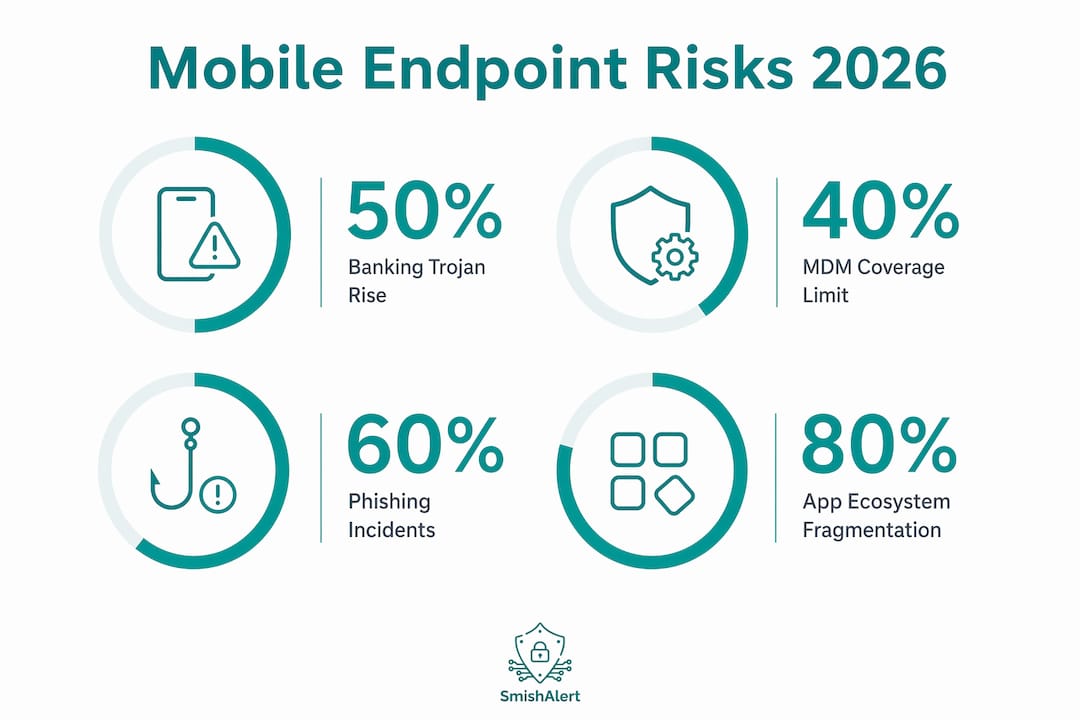
Mobile endpoints are defined as any smartphone, tablet, or mobile device that accesses corporate resources, and they present fundamentally different security challenges than traditional desktop or server endpoints. The core reason why mobile endpoints are harder to protect comes down to three converging factors: operating system architecture that limits defender visibility, fragmented app ecosystems that resist centralized governance, and a threat landscape that has evolved specifically to exploit these gaps. Tools like MDM platforms, XDR agents, and unified endpoint management solutions that work reliably on Windows or macOS lose critical capabilities when deployed against iOS and Android. Q1 2026 data from Securelist recorded 2,676,328 mobile attacks in a single quarter, including 306,070 Android malware samples, with banking Trojans rising 50% quarter-over-quarter. That volume reflects a threat environment that has outpaced the tools most organizations rely on.
Why mobile endpoints are harder to protect: the OS sandboxing problem
Mobile operating system sandboxing is the architectural feature that most directly creates visibility and enforcement gaps for security teams. Both iOS and Android isolate each application in its own sandbox, preventing any third-party security tool from observing the runtime behavior of other processes. On a Windows endpoint, an EDR agent like CrowdStrike Falcon or Microsoft Defender for Endpoint can inspect memory, monitor process trees, and intercept system calls in real time. On an iPhone or Android device, that level of inspection is structurally impossible.
The practical consequence is what security researchers call the “telemetry gap.” As Hexnode describes, XDR platforms are effectively blind on iOS and Android because sandboxing prevents them from accessing jailbreak status, sideloaded app inventories, or full filesystem state. A security agent on a mobile device functions as a passive observer, not an active inspector. It can report what the OS chooses to share, nothing more.
MDM platforms compound this problem by design. iVerify notes that MDM communicates with Apple management APIs but has no visibility beyond high-level compliance data. It can confirm that a device is enrolled, that the OS version meets policy, and that certain configuration profiles are applied. It cannot detect a credential-harvesting app operating within its sandbox, a malicious payload delivered through a messaging channel, or lateral movement initiated from a compromised app.
“MDM was designed for compliance and enrollment tracking, not runtime inspection, creating inherent blind spots that modern attackers exploit.” — iVerify
Pro Tip: If your mobile security posture relies entirely on MDM compliance dashboards, treat those dashboards as enrollment records, not threat detection. Layer in behavioral monitoring tools that operate outside the sandbox to close the telemetry gap.
How fragmented app ecosystems undermine endpoint protection
The app layer is the most underprotected surface in mobile endpoint security, and the fragmentation problem is worse than most security teams acknowledge. Unlike enterprise software deployed through SCCM or Intune on Windows, mobile apps arrive through multiple distribution channels: the Apple App Store, Google Play, enterprise app catalogs, and sideloading mechanisms that bypass store review entirely.

Jamf VP Michael Covington describes the core challenge as decentralized app distribution combined with unpredictable update mechanisms. Users control when they update apps, which means multiple versions of the same application run concurrently across a device fleet. A vulnerability patched in version 4.2 of a banking app may still be present on 30% of devices running version 4.0, with no automated enforcement mechanism to close that gap.
The risks this creates extend beyond patch lag:
- Excessive permissions: Apps granted access to contacts, location, camera, or microphone beyond their stated function create unmonitored data flows that MDM cannot inspect.
- Parallel app versions: Concurrent version deployment across a fleet makes vulnerability management reactive rather than preventive.
- Sideloaded apps: Apps installed outside official stores bypass malware scanning and code-signing verification entirely.
- Unmonitored data flows: Without runtime visibility, security teams cannot detect when an app exfiltrates data to an unauthorized endpoint.
| Control mechanism | Coverage scope | Key limitation |
|---|---|---|
| MDM app management | Enrollment, policy compliance | Cannot inspect app runtime behavior |
| App store review | Pre-publication screening | Does not catch post-install behavior changes |
| UEM app catalog | Approved app distribution | User-controlled updates create version drift |
| Mobile app governance | Real-time permission and behavior monitoring | Requires dedicated tooling beyond standard MDM |
Mobile app governance, meaning real-time monitoring of app states, permissions, and behaviors across the fleet, is the control that most organizations are missing. Device controls alone are not sufficient when the threat surface is the application layer.
How the mobile threat landscape increases exposure
The mobile threat landscape has evolved to specifically target the visibility gaps described above, and the 2026 data confirms the acceleration. Securelist’s Q1 2026 report recorded 306,070 Android malware samples in a single quarter, with banking Trojans increasing 50% quarter-over-quarter. Banking Trojans are particularly dangerous on mobile because they operate within the financial app sandbox, overlaying legitimate interfaces to capture credentials without triggering any MDM alert.
Phishing and social engineering represent the other major threat vector, and mobile devices face disproportionate exposure. Lookout’s Q3 2025 Mobile Threat Landscape Report documents a global mobile phishing encounter rate of nearly 13%, with 1.2 million enterprise-focused phishing attacks analyzed. That encounter rate is significantly higher than desktop phishing rates, reflecting the fact that mobile users interact with SMS, iMessage, WhatsApp, and other messaging channels where URL inspection tools and email gateway filters have no reach.
The structural reasons mobile devices face higher phishing exposure include smaller screen real estate that obscures full URLs, the absence of hover-to-preview link behavior, and the social context of messaging apps that conditions users to respond quickly. Attackers have adapted their campaigns accordingly, using AI-generated messages that personalize smishing attacks at scale and impersonate known contacts or trusted brands with high fidelity.
Key mobile-specific threat patterns security teams must account for:
- Smishing campaigns targeting employees through SMS and iMessage with credential-harvesting links
- Banking Trojans operating within app sandboxes to overlay legitimate financial interfaces
- AI-enhanced impersonation using synthesized voice or text to bypass user skepticism
- Zero-click exploits delivered through messaging channels that require no user interaction
Pro Tip: MDM enrollment status does not reduce phishing risk. Deploy mobile phishing detection that operates at the messaging layer, where the attack chain actually begins.
What makes BYOD and remote workforce management so difficult
Operational visibility is a security control in its own right, and BYOD environments systematically degrade it. Samsung SDS USA outlines the core problem: organizations managing BYOD fleets typically lack coherent device inventories, real-time device state tracking, and unified audit records. When a device is compromised, the time between initial compromise and detection expands because the telemetry needed to trigger an alert either does not exist or is siloed across multiple tools.
The fragmentation of management tooling makes this worse. A typical enterprise might use Jamf for iOS, Microsoft Intune for Android and Windows, and a separate SIEM like Splunk or Microsoft Sentinel for log aggregation. Each tool maintains its own device records, and reconciling them into a unified view of device state is a manual, error-prone process. Audit gaps created by this fragmentation directly increase risk.
“Visibility itself is a security control; fragmented, delayed mobile device state tracking directly weakens enforcement and increases risk.” — Samsung SDS USA
There is also a less-discussed risk at the management plane itself. Assured’s analysis of Ivanti zero-day breaches demonstrates that UEM and MDM platforms are high-value targets. Compromising the management infrastructure exposes identity and control data across thousands of enrolled devices simultaneously. Organizations that harden endpoints but neglect management-plane segmentation and access controls are protecting the perimeter while leaving the control center exposed.
Comparing mobile endpoint protection strategies
No single tool closes all the gaps described above, but understanding what each layer covers helps security teams build a defense that accounts for mobile endpoint realities.
- MDM and UEM platforms (Jamf, Microsoft Intune, VMware Workspace ONE): Provide enrollment management, policy enforcement, and OS version compliance. They do not provide runtime behavioral visibility or phishing detection at the messaging layer.
- XDR platforms (CrowdStrike, SentinelOne, Palo Alto Cortex): Deliver strong telemetry on Windows and macOS endpoints but face structural limitations on iOS and Android due to sandboxing. Mobile coverage is improving but remains incomplete.
- Mobile threat defense agents (Lookout, Zimperium): Operate on-device and provide outside-the-sandbox telemetry by analyzing network traffic, app behavior signals, and OS anomalies. These agents close part of the telemetry gap that XDR cannot address.
- Messaging security platforms (SmishAlert): Address the phishing and social engineering attack chain at the messaging layer, where MDM and XDR have no visibility. On-device filtering, AI-powered threat analysis, and one-tap reporting provide detection before credential theft occurs.
- Identity and access management integration (Okta, Microsoft Entra ID): Zero Trust architectures that tie device health signals from MTD agents to IAM policy enforcement create a continuous risk-based access control layer that compensates for the absence of process-level telemetry.
Deploying mobile phishing protection without MDM is a practical option for organizations where BYOD policies limit MDM enrollment, allowing messaging-layer defense to operate independently of device management enrollment.
The blind spots that keep mobile security teams up at night
I have spent years reviewing mobile security architectures across enterprise environments, and the pattern I see most consistently is not a lack of investment. It is misplaced investment. Organizations deploy MDM, check the compliance box, and assume mobile endpoints are covered. The compliance dashboard shows green, and the security team moves on. What the dashboard does not show is the credential-harvesting smishing message that arrived on an enrolled device thirty minutes ago, or the banking Trojan operating silently inside its sandbox on a device that passed its last policy check.
The shift that matters most is moving from device compliance as a proxy for security to continuous behavioral risk monitoring as the actual security control. Compliance tells you the device met a policy at a point in time. Behavioral monitoring tells you what is happening right now. These are fundamentally different capabilities, and conflating them is the root cause of most mobile security blind spots I encounter.
The management-plane risk deserves more attention than it typically receives. When Ivanti vulnerabilities exposed MDM infrastructure in 2026, the blast radius was not one device. It was every device enrolled in the compromised platform. Hardening the tools that manage mobile endpoints is as important as hardening the endpoints themselves.
The organizations that are getting this right are treating mobile endpoints as a distinct security domain, not a subset of endpoint management. They layer messaging security, mobile threat defense, and IAM integration rather than expecting any single tool to cover the full attack surface.
— Sophie
Protect your mobile endpoints from messaging-based attacks
Mobile phishing delivered through SMS, iMessage, and messaging apps bypasses every control that MDM and XDR provide at the device layer. SmishAlert addresses this gap directly, combining on-device filtering with AI-powered threat analysis to detect credential-harvesting messages before users act on them. Security teams gain visibility into messaging-based threats targeting employees and executives, with user-reported attacks correlated in real time to identify broader campaigns. For organizations managing BYOD fleets or remote workforces where MDM enrollment is incomplete, SmishAlert deploys independently of device management infrastructure. Explore the platform to see how messaging-layer defense closes the visibility gap that traditional endpoint tools leave open.
FAQ
Why are mobile endpoints harder to protect than desktops?
Mobile operating systems like iOS and Android use sandboxing that prevents security tools from observing process-level behavior, creating a telemetry gap that EDR and XDR agents cannot bridge the way they do on Windows or macOS.
Does MDM provide sufficient mobile endpoint security?
MDM provides enrollment management and policy compliance tracking but cannot detect runtime threats operating within app sandboxes. It is a necessary baseline, not a complete security control.
What is the biggest mobile threat in 2026?
Banking Trojans increased 50% quarter-over-quarter in Q1 2026 according to Securelist, while mobile phishing encounter rates reached nearly 13% globally, making credential-harvesting attacks the primary risk for enterprise mobile endpoints.
How does BYOD increase mobile security risk?
BYOD environments fragment device inventory and delay real-time state tracking, which directly weakens threat detection and incident response. Siloed management tools create audit gaps that attackers can exploit before security teams identify a compromise.
Can mobile phishing be detected without MDM enrollment?
Yes. Messaging-layer security platforms like SmishAlert operate independently of MDM enrollment, providing phishing detection in SMS and messaging apps on both managed and unmanaged devices.
Key takeaways
Mobile endpoints require a layered defense strategy because no single tool addresses all the architectural, operational, and threat-layer gaps that make them uniquely difficult to protect.
| Point | Details |
|---|---|
| OS sandboxing limits telemetry | iOS and Android prevent security tools from observing runtime behavior, leaving XDR and EDR platforms partially blind. |
| MDM is not mobile security | MDM tracks enrollment and policy compliance but cannot detect threats operating within app sandboxes. |
| App fragmentation creates patch lag | Decentralized updates and multiple app versions mean vulnerabilities persist across device fleets without enforcement mechanisms. |
| BYOD degrades operational visibility | Fragmented tooling and incomplete inventories delay threat detection and expand the window of exposure. |
| Management-plane hardening is critical | UEM and MDM platforms are high-value targets; compromising them exposes all enrolled devices simultaneously. |