
Why Work SMS on Personal Devices Is Risky

Using personal devices for work SMS is a documented security liability, not a minor policy inconvenience. A january 2026 analysis of 33 million texts found that 177 services exposed critical PII through SMS sign-in links, with some links remaining active for years. Government and industry guidance now explicitly states that SMS is inappropriate for transmitting sensitive data, recommending end-to-end encrypted apps and Mobile Device Management (MDM) enrollment instead. The industry term for this threat category is “mobile social engineering,” and it targets the exact gap that opens when work and personal SMS lines share one device. Understanding why work SMS on personal devices is risky is the first step toward closing that gap.
Why work SMS on personal devices is risky: the core vulnerabilities
SMS was designed for convenience, not security. The protocol transmits messages as plain text, meaning any interception point between sender and recipient can expose the content. The Canadian Centre for Cyber Security confirms that SMS messages are unencrypted and susceptible to interception, SIM swapping, and smishing attacks. Each of those attack vectors is worth understanding separately.
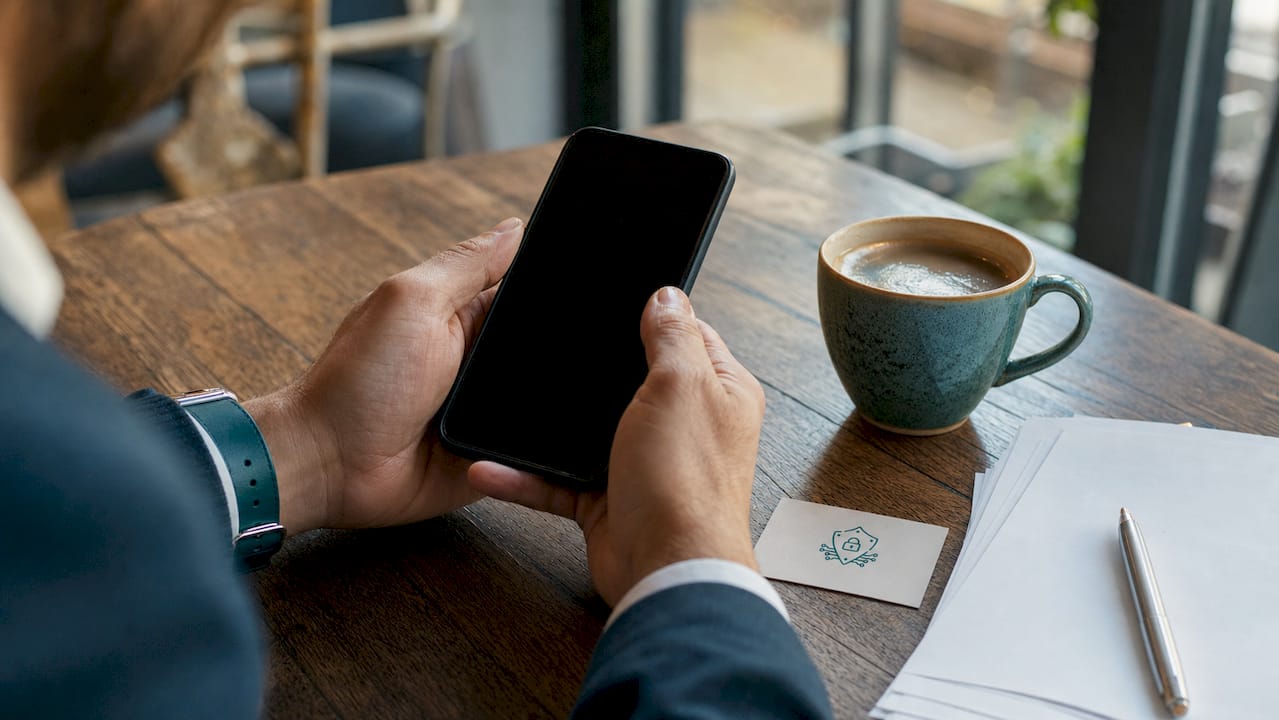
SIM swapping is the process by which an attacker convinces a carrier to transfer a victim’s phone number to an attacker-controlled SIM card. Once successful, the attacker receives every SMS sent to that number, including one-time passwords and work verification codes. Smishing is SMS-based phishing. Unlike email phishing, SMS lacks sender authentication standards like DMARC, which means attackers can impersonate executives via text with no technical barrier. An employee receiving an urgent text that appears to come from the CEO has no reliable way to verify it through the SMS channel alone.
Personal devices compound these vulnerabilities in ways that corporate-issued hardware does not. Most personal phones are not enrolled in MDM, so IT teams cannot enforce encryption policies, push security patches, or remotely wipe data if a device is lost or stolen. Automatic cloud backups on iOS and Android sync SMS threads to personal cloud accounts, which sit entirely outside corporate control. Bluetooth accessories, including smartwatches and wireless earbuds, can also receive and display SMS content, extending the exposure surface beyond the phone itself.
“Employees mistakenly consider their personal phone ‘just another screen,’ not realizing this creates a corporate data liability with no organizational oversight.”
Real-world consequences follow predictably. A sales manager who texts a client’s contract terms over SMS has transmitted that data through an unencrypted channel, stored it on a personal device, and potentially synced it to a personal cloud account. None of those steps are auditable by the organization.
How personal and work SMS lines together create unique risks
Mixing personal and work SMS on one device does not just double the volume of messages. It creates a set of compounded risks that neither channel would generate alone.
-
Fragmented audit trails. Corporate investigations and regulatory audits require complete communication records. When work conversations occur on personal SMS, they fall outside corporate archiving systems. Security teams have no visibility, and compliance officers cannot produce records they do not control.
-
Permanent data sprawl after offboarding. After an employee leaves, corporate SMS conversations remain on their personal device indefinitely. The organization has no mechanism to retrieve or delete that data. This is a permanent uncontrolled data sprawl problem that grows with every departing employee.
-
Legal discovery exposure. When a corporate investigation requires forensic imaging of a device used for work, the entire device is typically imaged. Personal photos, private messages, banking apps, and health data all become part of the discovery record. Forensic imaging of personal devices exposes private content that employees never intended to share with their employer or opposing counsel.
-
Compliance with “right to disconnect” laws. Several jurisdictions now require employers to respect employees’ right to disconnect outside working hours. When work SMS arrives on a personal device, there is no technical boundary between work and personal time. Enforcing compliance with these laws becomes nearly impossible without separate communication channels.
-
Notification fatigue and burnout. Mixed notifications from personal contacts and work threads on the same device reduce the ability to triage urgent security alerts. An employee who ignores a smishing warning because it appeared alongside a flood of personal messages is a predictable outcome of this setup.
Pro Tip: Establish a written BYOD policy that explicitly prohibits work-related SMS on personal devices and specifies which approved apps employees must use instead. A policy without a technical enforcement mechanism is not a control.
Convenience drives Shadow IT usage of personal SMS for work, but that convenience fragments communication outside corporate control and complicates both HR processes and compliance obligations. The risk is not theoretical. It compounds daily with every work message sent through an unmanaged channel.
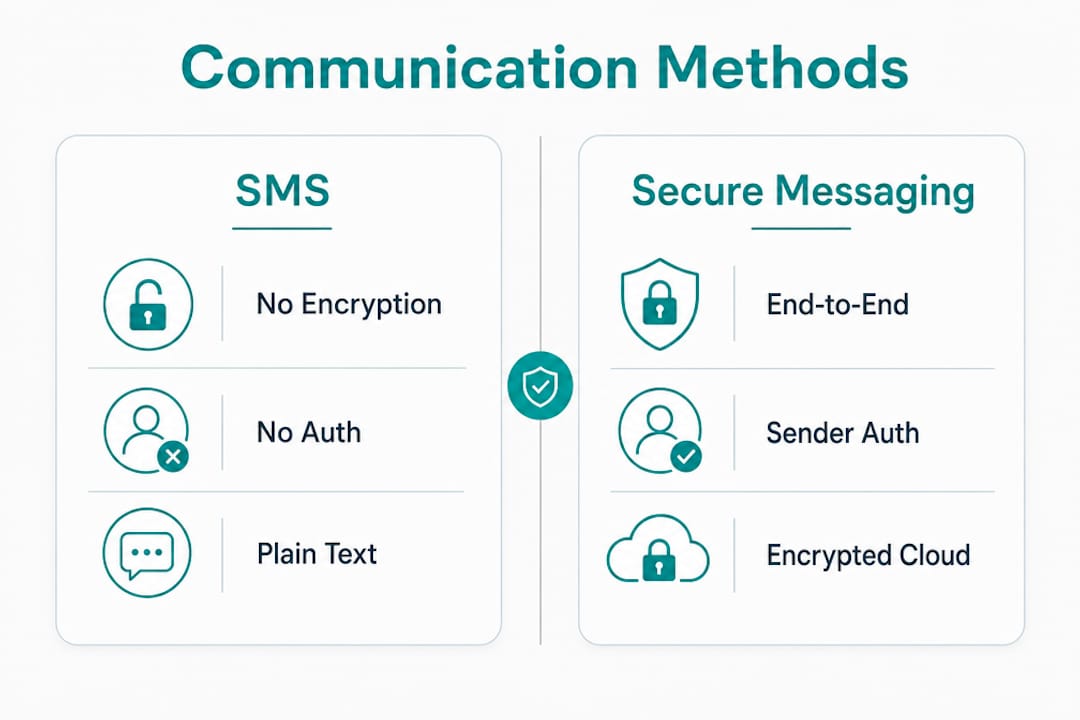
Why SMS is inappropriate for sensitive or regulated data
Regulatory bodies and government agencies have reached a clear consensus: SMS is not a secure channel for sensitive data. This applies to personally identifiable information (PII), protected health information (PHI), financial account data, and any information subject to frameworks like HIPAA, GDPR, or PCI DSS.
The table below compares SMS against company-approved secure messaging on the criteria that matter most for corporate data protection.
| Feature | SMS | Approved secure messaging |
|---|---|---|
| End-to-end encryption | No | Yes |
| Sender authentication | No | Yes (via IAM integration) |
| Remote wipe capability | No | Yes (via MDM) |
| Corporate archiving | No | Yes |
| Audit trail | No | Yes |
| Cloud backup control | No (personal cloud) | Yes (corporate cloud) |
The gap is not marginal. SMS fails on every criterion that regulated industries require. Approved secure messaging apps, deployed through MDM and integrated with identity and access management (IAM) systems, address each of those gaps directly.
Disabling automatic cloud backups for work-related message threads is a necessary step even when employees use approved apps on personal devices. If MDM enrollment is not possible, organizations should require employees to use a dedicated work profile on Android or a managed app container on iOS. These approaches limit data sprawl without requiring a corporate-issued device.
Pro Tip: When evaluating secure messaging apps for BYOD environments, prioritize platforms that support mobile messaging policy enforcement, message expiration, and integration with your SIEM for telemetry.
Best practices for securing work communications on personal devices
Eliminating SMS for work is the correct goal. Getting there requires a practical framework that employees will actually follow.
-
Use only approved secure messaging apps for work. Deploy apps that offer end-to-end encryption, message expiration, and corporate archiving. Require enrollment before granting access to work systems. Document the approved app list in your BYOD policy.
-
Enforce strong device security settings. Require a PIN or biometric lock with an auto-lock timeout of no more than two minutes. Devices without a screen lock provide no barrier to physical access attacks.
-
Disable notification previews on the lock screen. SMS and messaging app previews visible on a locked screen expose content to anyone in physical proximity. This is a simple setting change that eliminates a significant passive exposure risk.
-
Avoid public Wi-Fi without a VPN. Unencrypted Wi-Fi networks allow traffic interception. Employees accessing corporate data over public Wi-Fi without a VPN are transmitting data through an untrusted network. Require VPN use as a condition of BYOD access.
-
Establish a clear incident response procedure for lost or stolen devices. Employees must know to report a missing device immediately. MDM enrollment enables remote wipe. Without it, a lost device containing work SMS threads is an uncontrolled data breach.
-
Train employees to recognize smishing. SMS lacks the sender authentication that email security tools use. Employees are the last line of defense against smishing attacks targeting corporate credentials. Regular simulated smishing campaigns build recognition and reduce click rates on malicious links.
Pro Tip: Phone number spoofing is a common technique attackers use to make smishing messages appear legitimate. Teach employees to verify any urgent financial or credential request through a secondary channel, regardless of the apparent sender. For more on this tactic, see how spoofing works and how to counter it.
Organizations should also consider that SMS security concerns extend beyond IT. Legal, HR, and compliance teams all carry exposure when personal devices hold corporate data. Coordinating policy across those functions produces more durable controls than IT-only mandates.
Key Takeaways
Using personal devices for work SMS creates security, legal, and compliance risks that organizations cannot manage through policy alone. Technical controls and approved platforms are required.
| Point | Details |
|---|---|
| SMS is unencrypted by design | Every work message sent via SMS travels as plain text and is vulnerable to interception. |
| Personal devices lack corporate controls | Without MDM enrollment, IT teams cannot audit, wipe, or enforce security policies on personal phones. |
| Data sprawl outlasts employment | Corporate SMS threads remain on personal devices after offboarding, creating permanent uncontrolled exposure. |
| Forensic imaging carries legal risk | Corporate investigations that image personal devices expose private employee data alongside work content. |
| Approved apps and MDM close the gap | End-to-end encrypted messaging with MDM enrollment addresses every security failure that SMS introduces. |
The uncomfortable truth about SMS convenience in corporate environments
I have spent years watching organizations treat SMS as a low-risk communication channel because it feels informal. That framing is exactly what makes it dangerous. Attackers do not target channels based on how formal they feel. They target channels with weak authentication, no encryption, and high user trust. SMS checks all three boxes.
The pattern I see most often is this: a company deploys a secure messaging platform, trains employees on it, and then watches adoption stall because SMS is already on every phone and requires no setup. Convenience wins in the short term. The compliance and legal teams inherit the consequences months or years later, usually during an investigation or a regulatory audit.
What concerns me most about the current threat environment is the sophistication of executive impersonation via SMS. Because SMS has no DMARC equivalent, an attacker who knows a CEO’s name and an employee’s phone number can send a convincing impersonation text with no technical skill. The mobile messaging blind spot this creates is not a future problem. It is active in enterprise environments right now.
The organizations that manage this risk well share one characteristic: they treat mobile messaging as part of the corporate attack surface, not as a personal employee matter. That shift in framing changes everything from policy design to incident response.
— Sophie
How Smishalert helps organizations address SMS-based threats
Security teams need visibility into threats that occur outside the corporate perimeter. Smishalert is built specifically for that gap.
Smishalert detects smishing attacks, executive impersonation, credential-harvesting campaigns, and payroll fraud targeting employees through SMS, iMessage, WhatsApp, and other messaging channels. The platform enables user reporting, threat correlation, and campaign analysis so security teams can identify patterns before they result in compromise. For organizations managing BYOD environments, Smishalert provides the social engineering attack visibility that traditional email security platforms cannot deliver. If your team needs to understand its human attack surface across messaging channels, Smishalert gives you the telemetry to act on.
FAQ
What makes SMS less secure than other messaging apps?
SMS transmits messages as plain text with no end-to-end encryption and no sender authentication standard like DMARC. Approved secure messaging apps encrypt content in transit and at rest, and they support identity verification that SMS cannot provide.
Can my employer access SMS messages on my personal phone?
Your employer cannot directly access SMS messages on an unmanaged personal device. However, if your device is subject to forensic imaging during a corporate investigation, all content including personal messages may be captured as part of that process.
What is smishing and why does SMS make it worse?
Smishing is phishing conducted via SMS. SMS makes it worse because the protocol has no mechanism to verify the sender’s identity, so attackers can impersonate executives or trusted organizations with no technical barrier. Users are also statistically more likely to trust and act on urgent-looking text messages than emails.
What should organizations do instead of allowing work SMS on personal devices?
Organizations should deploy company-approved end-to-end encrypted messaging apps, require MDM enrollment for any device accessing corporate data, and establish a written BYOD policy that explicitly prohibits work-related SMS. Training employees to recognize smishing is a necessary complement to these technical controls.
Does BYOD automatically create a compliance risk?
BYOD creates compliance risk when it is unmanaged. A BYOD program with MDM enrollment, approved apps, and a clear offboarding procedure that includes remote wipe can meet regulatory requirements. An informal BYOD arrangement where employees use personal SMS for work cannot.