
How to Triage Mobile Phishing Alerts Effectively

Mobile phishing alert triage is the systematic process of assessing, prioritizing, and resolving suspected phishing attempts on mobile devices before they result in account compromise or data loss. Security teams that lack a structured approach to how to triage mobile phishing alerts leave attackers with unchecked dwell time inside the organization. Effective triage combines the NIST Cybersecurity Framework’s “Detect and Respond” functions with mobile-specific telemetry, machine learning classification, and a 15-minute disposition standard that forces rapid, evidence-based decisions. Smishalert is built specifically to surface these threats across SMS, iMessage, and WhatsApp before they reach that critical threshold.
How to triage mobile phishing alerts: the core workflow
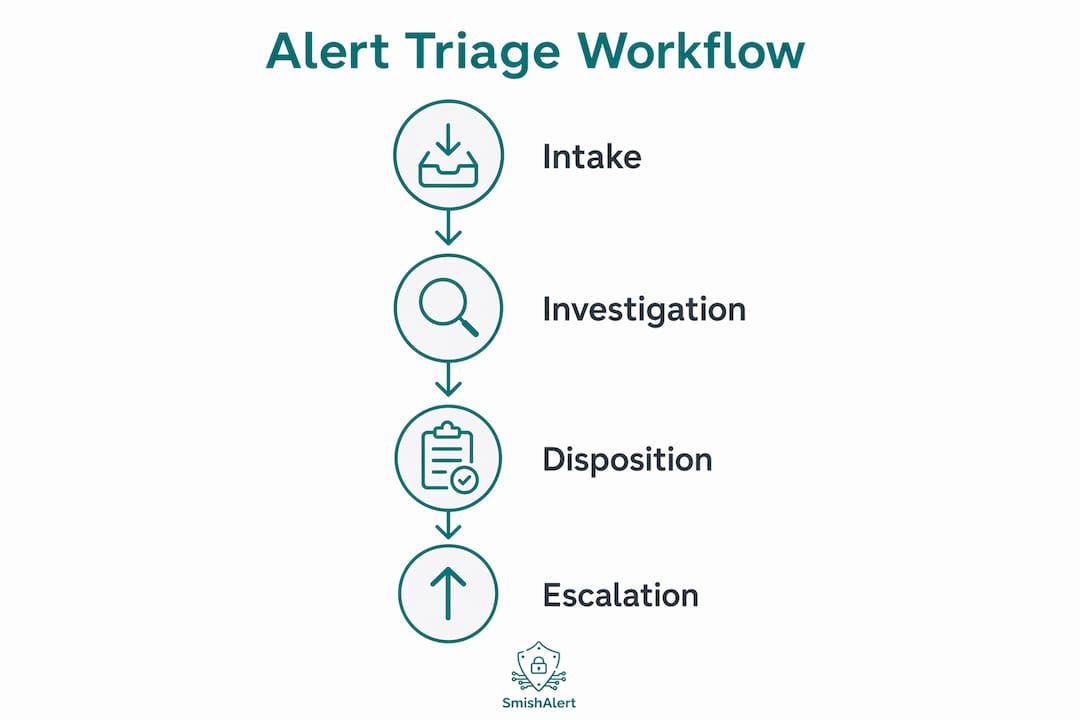
Effective mobile phishing alert triage follows four phases: intake, investigation, disposition, and escalation. Each phase has a defined output, and the entire sequence must complete within a 15-minute triage window to limit attacker dwell time. Missing that window on a credential-harvesting campaign can mean the difference between a contained incident and a full account takeover.
Intake and initial classification
Intake begins the moment a user report or automated detection fires an alert. The analyst records the source channel (SMS, iMessage, WhatsApp, or email), the reported sender, and the message timestamp. Alerts from executive impersonation or payroll fraud lures receive immediate priority because the blast radius of a successful compromise is larger.
Investigation criteria
Investigation applies three authentication checks in sequence: SPF, DKIM, and DMARC validation against the claimed sending domain. After authentication, the analyst submits every URL in the message to a reputation service and runs suspicious links through a sandbox environment. Phishing reports ranked by lookalike domains and brand impersonation signals consistently produce higher-fidelity alerts than generic keyword matching.

Disposition and escalation
Every alert exits triage with one of three dispositions: benign, phishing simulation, or malicious. The table below maps each disposition to its required action.
| Disposition | Key indicators | Required action |
|---|---|---|
| Benign | Passes SPF/DKIM/DMARC, clean URL reputation, no user credential entry | Close alert, log for metrics |
| Phishing simulation | Matches known simulation vendor domain or campaign ID | Close alert, credit user report |
| Malicious | Fails authentication, suspicious URL, credential entry confirmed | Escalate to IR, isolate account, preserve device |
Pro Tip: Never check only the first URL in a message. Phishing campaigns frequently chain URLs through legitimate redirectors such as Google AMP or Microsoft SafeLinks to evade reputation filters. Follow every redirect to its final destination before assigning a disposition.
How does machine learning improve mobile phishing detection?
Machine learning now handles the URL classification step faster than any human analyst. Two models define the current performance ceiling for mobile phishing detection.
- PhishLang (MobileBERT-based): This client-side framework identified roughly 26,000 phishing URLs with over 91% detection of zero-day threats across a 3.5-month deployment. Running entirely on the device means no round-trip latency to a cloud classifier.
- Hybrid super learner ensembles: These ensemble models reached 98.93% accuracy and 99.15% precision in resource-constrained mobile environments. That precision figure matters because false positives waste analyst time and erode trust in the alert pipeline.
- Zero-day coverage: Both architectures address the core weakness of blocklist-based detection, which is the inability to catch newly registered phishing domains before they appear on threat feeds.
- Resource constraints: Mobile processors cannot run large transformer models without optimization. MobileBERT and ensemble methods are specifically designed to operate within mobile CPU and memory limits without sacrificing detection quality.
The practical implication is clear. Integrating a pre-trained ML classifier into the triage workflow means analysts receive a machine-generated confidence score alongside each alert. That score compresses the investigation phase from several minutes to seconds for the majority of clear-cut cases.
Pro Tip: Treat ML confidence scores as a triage accelerator, not a final verdict. Mobile users face heightened susceptibility to AI-generated urgent phishing lures, so a high-confidence “benign” score on a message mimicking an executive still warrants a 30-second human review of the sender domain.
What telemetry sources improve triage decision quality?
Security teams err by treating mobile phishing alerts as isolated events. Accurate triage requires stitching together multiple data streams to build a complete attack narrative before assigning a disposition.
The following sequence describes how correlated telemetry changes a triage outcome. An analyst receives a mobile phishing alert for a credential-harvesting SMS. In isolation, the alert looks low severity because the user did not click the link. Correlated telemetry tells a different story.
- Mobile device management (MDM) logs show the device enrolled a new app with broad permissions 20 minutes before the SMS arrived.
- Identity provider (IdP) logs record a successful login from an unfamiliar geographic location 10 minutes after the SMS.
- SaaS access logs show a bulk download from the organization’s SharePoint environment immediately following that login.
- Email gateway logs reveal a new inbox forwarding rule was created, routing all messages to an external address. Attackers routinely add forwarding rules and unauthorized MFA device enrollments to maintain persistence after initial compromise.
- SIEM correlation surfaces all four events as a single attack chain, elevating the alert from low to critical within the triage queue.
Integrating telemetry from MDM, mobile EDR, identity providers, and cloud access logs gives analysts the full context needed to make accurate disposition decisions. Without that correlation, the SMS alert closes as benign while the attacker operates freely inside the environment. Understanding how endpoint detection response works is foundational to building this kind of correlated triage pipeline.
What pitfalls should security teams avoid in mobile phishing triage?
Common triage mistakes consistently undermine detection quality and destroy forensic evidence. Recognizing these errors before they occur is the fastest way to improve a phishing alert response program.
- Trusting display names over sender domains. Attackers spoof the display name of a known executive while using a completely different sending domain. Always verify the actual domain, not the name shown in the message preview.
- Checking only the first URL. As noted in the investigation phase, redirect chaining hides the true destination. Stopping at the first link produces false benign dispositions on a significant share of mobile phishing campaigns.
- Wiping devices before forensic analysis. Prematurely factory resetting a device destroys volatile memory, local session tokens, and app data that investigators need to reconstruct the attack timeline. Isolate the device from the network first; preserve it second.
- Ignoring inbox forwarding rules. After account compromise, attackers add forwarding rules and new MFA devices to hide ongoing access. Triage that closes at the phishing message without checking account configuration misses the persistence mechanism entirely.
- Skipping user context. Mobile users respond more readily to urgent AI-generated phishing messages because distraction and small screens reduce critical evaluation. A user who clicked a link while commuting deserves a different risk score than one who reviewed the message at a desktop. Triage workflows must account for behavioral context, not just technical indicators.
Correcting these errors requires updating triage playbooks to mandate full URL chain analysis, account configuration review, and a device preservation protocol before any remediation action.
Key Takeaways
Effective mobile phishing alert triage requires a structured, time-bound workflow that combines ML classification, correlated telemetry, and human analyst judgment to reach accurate dispositions within 15 minutes.
| Point | Details |
|---|---|
| 15-minute disposition standard | Every alert must reach a benign, simulation, or malicious verdict within 15 minutes to limit attacker dwell time. |
| Full URL chain inspection | Follow every redirect to its final destination; stopping at the first URL produces false benign dispositions. |
| Correlated telemetry is required | Stitch MDM, IdP, SIEM, and email gateway data together to build a complete attack narrative before closing an alert. |
| Preserve devices before remediation | Isolate compromised devices from the network before any wipe or reset to protect forensic evidence. |
| ML accelerates, humans validate | Machine learning confidence scores compress the investigation phase, but human review of high-risk lures remains necessary. |
The triage gap most security teams are not closing
The honest reality is that most enterprise security programs have mature email triage workflows and almost nothing purpose-built for mobile channels. I have reviewed incident timelines where a credential-harvesting SMS sat unreported for days because the organization had no structured way for employees to flag suspicious messages outside of email. By the time the alert surfaced, the attacker had already established persistence through a forwarding rule and a new MFA enrollment.
The fix is not purely technical. Training employees to report suspicious SMS and WhatsApp messages with the same reflex they apply to email phishing is the fastest way to improve detection speed. A reported message that arrives within minutes of delivery gives analysts a fighting chance to meet the 15-minute disposition window. A message reported three days later is a forensic exercise, not a prevention opportunity.
The other gap I see consistently is over-reliance on ML scores without analyst validation. Ensemble models achieving 99% precision are genuinely impressive, but that remaining fraction of misclassified alerts includes the most sophisticated, targeted campaigns. AI-generated phishing content is now good enough to fool both users and classifiers on first pass. The mobile-specific vulnerability to urgent lures means that adaptive triage workflows, ones that escalate any executive-impersonation or payroll-fraud lure for human review regardless of ML score, will outperform fully automated pipelines in 2026 and beyond.
— Sophie
How Smishalert supports mobile phishing alert triage
Security teams that need visibility into messaging-based threats outside the corporate perimeter have a specific problem that general-purpose SIEM tools do not solve on their own.
Smishalert is built to capture, correlate, and surface social engineering attacks across SMS, iMessage, and WhatsApp before they result in compromise. The platform combines user reporting, threat analysis, and campaign correlation to give analysts the context they need to reach accurate dispositions fast. Security leaders can explore the full range of social engineering attack types Smishalert surfaces, or run a 2-minute readiness check to assess current mobile phishing triage gaps. For teams evaluating live campaign examples, Smishalert Threat Intel provides real-world data to benchmark detection quality.
FAQ
What is mobile phishing alert triage?
Mobile phishing alert triage is the process of assessing, classifying, and responding to suspected phishing attempts on mobile devices. The goal is to assign a disposition (benign, simulation, or malicious) within a defined time window, typically 15 minutes.
How long should mobile phishing triage take?
Effective triage playbooks target a 15-minute maximum window to reach a disposition. Exceeding that window increases attacker dwell time and reduces the chance of containing a credential-harvesting campaign before lateral movement occurs.
Why is telemetry correlation important for mobile phishing triage?
An isolated mobile phishing alert often appears low severity. Correlating it with MDM logs, IdP login events, and email gateway data reveals whether a broader attack chain is already in progress, which changes both the disposition and the escalation priority.
What is the most common mistake in mobile phishing triage?
Checking only the first URL in a message is the most frequent error. Modern phishing campaigns use redirect chains through legitimate services to hide the true destination, so stopping at the first link produces inaccurate benign dispositions.
How does machine learning help with identifying mobile phishing threats?
ML models like MobileBERT-based classifiers and hybrid super learner ensembles generate confidence scores for suspicious URLs in near real time. Those scores compress the investigation phase significantly, though human validation remains necessary for high-risk lure categories such as executive impersonation.