
Messaging App Security Gap: What IT Teams Must Know

A messaging app security gap is any vulnerability in communication apps that end-to-end encryption alone does not address, leaving users exposed to identity attacks, metadata collection, device compromise, and social engineering. The term maps closely to what security researchers call “residual attack surface” in encrypted communications. Understanding this gap is the first step toward building a defense that actually holds. Smishalert identifies and surfaces exactly these threats, targeting the channels that corporate security stacks consistently miss: SMS, iMessage, WhatsApp, and similar platforms. End-to-end encryption protects message content in transit but leaves identity, metadata, device integrity, screenshot risks, and backups fully exposed.
What is a messaging app security gap?
A messaging app security gap describes the class of vulnerabilities that persist after encryption is applied. Encryption solves one problem well: it prevents a network-level attacker from reading message content as it travels between devices. It does not solve the five other problems that attackers routinely exploit.
The five-gap framework covers identity verification, metadata exposure, device integrity, content persistence (screenshots and forwarding), and backup security. Each gap operates independently. An attacker who cannot break the encryption can still impersonate a sender, harvest metadata, compromise the endpoint, capture a screenshot, or access an unencrypted cloud backup. Security teams that treat E2EE as a complete solution leave four of these five attack surfaces undefended.

The industry term for this broader problem is “messaging app threat surface.” The phrase “messaging app security gap” captures the same concept in plain language and is increasingly used by CISA and enterprise security teams when briefing decision-makers on communication app vulnerabilities.
What are the common types of messaging app security gaps?
Messaging app security issues cluster into five distinct categories. Each one represents a separate attack vector that encryption does not address.
Identity and account recovery weaknesses. Most consumer messaging apps tie identity to a phone number. An attacker who ports that number through a SIM-swap attack gains full access to the account, including message history. Account recovery flows often rely on SMS codes, which creates a circular dependency: the channel being secured is also the recovery channel.
Metadata leakage. Encrypted messaging apps leak metadata such as device fingerprints and contact patterns that attackers can collect silently without user alerts. Metadata reveals who communicates with whom, how often, and at what times. That information alone is enough to map an organization’s reporting structure, identify high-value targets, and time a social engineering attack for maximum effect.
Device-level compromise. Zero-click exploits bypass all application-level encryption by compromising the operating system itself. Once the device is compromised, the attacker reads messages before encryption is applied or after decryption occurs. No messaging app can protect against this at the application layer.
Content persistence risks. Screenshots, screen recordings, and message forwarding move content outside the encrypted channel entirely. A message forwarded to an unmanaged device or captured as a screenshot is no longer subject to any cryptographic protection.
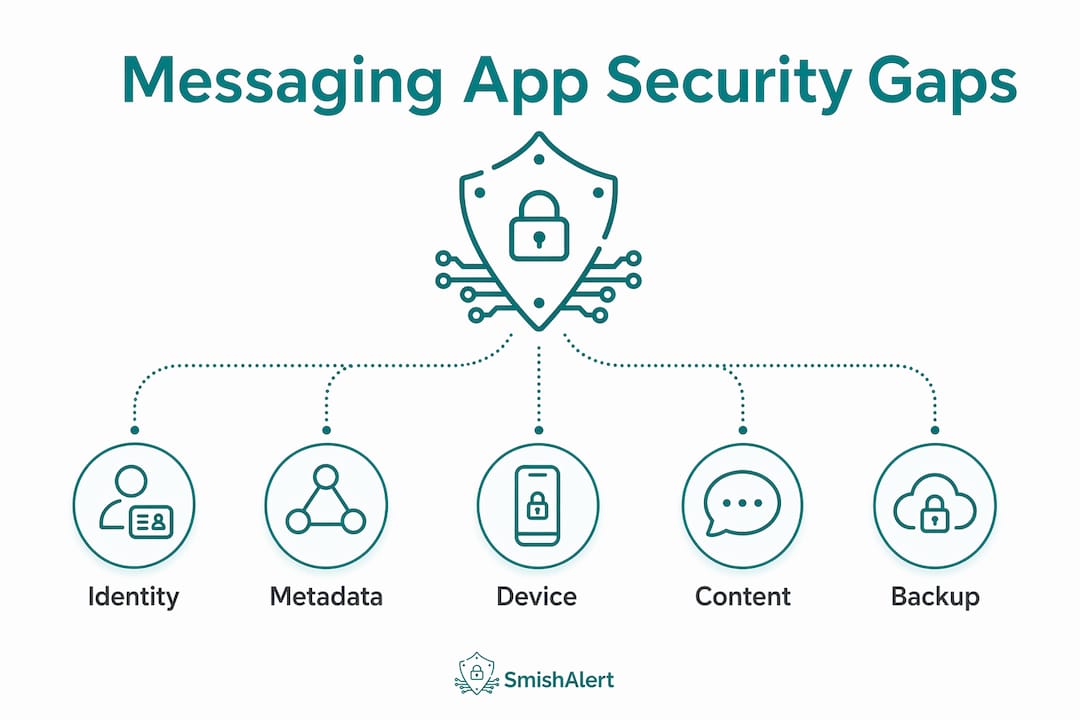
Backup and server retention. Cloud backups of message history are frequently stored without the same encryption applied to messages in transit. An attacker who accesses a cloud storage account retrieves the full message archive in plaintext.
Pro Tip: Audit which cloud backup services your organization’s employees use for messaging apps. iCloud and Google Drive backups of WhatsApp conversations have historically been stored without end-to-end encryption by default. Verify current settings and enforce policy accordingly.
How do recent research findings highlight evolving threats?
The threat landscape for messaging apps shifted materially in 2025 and 2026. Research findings now document attack methods that were previously theoretical or limited to nation-state actors.
| Threat Category | Finding | Implication |
|---|---|---|
| Spyware and zero-click exploits | CISA confirmed that cyber threat actors use commercial spyware to bypass E2EE by compromising the device | Government officials and civil society targets are actively exploited; corporate executives face the same risk profile |
| Protocol-level vulnerabilities | Formal analysis of the Double Ratchet protocol revealed vulnerabilities affecting Forward Secrecy and message injection, patched after disclosure in Q1/Q2 2026 | Cryptographic protocols considered mature can still carry undetected flaws for years |
| Metadata persistence | Metadata leakage persists regardless of message content encryption, enabling social graph mapping | Traffic analysis alone can expose organizational structure without decrypting a single message |
| Impersonation attacks | Executive impersonation via messaging apps is a documented attack vector targeting payroll, wire transfers, and credential access | Social engineering exploits identity gaps, not cryptographic gaps |
The Double Ratchet finding deserves particular attention. Protocols like the Double Ratchet are difficult to analyze formally, and recent proofs found novel vulnerabilities that had persisted undetected for years. The fact that a widely deployed, peer-reviewed protocol carried exploitable flaws through Q1 2026 demonstrates that no cryptographic implementation should be treated as permanently secure.
Social engineering attacks target identity and user behavior layers rather than cryptographic layers. This is the core reason why messaging app security gaps matter to IT security teams: the attacker’s most efficient path to compromise runs through the human layer, not the encryption layer.
What are the nuances and trade-offs in messaging app security?
End-to-end encryption is necessary but not sufficient. Security teams that deploy E2EE-capable apps and consider the problem solved have addressed one layer of a five-layer problem.
The most commonly misunderstood trade-off involves backups. Decision-makers must differentiate between protecting data in transit and protecting backups and device storage, which are often far less secure. A message encrypted in transit can be stored in a cloud backup without equivalent protection. The encryption status of the backup depends on the backup provider’s implementation, not the messaging app’s.
Device control is the second major gap. Application-level security cannot compensate for a compromised operating system. An attacker with root access to a device reads every message on that device regardless of which app sent it. This is why device-level compromises represent the highest-severity threat in the messaging app risk model.
Social engineering exploits the identity gap directly. An attacker does not need to break encryption to impersonate a CFO over WhatsApp and instruct a finance team member to process a wire transfer. The attack succeeds because the messaging app provides no verified identity signal. The recipient sees a display name and a phone number, neither of which is cryptographically bound to the sender’s real identity.
Pro Tip: Metadata minimization is an architectural choice, not a configuration setting. Apps with no-account identity models and built-in metadata minimization provide stronger protection against tracking than phone-number-based apps. Evaluate this at the procurement stage, not after deployment.
A layered security defense stack for messaging must address all five gaps independently. Encryption handles content in transit. Identity verification handles sender authentication. Mobile device management or equivalent controls handle device integrity. Policy and training handle content persistence risks. Encrypted, access-controlled backup solutions handle data at rest.
What practical steps can IT teams take to mitigate these risks?
Closing messaging app security gaps requires policy, technical controls, and user education working together. No single control addresses all five gap categories.
-
Restrict consumer-grade apps for sensitive communication. Consumer messaging apps lack compliance mechanisms, auditing, and administrative controls required for sensitive corporate communication. Define which apps are approved for which communication categories and enforce that policy through acceptable-use agreements and technical controls where possible.
-
Harden devices and maintain patch cadence. Zero-click exploits target unpatched operating systems. A rigorous patch management program that prioritizes mobile OS updates reduces the window of exposure. Verify that all devices accessing corporate messaging channels run current OS versions.
-
Minimize metadata exposure. Prefer apps that do not require phone number registration and that minimize contact metadata collection. Evaluate security-focused messaging options that offer delete-on-read and screenshot resistance features. Document the metadata retention policies of every approved messaging platform.
-
Train employees to recognize social engineering in messaging channels. Credential-harvesting attacks, executive impersonation, and gift card scams all arrive via messaging apps. Training must cover messaging-specific attack patterns, not just email phishing. Employees should know how to report suspicious messages and understand that display names are not verified identities.
-
Enforce encrypted backup policies. Require that messaging app backups use end-to-end encrypted backup options where available. Audit cloud storage permissions and restrict backup destinations to approved, access-controlled environments.
-
Deploy a messaging security checklist and run periodic readiness evaluations. Structured checklists surface configuration gaps that policy documents miss. Readiness evaluations identify which employee populations are most vulnerable to messaging-based social engineering before an incident occurs.
-
Establish an incident response process for messaging-based attacks. Phishing and smishing attacks increasingly abuse messaging apps because of their ubiquity and user trust. An incident response plan that does not include messaging channels is incomplete. Define escalation paths, evidence preservation steps, and communication protocols specific to messaging-based incidents.
Key Takeaways
Messaging app security gaps exist across five independent attack surfaces, and end-to-end encryption addresses only one of them, leaving identity, metadata, device integrity, content persistence, and backup security as active risks.
| Point | Details |
|---|---|
| E2EE is not a complete defense | Encryption protects content in transit but leaves metadata, identity, backups, and device integrity unprotected. |
| Device compromise overrides all app security | Zero-click exploits and root-level access defeat application-layer encryption entirely. |
| Metadata reveals organizational structure | Contact patterns and communication frequency expose high-value targets even when message content is encrypted. |
| Social engineering targets the identity gap | Executive impersonation and credential-harvesting attacks exploit the absence of verified sender identity in consumer apps. |
| Mitigation requires layered controls | Effective defense combines policy, device hardening, metadata minimization, user training, and encrypted backups. |
The gap that keeps getting wider
Security teams tend to evaluate messaging apps the way they evaluate email: look for encryption, check the box, move on. That mental model is the real vulnerability. After working with organizations across regulated industries, the pattern is consistent. The breach rarely comes through the encryption. It comes through an employee who received a WhatsApp message from someone claiming to be the CEO, asking for an urgent wire transfer or a set of credentials. The encryption was working perfectly. The identity layer was completely absent.
The Double Ratchet findings from 2026 reinforce a point that experienced practitioners already know: cryptographic confidence decays. Protocols that passed peer review carry undiscovered flaws. Implementations diverge from specifications. The threat actors who target enterprise messaging channels are not trying to break the math. They are exploiting the gaps around the math, and those gaps are organizational, behavioral, and architectural.
The organizations that close these gaps fastest share one characteristic: they treat messaging security as a continuous program, not a one-time configuration. They run regular readiness evaluations, update training to reflect current attack patterns, and maintain visibility into the messaging channels their employees actually use, not just the ones IT approved. That visibility is the hardest part to build and the most valuable to have.
— Sophie
How Smishalert addresses messaging app security gaps
Smishalert provides security teams with visibility into the messaging channels that traditional perimeter tools cannot reach. The platform surfaces social engineering attacks delivered via SMS, iMessage, WhatsApp, and other consumer messaging apps, including executive impersonation, credential-harvesting campaigns, payroll fraud, and gift card scams. Smishalert deploys without requiring MDM, which removes the primary barrier to adoption in organizations with BYOD policies. Security teams gain campaign correlation, threat analysis, and user reporting in a single view. Start with the 2-minute readiness check to identify where your organization’s messaging attack surface is most exposed, or review the full solutions catalog to see the specific attack types Smishalert surfaces.
FAQ
What is a messaging app security gap?
A messaging app security gap is any vulnerability in a communication app that end-to-end encryption does not address, including identity verification failures, metadata leakage, device compromise, screenshot risks, and unencrypted backups.
How secure are messaging apps with end-to-end encryption?
End-to-end encryption secures message content in transit, but it does not protect metadata, sender identity, device integrity, or backup storage. Attackers routinely exploit these residual gaps without breaking the encryption itself.
What are the biggest communication app vulnerabilities in 2026?
CISA confirmed that commercial spyware and zero-click exploits bypass E2EE by compromising the device directly. Formal analysis of the Double Ratchet protocol also revealed patched vulnerabilities affecting Forward Secrecy and message injection as recently as Q1/Q2 2026.
How does metadata leakage create messaging app privacy concerns?
Metadata traffic analysis can reveal social graphs, communication frequency, and organizational hierarchies even when message content is fully encrypted. This data requires separate architectural protections that most consumer messaging apps do not provide.
What is the most effective way to protect messaging app data in an organization?
A layered approach combining device hardening, approved-app policies, encrypted backup enforcement, metadata minimization, and employee training against social engineering provides the most complete defense against messaging app security gaps.