
VIP Mobile Threat Monitoring Checklist for Security Teams

A VIP mobile threat monitoring checklist is a curated set of targeted security controls and detection steps designed to protect high-profile individuals from advanced mobile attacks. Security teams managing executive and VIP endpoints face a distinct threat profile: targeted spyware, credential-harvesting campaigns, and executive impersonation via SMS and messaging apps. Combined deployment of Mobile Device Management (MDM), Mobile Threat Defense (MTD), and incident response runbooks reduces attacker dwell time and business impact by 30–60%. This guide breaks down every control, detection practice, and implementation timeline your team needs to protect high-risk mobile endpoints.
1. What essential controls belong in a VIP mobile threat monitoring checklist?
The foundation of any enterprise mobile threat visibility checklist is a layered control stack. No single tool covers the full attack surface. MDM handles configuration enforcement, MTD handles active threat detection, and incident response runbooks handle containment. All three must work together.
Device enrollment and configuration controls:
- Enroll all VIP devices in MDM before deployment. Unenrolled devices cannot receive policy updates or remote wipe commands.
- Enforce OS updates within 48 hours of release. Unpatched devices are the most common entry point for mobile exploits.
- Require hardware-based multi-factor authentication (MFA) such as FIDO2 security keys. SMS-based MFA is vulnerable to SIM-swapping attacks.
- Block installation of unmanaged configuration profiles. Restricting profile installs removes the most straightforward vectors exploited by iOS exploit frameworks.
- Prohibit sideloading. Restrict app installation to the App Store or enterprise-signed apps only.
Mobile Threat Defense requirements:
MDM is a configuration tool, not a threat detector. It cannot identify rogue Wi-Fi networks, man-in-the-middle attacks, or malicious browser behavior. MTD agents fill that gap by collecting real-time telemetry including app installs, jailbreak indicators, and suspicious network connections.
- Deploy MTD agents on all VIP devices.
- Configure telemetry collection for app behavior, network anomalies, and device integrity signals.
- Route MTD alerts to your SIEM for correlation with identity and network signals.
Incident response playbook elements:
- Define forensic image capture procedures before any device is wiped.
- Establish device isolation steps that do not destroy evidence.
- Set triage timelines: high-severity alerts must reach a human analyst within 15 minutes.
Pro Tip: Audit your MDM enrollment status weekly. Devices that fall out of management silently are a common blind spot in VIP security programs.
2. How should security teams conduct ongoing threat detection and hunting on VIP devices?

Continuous monitoring requires more than passive alerting. Weekly mobile threat hunts focused on unauthorized profile installs, unsigned processes, and abnormal mailbox access increase detection sensitivity and reduce dwell time.
Telemetry sources to integrate:
- MDM logs: enrollment status, policy compliance, app inventory changes
- MTD agent data: network connections, jailbreak signals, malicious URL detections
- Identity signals: IAM login anomalies, MFA bypass attempts, OAuth token grants
- Network signals: DNS query logs, VPN connection gaps, rogue access point detections
- Email and messaging telemetry: abnormal forwarding rules, mailbox delegation changes
Hunting queries to run weekly:
- New configuration profiles installed outside the MDM console
- Unsigned daemons or processes on managed iOS and Android devices
- Abnormal mailbox access from mobile IP ranges not associated with the VIP’s travel history
- MFA enrollment changes not initiated by IT
- App installations from outside approved sources
Detection SLAs to enforce:
Integrating telemetry into a central SIEM with automated alerting achieves detection SLAs under 8 hours for mobile exploitation indicators. High-severity alerts should trigger automated notifications within 15 minutes. Medium-severity alerts should reach an analyst within 4 hours.
Tuning matters as much as coverage. Untuned rules generate alert fatigue and cause analysts to miss real signals. Review and refine detection rules monthly based on hunt findings and false-positive rates.
Pro Tip: Build a dedicated hunt playbook for VIP devices separate from your general endpoint hunt program. VIP devices have different baseline behaviors, and generic rules generate excessive noise.
For practical guidance on mobile threat detection tailored to enterprise security teams, Smishalert’s resource library covers telemetry sources and focal points in depth.
3. What are the best practices for VIP mobile threat prevention through attack surface reduction?
Attack surface reduction is the most underused control in most VIP security programs. Disabling 2G, enforcing hardware MFA, and blocking sideloading together reduce the most common spyware delivery vectors.
Radio and network controls:
- Disable 2G on all VIP devices. Legacy 2G networks are vulnerable to IMSI catcher attacks that intercept calls and SMS.
- Disable Bluetooth when not actively in use. Bluetooth proximity attacks require no network access.
- Block auto-join for open Wi-Fi networks. Require VPN before any network connection outside managed corporate Wi-Fi.
Authentication hardening:
- Replace SMS-based MFA with FIDO2 hardware keys or device-bound passkeys. SMS MFA fails against SIM-swapping and SS7 attacks.
- Enforce biometric lockscreen with a maximum 30-second auto-lock timeout.
- Require full-disk encryption on all VIP devices. Verify encryption status through MDM compliance reports.
App and profile controls:
- Maintain an approved app allowlist. Any app outside the list requires security review before installation.
- Block developer mode and USB debugging on all VIP devices.
- Restrict AirDrop and similar peer-to-peer file transfer features to contacts only, or disable entirely.
Treating a VIP’s mobile device as a personal gadget is the single most dangerous assumption in executive protection. The device is a high-value intelligence target. Every radio, every app, and every authentication method is an attack vector. Radical surface reduction is not inconvenient. It is the baseline.
Physical custody matters too. VIP devices should never be left unattended in public spaces. Tamper-evident cases and secured storage protocols belong in the physical security plan alongside the digital controls.
4. How to operationalize the checklist with a phased rollout plan
Security teams should implement prioritized controls within 30–90 days to effectively mitigate risks for high-profile individuals. The table below maps controls to implementation phases.
| Phase | Timeline | Controls to Deploy |
|---|---|---|
| Urgent controls | Days 0–30 | MDM enrollment, OS update enforcement, hardware MFA, sideloading block, MTD agent deployment |
| Detection enablement | Days 31–60 | SIEM telemetry integration, hunting queries, alert triage SLAs, forensic image procedures |
| Tuning and automation | Days 61–90 | Rule refinement, automated response playbooks, tabletop exercises, credential rotation schedule |
Field and travel deployment practices:
VIP devices used in high-risk travel environments require additional controls. Post-travel device sanitization including quarantining, forensic scanning, and credential rotation is critical after field deployments. Treat any device that traveled to a high-risk country as potentially compromised until cleared.
- Issue managed eSIMs for international travel. Physical SIM swaps in foreign countries are a known attack vector.
- Disable auto-join Wi-Fi before departure. Require manual VPN connection before any network use.
- Quarantine the device for forensic review upon return before reconnecting to corporate systems.
- Rotate all credentials associated with the device after high-risk travel, including email, VPN, and IAM tokens.
Tabletop exercises and IR drills:
Run a mobile compromise tabletop exercise at least twice per year. Include the VIP’s protection team, IT, and the security operations center. Scenarios should cover spyware installation via malicious profile, credential theft via smishing, and physical device compromise. Post-exercise, update the incident response playbook with findings.
Adjust control intensity based on the VIP’s role and current threat level. A traveling executive during a high-profile acquisition requires stricter controls than the same executive in a low-risk period. Build tiered profiles into your mobile security checklist so teams can escalate quickly.
Key Takeaways
A VIP mobile threat monitoring checklist requires layered controls across MDM, MTD, attack surface reduction, and incident response to cut attacker dwell time by 30–60%.
| Point | Details |
|---|---|
| MDM alone is insufficient | Deploy MTD agents alongside MDM to detect active threats MDM cannot see. |
| Weekly hunting is required | Run targeted hunt queries weekly on profile installs, unsigned processes, and mailbox anomalies. |
| Attack surface reduction is critical | Disable 2G, block sideloading, and enforce hardware MFA to eliminate common spyware vectors. |
| Phased rollout in 30–90 days | Deploy urgent controls first, then detection, then automation to build a sustainable program. |
| Post-travel sanitization is mandatory | Quarantine, forensically scan, and rotate credentials for all VIP devices after high-risk travel. |
Why most VIP mobile security programs fail before they start
The most common failure I see is organizations that deploy MDM, check the compliance box, and assume the job is done. MDM tells you whether a device has a passcode. It does not tell you whether that device is actively exfiltrating data over an encrypted channel to a command-and-control server.
The second failure is treating VIP mobile security as an IT problem rather than a security operations problem. IT manages the device. Security operations detects the threat. When those two functions do not share telemetry and triage workflows, attackers exploit the gap. I have seen incidents where a malicious profile sat on an executive’s device for weeks because the MDM alert went to an IT queue that security never monitored.
The third failure is cultural. VIPs resist controls because they perceive them as friction. The framing matters. A device with 2G disabled and hardware MFA is not a restricted device. It is a device that will not be used to compromise the organization’s most sensitive communications. Security teams that make this case clearly get better compliance than teams that simply push policy.
Cybersecurity professionals building these programs should also consider how mobile threat monitoring skills are increasingly valued in enterprise security hiring. The demand for practitioners who can operate MTD platforms and run mobile-specific hunt programs is growing fast.
The checklist is not the destination. It is the starting point for a continuous program that adapts as the threat environment changes. Review it quarterly. Update it after every incident. Treat every near-miss as a signal that a control needs tightening.
— Sophie
Smishalert’s platform for mobile threat visibility
Security teams that have deployed MDM and MTD still face a critical gap: visibility into social engineering attacks that arrive via SMS, iMessage, and WhatsApp. These attacks target VIPs directly on their personal and corporate devices, outside the reach of traditional email security controls.
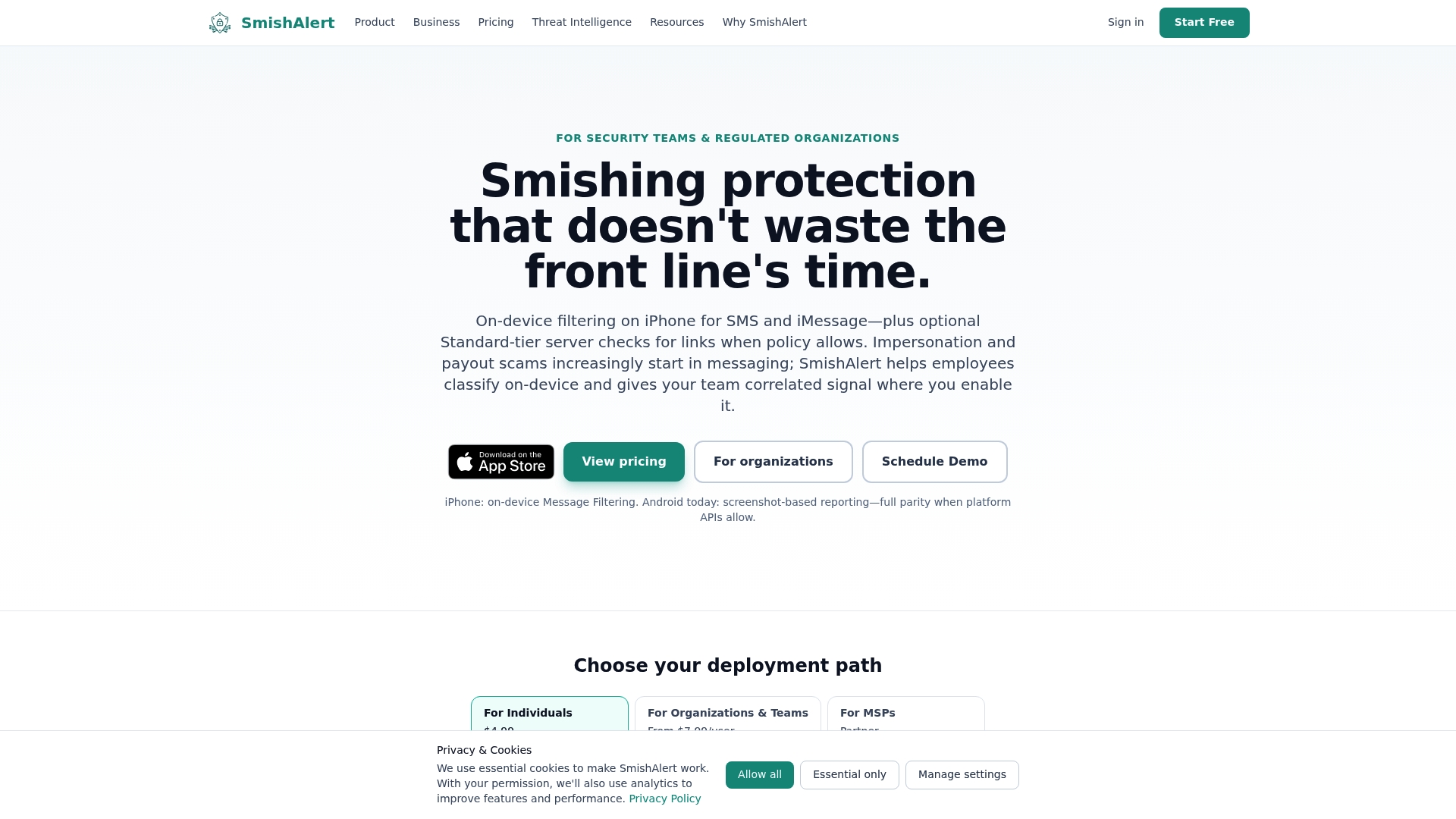
Smishalert provides mobile threat intelligence that surfaces executive impersonation, credential-harvesting campaigns, and smishing attacks before they result in compromise. The platform integrates with existing mobile security controls and gives security teams the campaign correlation and reporting they need to act fast. Teams can also use the Smishalert self-evaluation tool to assess their current mobile threat readiness in under two minutes and identify gaps in their VIP protection program.
FAQ
What is a VIP mobile threat monitoring checklist?
A VIP mobile threat monitoring checklist is a structured set of security controls, detection procedures, and response steps designed to protect high-profile individuals from targeted mobile attacks. It covers MDM enrollment, MTD deployment, attack surface reduction, and incident response playbooks.
Why is MDM not enough for VIP mobile security?
MDM is a configuration enforcement tool and cannot detect active threats like rogue Wi-Fi or man-in-the-middle attacks. Mobile Threat Defense agents are required to provide real-time telemetry and dynamic protection for VIP devices.
How often should security teams run mobile threat hunts for VIPs?
Security teams should run targeted threat hunts weekly, focusing on unauthorized profile installs, unsigned processes, and abnormal mailbox or MFA activity on VIP devices.
What should happen to a VIP device after high-risk travel?
The device should be quarantined, forensically scanned, and cleared before reconnecting to corporate systems. All associated credentials including email, VPN, and IAM tokens should be rotated immediately after return from high-risk travel.
How long does it take to implement a VIP mobile threat monitoring program?
A phased rollout covering urgent controls, detection enablement, and automation tuning takes 30–90 days. Urgent controls including MDM enrollment, MTD deployment, and sideloading blocks should be in place within the first 30 days.