
How to Align Mobile Threat Strategy in Your Security Roadmap

A mobile threat strategy is defined as the set of controls, policies, and detection capabilities an organization deploys to protect mobile devices, apps, and users from targeted attacks. Aligning that strategy within a broader security roadmap is the difference between reactive patching and proactive defense. Frameworks like OWASP MASVS and Zero Trust architecture give security teams a structured way to close the gap between mobile risk and enterprise policy. Without that alignment, mobile remains the weakest link in an otherwise mature security program.
What are the essential components to align mobile threat strategy in a security roadmap?
Mobile security alignment starts with connecting device controls to business objectives, not treating them as a separate IT concern. Every mobile policy decision, from acceptable use to app vetting, should trace back to a specific business risk the organization has agreed to manage.
The foundational controls matter more than most teams acknowledge. Increasing PIN complexity from 4 digits to 6 digits raises possible combinations from 10,000 to 1 million. That single change meaningfully raises the cost of a brute-force attack on an unmanaged device. Similarly, configuring automatic lock to activate after 30 seconds of inactivity reduces the window for unauthorized access when a device is left unattended.

Policy frameworks give these controls structure. OWASP MASVS defines verification requirements across storage, cryptography, authentication, and network communication for mobile apps. NIST SP 800-124 covers enterprise mobile device management at the policy level. Aligning to both gives security teams a defensible baseline and a common language for audits.
The table below maps key framework components to their primary function in a mobile security roadmap.
| Framework component | Primary function |
|---|---|
| OWASP MASVS authentication controls | Define minimum standards for biometric and MFA requirements |
| NIST SP 800-124 device management | Guide MDM policy, enrollment, and remote wipe procedures |
| Zero Trust access policy | Enforce continuous verification of device posture and user identity |
| App vetting and code signing | Prevent unauthorized or tampered apps from accessing corporate resources |
| Incident response playbooks | Define containment steps and reporting timelines for mobile incidents |
Pro Tip: Map each mobile control to a specific business risk in your risk register. Controls without a linked risk are the first to get cut when budgets tighten.
How do you implement mobile-specific identity and runtime protections effectively?
Mobile identity protection fails when teams apply web-centric assumptions to a fundamentally different environment. A browser session and a mobile app session carry different trust signals, different attack surfaces, and different user behaviors.
Zero Trust for mobile is a continuous verification process that evaluates device posture, user behavior, and environment throughout the session, not just at login. That distinction matters because a device that passes authentication at 9:00 AM may be compromised or in a different network context by 11:00 AM. Continuous evaluation catches that drift.
Effective mobile identity and runtime protections include the following layers:
- Biometric MFA with fallback controls. Fingerprint and face recognition reduce credential theft risk, but fallback PINs must meet complexity requirements to avoid creating a weaker path.
- Runtime Application Self-Protection (RASP). RASP monitors app behavior from inside the runtime environment and blocks tampering, reverse engineering, and injection attacks in real time.
- API attestation. Cryptographic tokens verify that API calls originate from a legitimate, unmodified app instance rather than an automated script or modified client.
- Certificate pinning. Pinning the app to a specific server certificate prevents man-in-the-middle attacks on mobile API traffic.
- Anti-tampering checks. Build-time and runtime checks detect rooted or jailbroken devices and deny access to sensitive resources when device integrity fails.
Mobile-specific risks require RASP and API-level attestation that treat devices as inherently untrusted regardless of user status. That assumption forces developers to build defenses into the app itself rather than relying on network perimeter controls that mobile devices routinely bypass.
Security leaders should also assign mobile risks to explicit layers: code, build-time, and runtime. Generic controls applied across all layers create gaps. A SQL injection risk lives in code. A tampered binary is a build-time risk. A rooted device executing malicious hooks is a runtime risk. Each requires a different control.
Pro Tip: Test your RASP and attestation controls against emulated environments, not just physical devices. Attackers increasingly use emulators to bypass device-level checks.
What role does telemetry-driven threat detection play in your security roadmap?
Telemetry is the foundation of a detection capability that can keep pace with mobile threats. Without structured signal collection, security teams are blind to what is happening on devices outside the corporate perimeter.
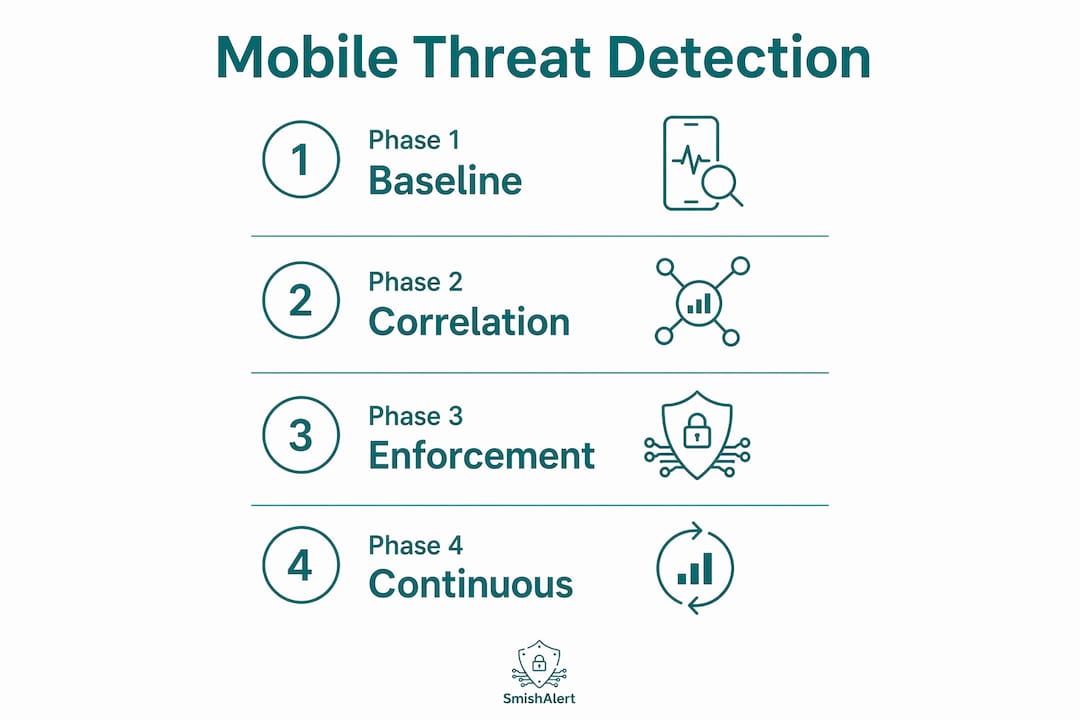
A mature mobile threat detection architecture collects signals from multiple sources and correlates them before triggering a response. Cryptographic attestation tokens combined with behavioral baselines at API gateways verify traffic legitimacy for mobile apps. WAF edge behavioral controls and behavioral analytics add additional detection layers that catch threats attestation alone misses.
The phased rollout approach below reduces false positives and builds team confidence before enforcement begins.
| Phase | Mode | Primary activity |
|---|---|---|
| Phase 1: Baseline | Monitor only | Collect signals, establish behavioral baselines, no blocking |
| Phase 2: Tune | Alert and review | Refine detection rules, reduce false positives, train SOC analysts |
| Phase 3: Enforce | Active blocking | Enforce policy violations, trigger automated containment |
| Phase 4: Automate | Automated response | Integrate playbooks, SIEM alerts, and remote wipe workflows |
Phased rollout of detection tools is critical. Starting in monitor-only mode establishes a baseline before enforcement begins, which prevents user disruption and gives analysts time to distinguish normal behavior from genuine threats.
GDPR-compliant telemetry design requires anonymizing user-level data before it enters logging pipelines. Aggregate behavioral signals rather than individual session logs wherever possible. That approach satisfies privacy requirements without sacrificing detection fidelity.
Mobile telemetry integration into CI/CD and SIEM creates a continuous feedback loop that makes security proactive rather than reactive. When a new app build introduces a regression in certificate pinning, the CI/CD pipeline catches it before production deployment. When a SIEM rule fires on anomalous API traffic, the SOC has mobile context alongside network and endpoint telemetry.
Pro Tip: Build a dedicated mobile threat dashboard in your SIEM from day one. Mixing mobile signals into generic endpoint dashboards buries the signals that matter most.
How do you maintain and evolve your mobile threat strategy over time?
A mobile threat strategy that does not change is a strategy that is already falling behind. The threat landscape shifts faster than annual review cycles can accommodate.
Continuous improvement requires structure. Runbooks, incident playbooks, and quarterly reviews are the mechanisms that turn lessons learned into updated controls. After each incident or near-miss, the playbook should be updated before the post-incident report is closed.
Key practices for sustaining mobile security alignment include:
- Quarterly threat model updates. Review new CVEs, OWASP MASVS updates, and threat intelligence feeds to identify gaps in current controls.
- Annual mobile penetration testing. Test both the app layer and the device management layer. Many teams test apps but skip MDM policy validation.
- KPI tracking. Measure mean time to detect (MTTD) and mean time to respond (MTTR) for mobile incidents separately from general endpoint metrics.
- Cross-team governance. Include legal, HR, and product teams in mobile policy reviews. Policies that ignore business workflows get bypassed.
- Emerging technology assessment. Evaluate decentralized identity standards and post-quantum cryptography on a defined schedule, not ad hoc.
Lost or compromised devices must be reported within 4 hours to enable timely remote wipe and containment. That 4-hour window is the difference between a contained incident and a data exfiltration event. Build that requirement into your acceptable use policy and test it in tabletop exercises.
Security teams should also avoid the checklist trap. Half of mobile risks require controls outside application code, such as RASP or API gateway settings. Treating a completed OWASP MASVS checklist as a finished security program misses the runtime and infrastructure layer entirely.
Pro Tip: Schedule a mobile-specific tabletop exercise twice a year. Most incident response teams practice for endpoint and cloud scenarios but have never walked through a mobile compromise scenario end to end.
Key Takeaways
Aligning a mobile threat strategy within a security roadmap requires layered controls, phased detection, and continuous review tied to measurable business outcomes.
| Point | Details |
|---|---|
| Start with baseline controls | A 6-digit PIN and 30-second auto-lock are the minimum acceptable device policy settings. |
| Apply Zero Trust continuously | Evaluate device posture, user behavior, and environment throughout every session, not just at login. |
| Phase your detection rollout | Begin in monitor-only mode to establish baselines before moving to enforcement and automated response. |
| Report incidents within 4 hours | A 4-hour reporting window for lost or compromised devices is the threshold for effective containment. |
| Review quarterly, not annually | Threat models, playbooks, and KPIs must update on a quarterly cycle to stay ahead of emerging mobile risks. |
The alignment gap most security roadmaps ignore
The hardest part of mobile security alignment is not the technology. It is the organizational assumption that mobile is covered because MDM is deployed. I have seen mature security programs with strong endpoint and cloud posture that had almost no visibility into what was happening on employee mobile devices outside the corporate network.
The real gap is in the human layer. Credential-harvesting attacks delivered via SMS, WhatsApp, and iMessage bypass every perimeter control an organization has built. Employees receive a message impersonating an executive, click a link on a personal device, and enter credentials that then get used against corporate systems. The MDM never sees it. The SIEM never fires. The SOC has no signal.
Closing that gap requires treating mobile messaging as an attack surface in its own right, not an extension of email. That means building mobile security into your enterprise defense strategy from the ground up, with specific controls for social engineering delivered through messaging channels. It also requires executive buy-in, because the budget for mobile-specific detection tools rarely comes from existing endpoint security allocations.
The teams that get this right share one trait: they treat mobile threat alignment as a continuous program, not a project with a completion date.
— Sophie
Smishalert and the mobile threat visibility gap
Mobile threat detection is only as good as the signals your team can see. Most enterprise security programs have strong coverage for email and endpoint but limited visibility into social engineering attacks delivered through SMS, iMessage, and WhatsApp.
Smishalert fills that gap. The platform captures user-reported messaging threats, correlates them into campaigns, and surfaces executive impersonation, credential harvesting, and payroll fraud attempts that never appear in email security logs. Security teams get real-time threat intelligence on active mobile phishing campaigns targeting their organization. For teams building a mobile threat detection roadmap, Smishalert provides the human-layer visibility that technical controls alone cannot deliver. Start with a 30-day exposure assessment to understand your current messaging attack surface before your next roadmap review.
FAQ
What is a mobile threat strategy in enterprise security?
A mobile threat strategy is the set of policies, controls, and detection capabilities an organization uses to protect mobile devices, apps, and users from targeted attacks. It covers device management, identity verification, runtime app protection, and incident response.
How does Zero Trust apply to mobile device security?
Zero Trust for mobile evaluates device posture, user behavior, and network environment continuously throughout each session, not just at the point of authentication. This approach catches compromised devices that passed initial login checks.
What is RASP and why does it matter for mobile apps?
Runtime Application Self-Protection (RASP) monitors app behavior from inside the runtime environment and blocks tampering, injection, and reverse engineering in real time. It is a critical control because mobile apps operate outside the corporate network perimeter where traditional defenses do not apply.
How quickly should a lost mobile device be reported?
A lost or compromised device should be reported within 4 hours to enable remote wipe and containment before data exfiltration occurs. Build this requirement into your acceptable use policy and test it in tabletop exercises.
How do you align mobile security policy with industry standards?
Align mobile policy to OWASP MASVS for app-level controls and NIST SP 800-124 for device management. Mapping each control to a specific business risk ensures the policy survives budget reviews and audit scrutiny. For additional guidance, review mobile threat policy alignment resources built for enterprise security teams.