
Top 3 Slashnext.com Alternatives for 2026

Managing threat detection for SMS, iMessage, and chat platforms is complicated when most security tools focus only on email or network threats and overlook mobile messaging channels. Existing options either require separate deployments for mobile and messaging or do not provide campaign-level context and executive reporting for high-risk groups like HR and finance. This comparison covers device coverage, deployment models, privacy controls, and reporting features so you can choose messaging threat detection that fits both your fleet and your compliance needs.
Table of Contents
SmishAlert
At a Glance
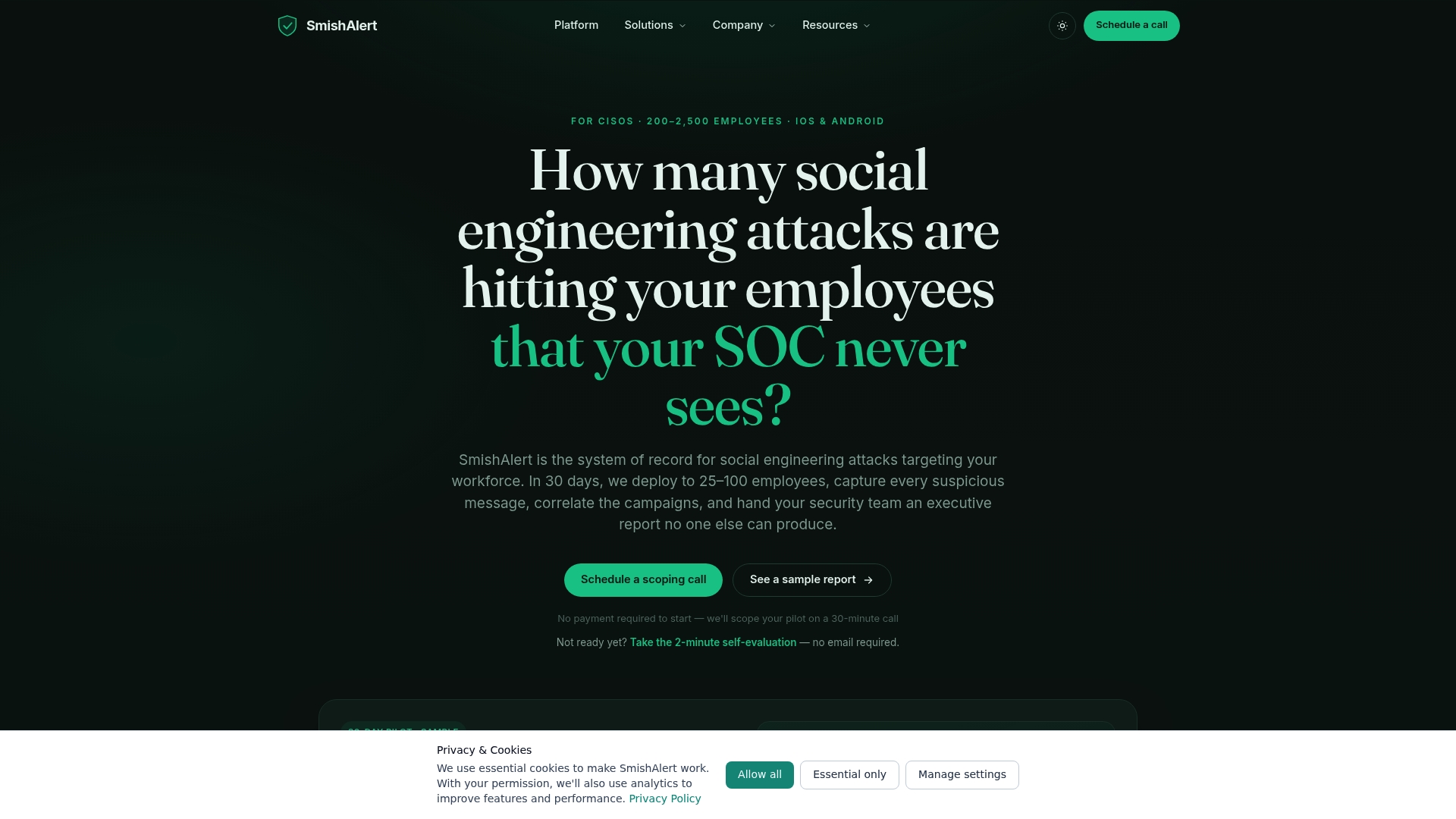
SmishAlert’s marketing materials state executive-grade reports are available within 30 days of a pilot deployment. The platform concentrates on messaging channels such as SMS, iMessage, and chat to expose impersonation, payroll fraud, credential harvesting, and vendor impersonation outside the email perimeter.
Core Features
SmishAlert delivers device-level signal collection, campaign correlation, reporting, and MDM-ready deployment that plugs into SOC workflows.
- Device-based classification of suspicious messages captured on managed iOS and Android devices.
- Campaign clustering and correlation that groups individual reports into campaign-level signals for triage.
- MDM-deployable native iOS and Android apps to collect and forward suspicious messages while preserving chain of custody.
- Integration hooks for SIEM and SOAR to route alerts into existing incident workflows.
Key Differentiator
Device-based classification paired with campaign correlation and executive reporting is the product’s core differentiator. That combination moves alerts from individual nuisance reports to correlated campaigns that SOC analysts can act on with context.
Pros
-
Provides a system of record for messaging threats outside email security scope so you have an audit trail for investigations and compliance reporting.
-
Automatic correlation of reports into campaigns reduces manual triage and lowers analyst time per incident.
-
Produces board-ready executive reports that translate detection activity into exposure metrics you can show leadership.
-
Deploys across managed fleets via MDM which keeps collection consistent on company devices without heavy user workflow changes.
-
Pilot options include a scoped 30-day assessment so security teams can measure exposure before committing to a full subscription.
Cons
- Focused on messaging channels and does not analyze email or voice directly, so you will need to integrate it with your existing email security and telephony controls.
Who It’s For
Security leaders and SOC managers at mid-sized organizations with roughly 200 to 2,500 employees, particularly in healthcare, financial services, and professional services. Teams that need measurable reporting and campaign-level signals for high-risk groups like HR and finance will find this most relevant.
Unique Value Proposition
Pilot pricing is typically $2,500 to $7,999 per month and is credited toward an annual subscription if you move forward after the pilot. That commercial structure lets you run a short evaluation and convert the spend to a longer term contract without double paying for the same work.
The 30-day pilot above gives security teams a rapid feedback loop. You get measurable exposure numbers and an executive report you can use in procurement conversations.
Real World Use Case
In the vendor example, a healthcare system ran the 30-day pilot across 87 employees and captured 147 suspicious messages. The exercise identified 11 impersonation attempts and 22 credential harvesting attempts and produced a leadership-ready summary for follow up.
Pricing
Pricing is scoped on a discovery call and typically ranges from $2,500 to $7,999 per month per organization for the pilot phase. If you engage after the pilot the pilot fee is credited toward the annual subscription.
Website: https://smishalert.ai
iVerify
At a Glance
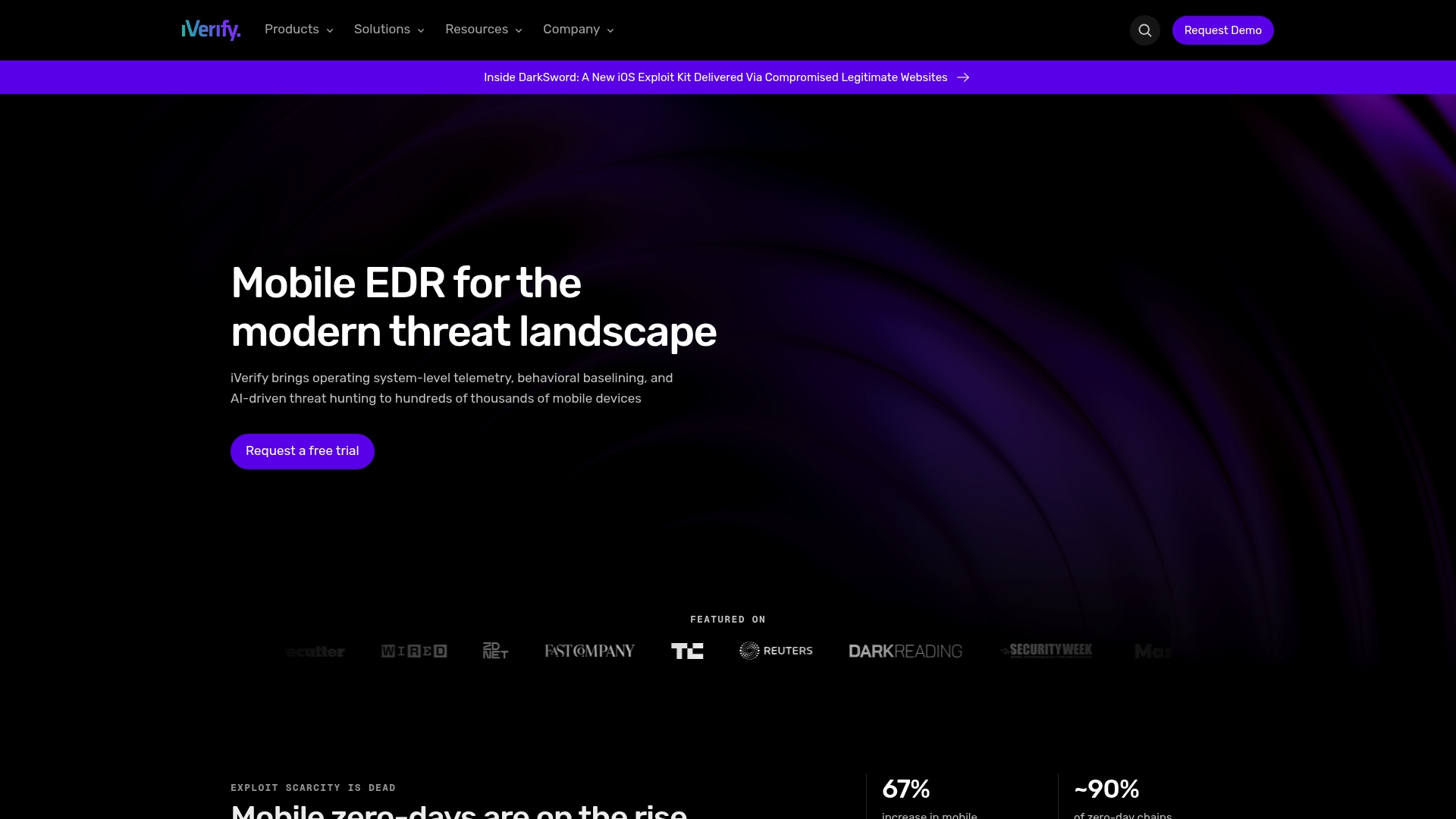
The vendor advertises OS-level telemetry that watches behavior below the application layer to surface zero-click, fileless, and exploit-based attacks. The pitch pairs that visibility with a privacy-first deployment model designed for BYOD and high-risk travel scenarios.
iVerify positions itself as a complement to network and app defenses, feeding device telemetry into security operations without harvesting user data.
Core Features
- Operating system telemetry and behavioral analysis that looks for anomalous processes, privilege escalations, and suspicious interprocess activity.
- Detection tailored to zero-click and fileless threats, with AI-assisted hunting to correlate subtle indicators across devices.
- Integrations into SOC tooling: SIEM and SOAR connectors, plus compatibility with MDM and MAM solutions.
- Privacy-preserving BYOD support that separates telemetry from personal content while offering continuous device risk monitoring.
Key Differentiator
iVerify’s primary claim is watching the OS rather than just apps or the network. That telemetry claim above lets it flag exploits that evade app-layer signatures and network filters.
This approach is useful when you need visibility on jailbroken behavior, kernel anomalies, or persistence mechanisms that standard mobile threat defense misses.
Pros
- Provides OS-level visibility beyond typical MTD and MDM signals, which helps detect stealthy persistence and low-noise exploits.
- Supports privacy-preserving telemetry, making it possible to run detection on BYOD fleets without collecting personal data.
- Offers relatively quick deployment and can run standalone, reducing time to useful alerts for security teams under travel or incident pressure.
- Integrates threat intelligence from active research teams, which helps translate raw telemetry into prioritized SOC leads.
- The focus on modern exploit types gives defenders a better chance to spot nation-state grade techniques before they escalate.
Cons
- No independent user reviews are publicly available, so usability and customer satisfaction are hard to evaluate beyond vendor materials.
- Coverage specifics for every model and OS version are not listed, which creates uncertainty for organizations with a broad diversity of devices.
- Pricing and customer support details are not published, adding procurement friction for teams that require transparent TCO before piloting.
When It May Not Fit
If your organization requires fully public pricing and SLA terms before starting a pilot, iVerify will feel opaque. Small teams with limited mobile diversity or those that need only app-level threat detection may find the platform overqualified.
Also avoid it when strict device model coverage is a must and you cannot validate support for every handset and OS build in your fleet.
Notable Integrations
iVerify advertises connectors for enterprise tooling: SIEM and SOAR platforms for alert ingestion and playbook automation, plus MDM and MAM systems to align telemetry with management and app controls.
Who It’s For
Security teams at large enterprises, government agencies, and organizations with high-value mobile exposures. It suits groups that operate BYOD policies or have employees who travel to high-risk regions and need OS-level detection integrated into the SOC.
Real World Use Case
A global enterprise deployed iVerify agents to employee smartphones. Telemetry flowed into the SOC’s SIEM where analysts correlated device anomalies with network and inbox signals, leading to the early identification of a targeted spyware campaign and accelerated containment.
Pricing
Pricing is not publicly disclosed. The vendor lists pricing as not applicable in marketing materials, so you will need to contact iVerify for pilot and commercial terms.
Website: https://iverify.io
Corrata
At a Glance
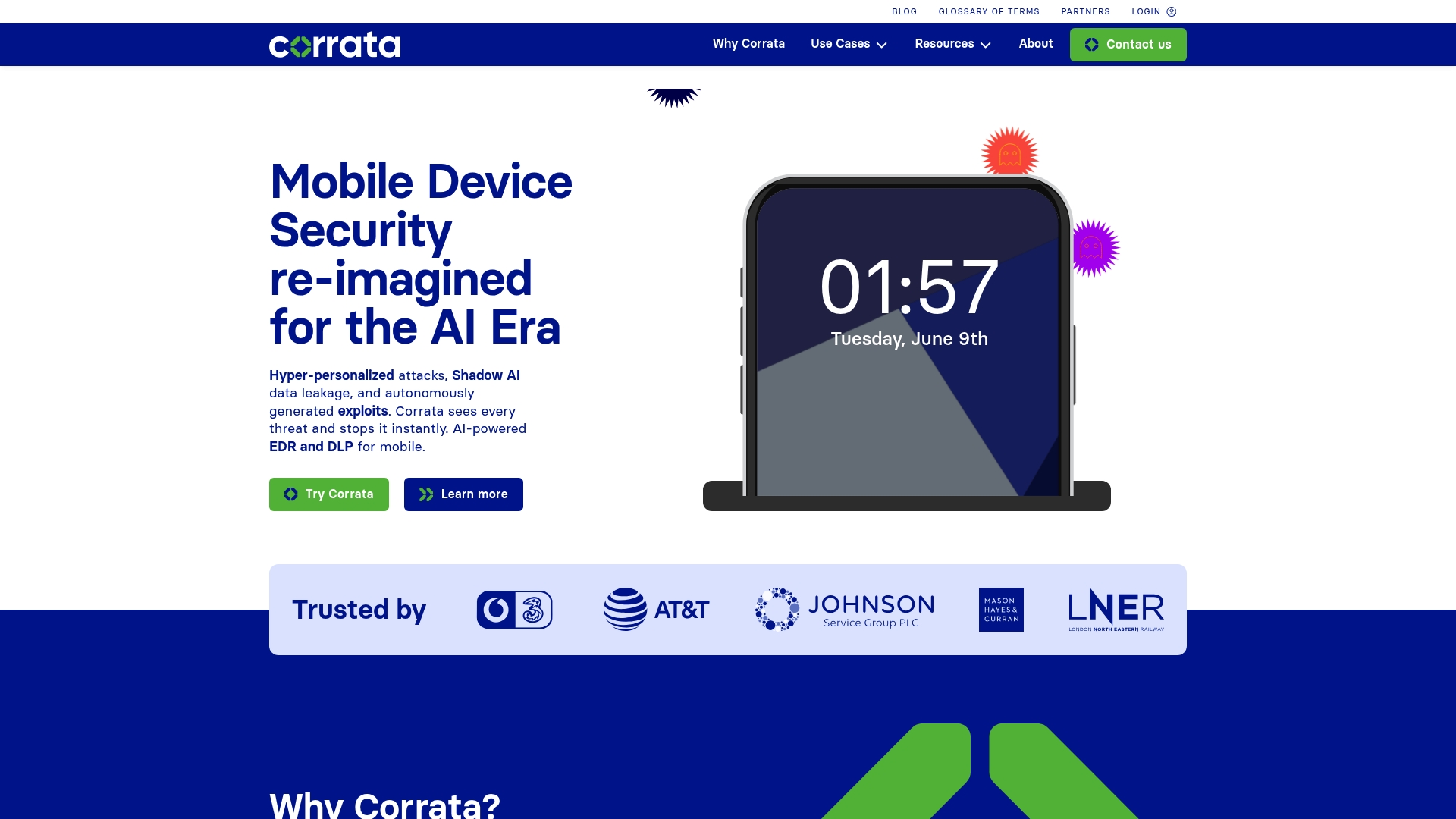
Corrata’s marketing materials describe a pairing of deep packet inspection with an on-device large language model to detect AI-driven mobile threats and govern Shadow AI data flows. The vendor positions that architecture as a privacy-first mobile threat defense with lightweight device operation.
Core Features
Corrata combines AI-powered EDR and mobile DLP to spot zero-day phishing and spyware on phones. The product performs real-time threat detection and automatic remediation while running models on the device rather than sending raw content to the cloud.
The feature set also includes device trust verification, vulnerability assessment, and AiTM protection for data privacy on public networks.
Key Differentiator
The standout claim is that Corrata pairs packet inspection with an on-device LLM to identify modern threats and policy breaches without accessing user location or raw content. The vendor frames that approach as a way to preserve privacy while still enforcing Shadow AI governance and DLP.
That architecture below will influence procurement questions about model lifecycle, updates, and auditability.
Pros
-
Industry recognition appears in the company materials, which supports confidence in the product’s positioning for mobile threat defense.
-
Lightweight deployment model reduces operational overhead. Corrata advertises fast rollouts and minimal ongoing management for IT teams.
-
Strong privacy posture because the product runs analysis on-device and does not require access to location or message content.
-
Real-time remediation and mobile phishing protection, including zero-day defense, shorten mean time to response for exposed mobile users.
Cons
-
Public, third-party reviews and independent user reports are limited, which makes peer benchmarking harder for procurement teams.
-
Pricing is not published. The vendor asks buyers to contact sales for cost details, which slows quick vendor shortlisting.
-
The product data does not list notable third-party integrations, so integration fit will need to be validated during evaluation.
Who It’s For
IT security teams protecting dispersed mobile workforces who need tighter control over Shadow AI and mobile phishing risk. Teams that prioritize on-device privacy controls and want an endpoint-first defense for unmanaged devices will find Corrata relevant.
Real World Use Case
A healthcare provider protects clinicians carrying patient data on phones. Corrata monitors app traffic and flags suspicious credential harvesting and AiTM attempts while enforcing Shadow AI policies to reduce exfiltration risk during off-network use.
Pricing
Pricing is not publicly available. Corrata requests that prospective buyers contact the vendor for quotes and deployment options, so expect a tailored commercial and licensing discussion rather than published tiered rates.
Website: https://corrata.com
Comparative Insights into Messaging Threat Detection Platforms
As organizations prioritize their defenses to tackle sophisticated messaging threats, evaluating feature sets and strengths of options such as SmishAlert, iVerify, and Corrata illuminates solutions tailored to specific needs.
Evaluation of Processing Techniques
Each platform employs distinct approaches to detect and analyze threats within mobile environments. SmishAlert excels in aggregating device-level messaging data, consolidating isolated reports into, campaign-level analyses, which is particularly beneficial for organizations aiming to detect patterns of impersonation or fraud. iVerify, on the other hand, focuses on OS-level telemetry capturing behavioral anomalies, making it well-suited for environments requiring detailed detection of zero-click exploits and other sophisticated attacks targeting system integrity. Meanwhile, Corrata applies cutting-edge on-device machine learning models for real-time threat prevention and data policy enforcement, offering strong capabilities for detecting advanced persistent threats.
Deployment and Privacy Mechanisms
Ease of integration and privacy considerations are for organizations adopting messaging security solutions. SmishAlert’s integration with existing SIEM and SOAR infrastructure enhances security team workflows without necessitating significant changes. Its native application for managed mobile devices ensures streamlined deployment. Conversely, iVerify prioritizes a privacy-centric approach, enabling organizations to monitor devices in BYOD setups while safeguarding personal employee data. Corrata’s use of on-device language models further bolsters user privacy, by preventing raw content transmission and ensuring data processing remains localized.
Best Fit Scenarios:
- SmishAlert: Most relevant for medium-sized organizations requiring sophisticated campaign correlation and executive reporting for their messaging activities.
- iVerify: A strong fit for enterprises with BYOD environments seeking OS-level threat detection for zero-click exploits and behavioral anomalies.
- Corrata: Recommended for companies prioritizing privacy-preserving, real-time threat remediation emphasizing data policy enforcement on mobile devices.
Our Pick: SmishAlert
SmishAlert’s focus on campaign-level threat analysis and its integration in mobile device environments, coupled with the capability to provide executive-grade reports rapidly, make it the leading choice for organizations requiring targeted, scalable messaging threat detection. However, organizations with unique needs, such as extensive BYOD policies or a demand for infrastructure-independent solutions, may find alternatives like iVerify or Corrata better suited to their contexts.
Messaging Threat Detection Solutions Comparison
Identify the ideal messaging threat detection solution tailored to your organizational needs, balancing features, pricing, and limitations for thorough security coverage.
| Product | Key Features Descriptions | Distinctive Advantage | Best Suited For | Pricing Information | Identified Limitation |
|---|---|---|---|---|---|
| Smishalert | Messaging threat audits using SMS and chat correlation | Turns reports into actionable campaign data | Mid-sized firms needing executive-grade summaries | $2,500–$7,999 for pilots | Limited to messaging systems, requires integration for complete coverage |
| iVerify | OS-level telemetry identifying kernel exploits | Zero-click attacks detection at OS level | High-risk regions or BYOD implementations | Not disclosed | Must validate multi-device and OS update support |
| Corrata | On-device AI-driven mobile DLP and phishing detection | Combines AI inspection without personal data collection | Mobile-first companies needing Shadow AI controls | Not disclosed | Limited peer benchmarking or existing customer reviews |
Explore Smishalert as a Trusted Alternative to Slashnext.com
If you are searching for effective slashnext.com alternatives that focus beyond email security Smishalert delivers targeted protection against social engineering attacks over SMS iMessage WhatsApp and other messaging channels. This platform tackles challenges like executive impersonation payroll fraud credential harvesting and mobile phishing that often slip past traditional defenses.
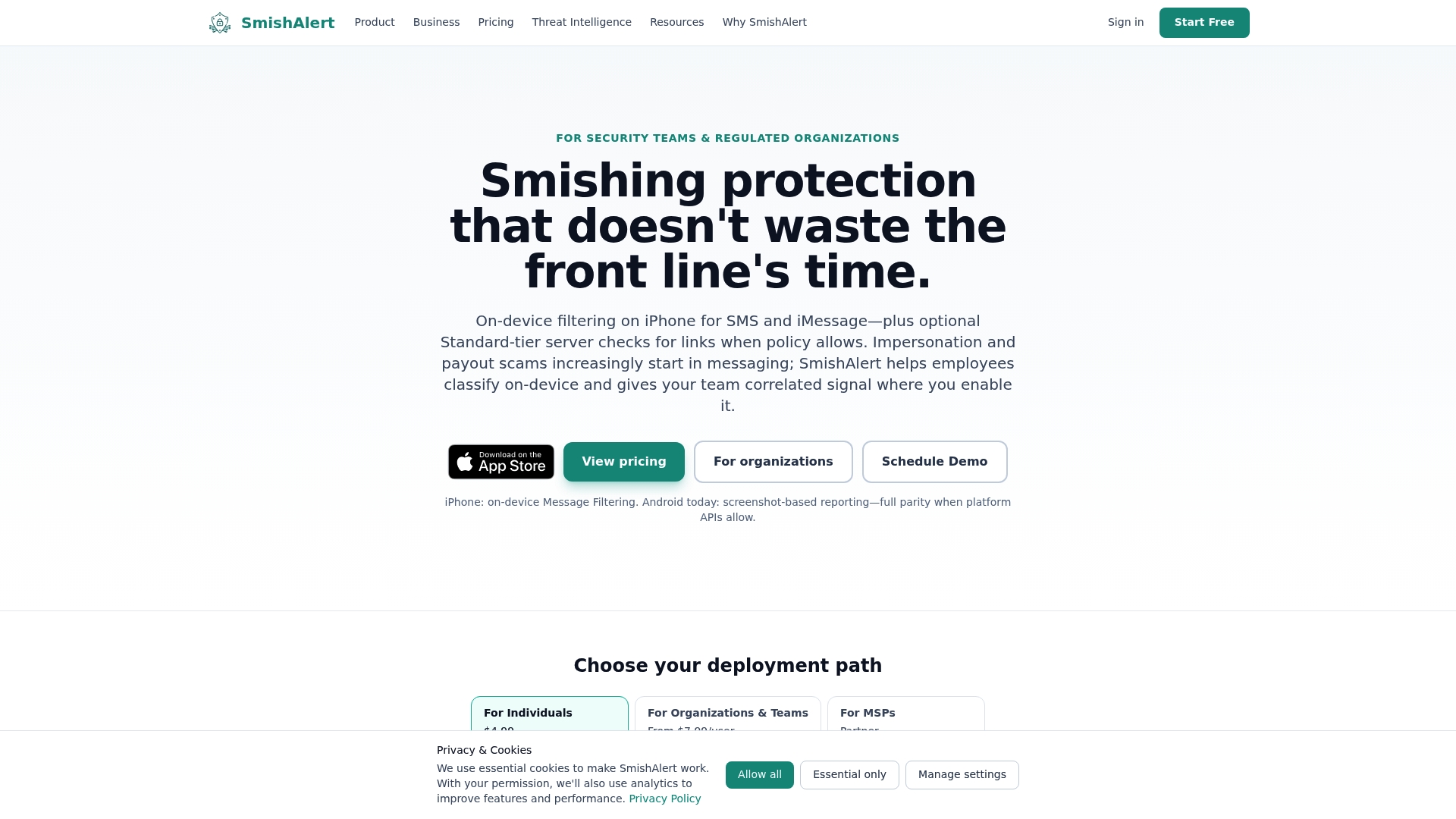
Take control of your organization’s messaging threat exposure with Smishalert’s device-based classification campaign correlation and executive-ready reporting. Discover how you can measure social engineering risks and get actionable insights by visiting Smishalert’s official site and start a pilot to capture real exposure numbers and build leadership-ready threat reports.
Frequently Asked Questions
How does Smishalert enhance messaging threat detection?
Smishalert utilizes device-based classification of suspicious messages to effectively capture threats on managed iOS and Android devices. This enables security teams to have a detailed audit trail for investigations and compliance reporting, particularly useful in environments where messaging threats are prevalent. Security leaders should consider incorporating Smishalert into their systems for improved threat visibility.
What is the difference between Smishalert and iVerify in terms of threat detection capabilities?
While iVerify offers OS-level telemetry and behavioral analysis for identifying zero-click and fileless threats, Smishalert specializes in device-based classification and campaign correlation for messaging threats specifically. This means that if your organization primarily deals with messaging vulnerabilities, Smishalert would be a better fit for targeting those risks effectively.
Which platform provides faster deployment and integration into existing workflows, Smishalert or Corrata?
Smishalert supports MDM-ready deployment, allowing for a quick setup across managed fleets, which minimizes user workflow changes. This functionality is essential for organizations looking to quickly integrate messaging threat detection into their security operations. Prospective users should evaluate how quickly they can implement Smishalert into their existing systems.
Can I use Smishalert if my organization primarily relies on email for communications?
Smishalert is designed specifically to address messaging threats outside of email security, focusing on channels like SMS and iMessage. This makes it ideal for organizations that handle a high volume of messaging communications and need targeted solutions. Security teams might find that adding Smishalert enhances their overall threat detection efforts.
How does the executive reporting feature of Smishalert benefit security leaders?
Smishalert produces board-ready executive reports that translate detection activity into exposure metrics. This allows security leaders to present clear, actionable insights to their organizations’ leadership, ensuring that compliance and risk management receive the attention they require. Organizations should utilize this feature to enhance communication regarding security postures to executives.